

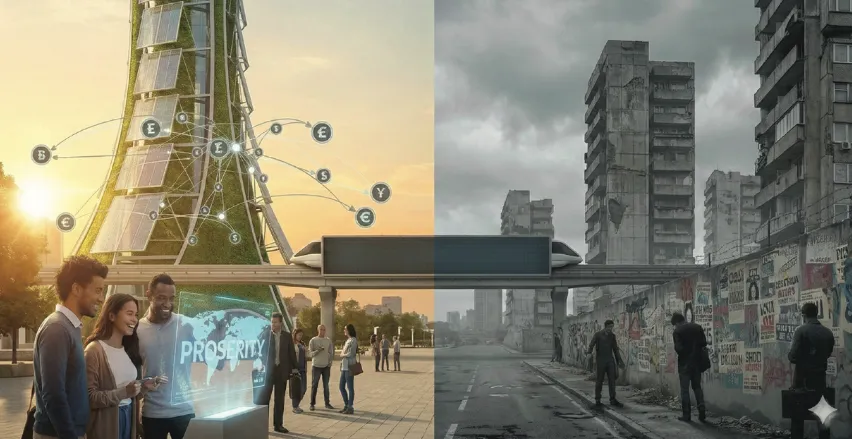






Predicting future events, especially political and administrative developments, is not easy. More so in the presence of opportunistic and unreliable politicians. As we enter 2026, Jammu and Kashmir stands at a critical juncture of “Economic Federalism” versus “Political Limbo.” While infrastructure and industry are reaching record milestones, the social and political fabric remains sensitive. The forecast for 2026 suggests a shift from infrastructure building to operational scaling. With proposals worth over ₹1.63 lakh crore registered by late 2025. 2026 is expected to be the year of “commissioning,” where hundreds of units in food processing and pharmaceuticals move from paper to production. The J&K Startup Policy 2024–27 aims to hit a milestone of 2,000 recognized startups by the end of 2026. Key focus areas include Ag-Tech (apple supply chain) and specialized manufacturing. A major “Solar Push” is underway with a target to solarize 12,000 government buildings by March 2026, projected to save the exchequer roughly `70–80 crore annually.
The “Vibrant 2026 Tourism” campaign is in a recovery and rebrand phase. The USBRL (Udhampur-Srinagar-Baramulla Rail Link) is the primary driver for 2026, with Vande Bharat trains expected to bring a more stable, weather-independent flow of domestic tourists. The Tourism Department is heavily promoting “unseen” spots and border tourism (Keran, Gurez) to decentralize the rush from the traditional Gulmarg and Pahalgam. Targeting more than 2 Crore tourists after reaching 1.58 crore visitors in 2025 (despite setbacks), the target for 2026 is to cross the 2-crore mark again, bolstered by international roadshows in Germany and Malaysia.
The security landscape in 2026 is dominated by a transition in militant tactics. Following “Operation Sindoor” in 2025, security agencies estimate approximately 150 foreign militants are operating in high-altitude forests (Kupwara, Rajouri, Poonch) and their movements are hopefully being watched. The non-Kashmiri senior bureaucracy with a poor people to people contacts makes it a challenge. The 2026 strategy focuses on “Area Domination” to prevent a repeat of the April 2025 Pahalgam incident. Taking a cue from the hushed up cyber-attack on the key sites in the post May 2025 skirmish with Pakistan, China combination which had rendered several websites and important public outlets un-operational, the Cyber surveillance 2026 should see intensified monitoring of social media and encrypted apps to counter “self-radicalized” cells. A concern that grew after the Red Fort blast investigations in late 2025.
The political climate remains the most uncertain variable. Political deadlock despite the Omar Abdullah government completing its first year in late 2025, the restoration of statehood in all likelihood will remain on the “back burner.” The year 2026 is likely to see continued power struggles between the elected Cabinet and the Lieutenant Governor’s office over bureaucratic appointments and legislative provisions. There is a growing “restoration fatigue” among the local population, with many shifting focus toward immediate economic needs and employment.
As we move through 2025 and look toward 2026, the attitude of Kashmiris regarding the non-restoration of statehood and Article 370 has shifted from shock to a complex form of “strategic pragmatism” tinged with deep-seated disillusionment. While the 2024 Assembly elections saw record participation, the mood in 2025 is increasingly cynical. There is a widespread perception that the elected government, led by the National Conference (NC), is a “glorified municipality.” Local residents often express frustration that while they voted for a Chief Minister, the real power remains with the Lieutenant Governor (LG). Many Kashmiris feel “betrayed” by the delay in statehood restoration, which was a central pillar of the 2024 election manifestos. However, there is also a growing realism that Article 370 or at least a special status is unlikely to return under the current central dispensation.
In 2025, the focus of public anger has subtly shifted from high-level constitutional debates to daily governance failures. While the central government highlights “peace and progress,” local sentiment remains sensitive to what they call “dual authority “, Issues like smart electricity meters, reservation policies, and bureaucratic high-handedness are now the primary flashpoints for public protest. For the first time in a decade, Kashmiris are closely following Assembly proceedings. This isn’t necessarily due to faith in the system, but rather a “vigilant disappointment”—watching to see if their representatives can wrest even minor powers back from the Centre. The lack of political restoration has contributed to a “quietening” of the public sphere that security agencies call normalcy, but locals describe as “enforced silence. A notable trend in late 2025 is the narrowing gap between Jammu and Kashmir’s sentiments on statehood. While Jammu initially celebrated the 2019 changes, by 2025, the business community in Jammu has become equally vocal about the loss of statehood, citing concerns over “outsider” dominance in trade and the lack of a local responsive government. Fears of a “permanent UT” status or a further bifurcation of the region (granting statehood to Jammu while keeping Kashmir as a UT) have created an atmosphere of deep suspicion across the entire Pir-Panjal range.
Civil society and local media remain under significant pressure. The 2025 security landscape—marked by “hybrid militancy” and the aftermath of the April Pahalgam attack—has led to continued restrictions that many feel are used to stifle political dissent rather than just fight terrorism. While stone-pelting has vanished, the lack of statehood and the perceived “outsider” control over land and jobs remain potent triggers for underlying alienation, which experts fear could feed into long-term radicalization if not addressed in 2026 and years to come. The Vexed and lingering political problem cannot be solved by the currently seen measures. At best it can be managed, which should be a reasonable goal.
Prof Upendra Kaul, Founder Director
Gauri Kaul Foundation