

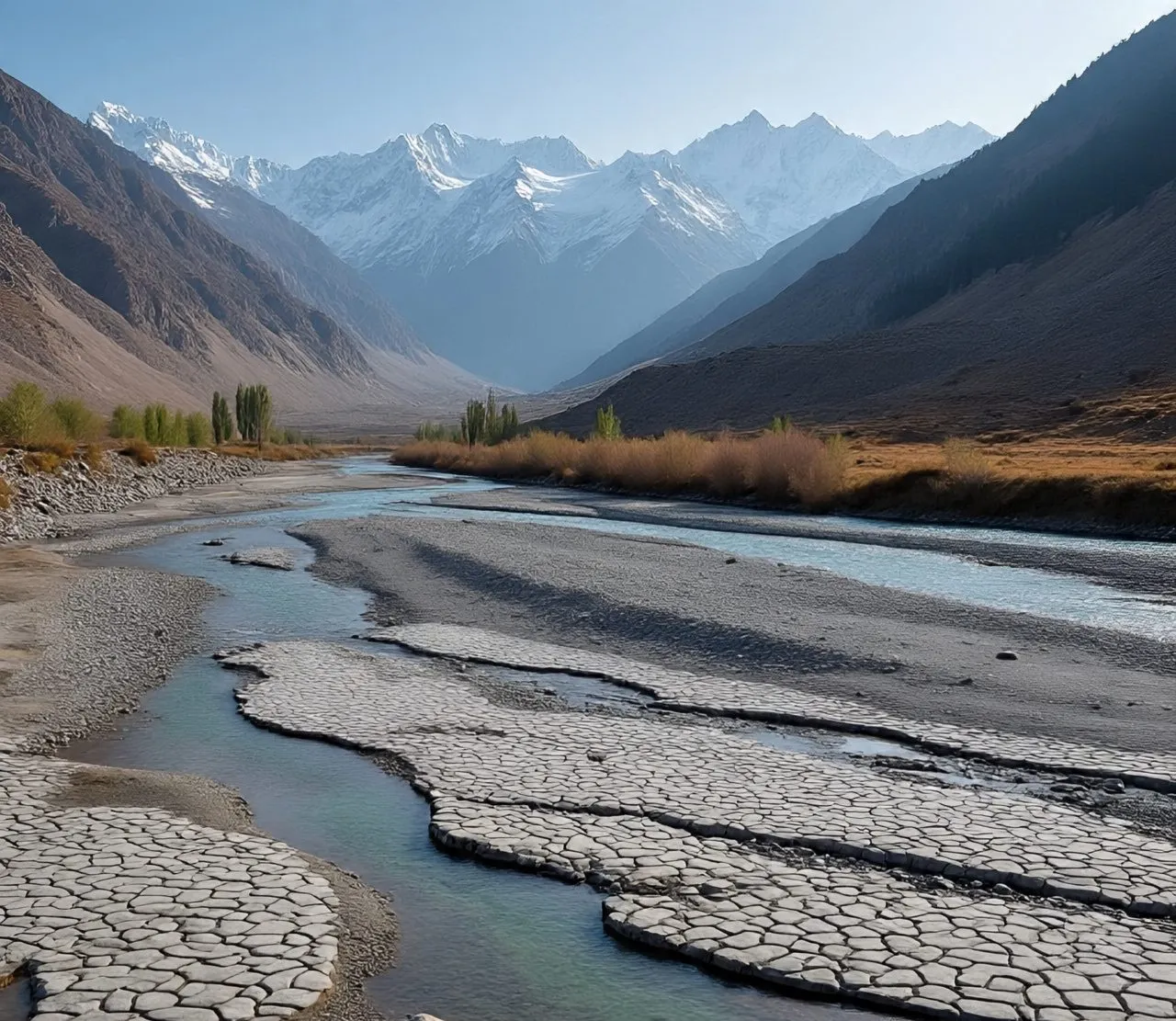






Kashmir has long been a land of green valleys, flowing rivers, and orchards heavy with apples, cherries, and walnuts. But today, the region’s lifeblood, its agriculture and water, is under siege. Generations of farmers who once relied on glacial rivers and snow-fed springs are watching their fields dry, crops fail, and livelihoods crumble. Agriculture, which employs more than 70% of the population and contributes nearly 15% to the local economy, is no longer a reliable source of sustenance. For families that have farmed the same land for centuries, climate change is not an abstract threat; it is a daily, lived catastrophe. Farmers like Ghulam Nabi in Pulwama, who have been cultivating apples for three decades, speak of winters that are now too short and temperatures that rise unpredictably. His apple trees bloom earlier than before, only to face late frosts that destroy flowers and reduce yield by 40–50%. Meanwhile, saffron growers in Pampore, once earning six to seven lakh rupees per acre, are now struggling to produce half the yield because warming winters and erratic rainfall upset the delicate flowering cycle of this labor-intensive crop. These numbers are more than statistics they represent families’ incomes, dreams, and survival.
Climate change is dismantling the precision on which Kashmir’s agriculture depends. Rice paddies, covering roughly 130,000 hectares in the Valley, are critically dependent on water from glaciers and rivers. Erratic rainfall and early snowmelt reduce irrigation during peak growth periods, resulting in lower yields. In villages like Haritar and Lelhar, canals that once ensured water supply are running dry. Farmers are now forced to pump water from deeper wells, increasing costs and energy use, or leave fields fallow, compounding food insecurity. Vegetable growers face similar struggles, with potato, cauliflower, and tomato yields declining by up to 35% due to heat stress and water scarcity.
The human cost of changing climate
Climate change in Kashmir is not just about failing crops; it is about people’s lives being reshaped. Families who once relied on predictable growing seasons are now caught between droughts and floods. Rising temperatures averaging 0.6°C per decade over the last 30 years have disrupted the region’s delicate ecological balance. Farmers report that unseasonal heat waves in May and June now scorch wheat and mustard crops, while delayed rains in July and August leave rice paddies parched. Apple cultivation, which accounts for more than 75% of India’s apples, is being forced into a crisis. Chilling hours below 1,000, down from an average of 1,500 just two decades ago, are no longer sufficient for optimal fruit set. This decline has forced farmers to invest heavily in artificial cooling and sprinklers, often taking loans that many struggle to repay. For smallholder farmers with less than 2 acres of land, such investments are unsustainable, pushing households toward debt or migration.
Saffron, once a high-income crop producing over 8 metric tonnes in the early 2010s, now yields barely a third of that. Families in Pampore, where saffron cultivation is central to identity and economy, report losses of 60–70% compared to previous decades. This decline has ripple effects: local laborers who harvested saffron earn significantly less, women who processed the flowers lose seasonal work, and ancillary businesses—from transporters to small shops—suffer as well. Even staple crops are not spared. Rice, grown on roughly 50% of the Valley’s irrigated land, faces reduced yields due to both drought and unpredictable flooding. In Anantnag and Pulwama, nearly 26,000 hectares of rice fields have been impacted in recent years by water shortages, while repeated flash floods destroy young seedlings in other areas. This duality of too little or too much water makes farming increasingly precarious. Families who once had stable harvests are now forced to depend on government support or informal loans to survive, undermining both economic and food security. Extreme weather events have become part of everyday life. Farmers recount frost that kills flowering trees in April, hailstorms that destroy ripening apples in June, and unseasonal rains that erode fertile topsoil in August. These are not isolated anomalies; they are the new normal, a constant disruption of the agricultural rhythm that defined Kashmir for centuries.
Water under siege
Agriculture in Kashmir cannot survive without water, yet water resources are collapsing. The Valley’s rivers, fed by glaciers such as Kolahoi, have shrunk dramatically. Kolahoi Glacier has retreated nearly 900 meters over the last 50 years, reducing summer river flows that irrigate thousands of hectares. Springs that once provided year-round water for both fields and households are drying up; nearly one in four major springs in farming villages has shown significant decline in flow. When rain does fall, it is often sudden and destructive, causing floods rather than replenishing groundwater. Water scarcity is most severe in the summer months, when crops need it the most. In Pulwama and Shopian, lift irrigation systems that once served hundreds of hectares now run below half capacity. Farmers are forced to dig deeper wells or rely on expensive motor pumps, raising costs by 40–50%. Smallholder farmers, who make up the majority of Kashmir’s agrarian population, often cannot afford these measures, leaving fields fallow and income lost.
The consequences of water scarcity extend beyond agriculture. Hydropower generation, which relies on consistent river flows, has decreased in capacity, impacting electricity availability for rural households. Wetlands and groundwater recharge zones are shrinking, threatening long-term water security. Communities that once had access to clean and sufficient water are now forced to ration, further highlighting the human toll of climate disruption. Extreme events amplify these pressures. Flash floods wash away fertile topsoil, destroy irrigation infrastructure, and damage homes. Prolonged dry spells leave soils cracked and infertile, making it difficult even to grow fodder for livestock. Families are left trapped between unpredictable extremes: too much water at once, or too little over months. This uncertainty erodes the social fabric, as disputes over water access increase, and farmers are forced to migrate in search of work.
Kashmir’s water crisis is not just an environmental issue; it is a question of justice. The region contributes minimally to global emissions yet bears the brunt of climate impacts. Farmers, laborers, and their families, who have historically lived in harmony with nature, are now the first victims of global environmental negligence. Their struggle underscores the urgent need for local and systemic solutions that protect both water and livelihoods. Efforts to address these challenges cannot be superficial. Traditional measures like digging more wells or expanding canals are insufficient. What is required is integrated watershed management, conservation of glaciers and springs, adoption of climate-resilient crops, efficient irrigation techniques, and community-based early warning systems for extreme weather. Policies must center on the grassroots—ensuring smallholders and women farmers have access to resources, knowledge, and support to adapt to this new reality. Without such interventions, Kashmir risks losing centuries-old agricultural systems, with devastating social and economic consequences.
The Valley’s crisis is a warning for similar regions worldwide. Mountainous, glacier-fed agricultural systems are highly sensitive to climate change. If adaptive measures are not taken, local collapse can trigger migration, food insecurity, and economic shocks across regions. Kashmir’s experience is a microcosm of the global challenge: climate change is not a distant threat; it is a present, tangible, and deeply human problem. In essence, Kashmir’s agriculture and water resources are at the edge of collapse. Crops are failing due to rising temperatures, erratic precipitation, and pest pressures. Water, the essential lifeline, is declining dramatically, leaving communities struggling to survive. Farmers face daily uncertainty, families risk losing livelihoods, and centuries-old agrarian systems are under threat. This is not a distant or abstract challenge it is an urgent crisis demanding immediate action.
Adaptation must be systemic, community-driven, and scientifically informed. Preserving glaciers and springs, managing water efficiently, introducing climate-resilient crops, and supporting farmers at the grassroots level are essential. The Valley’s future and the lives of millions dependent on its land and water—hinge on decisive, immediate intervention. Ignoring this reality risks not only the collapse of agriculture but the erosion of Kashmir’s cultural, social, and economic identity. Climate change in Kashmir is more than an environmental challenge; it is a human crisis.
(Sheikh Sofia is pursuing a bachelor’s degree in economics and statistics at Mount Carmel College.)