

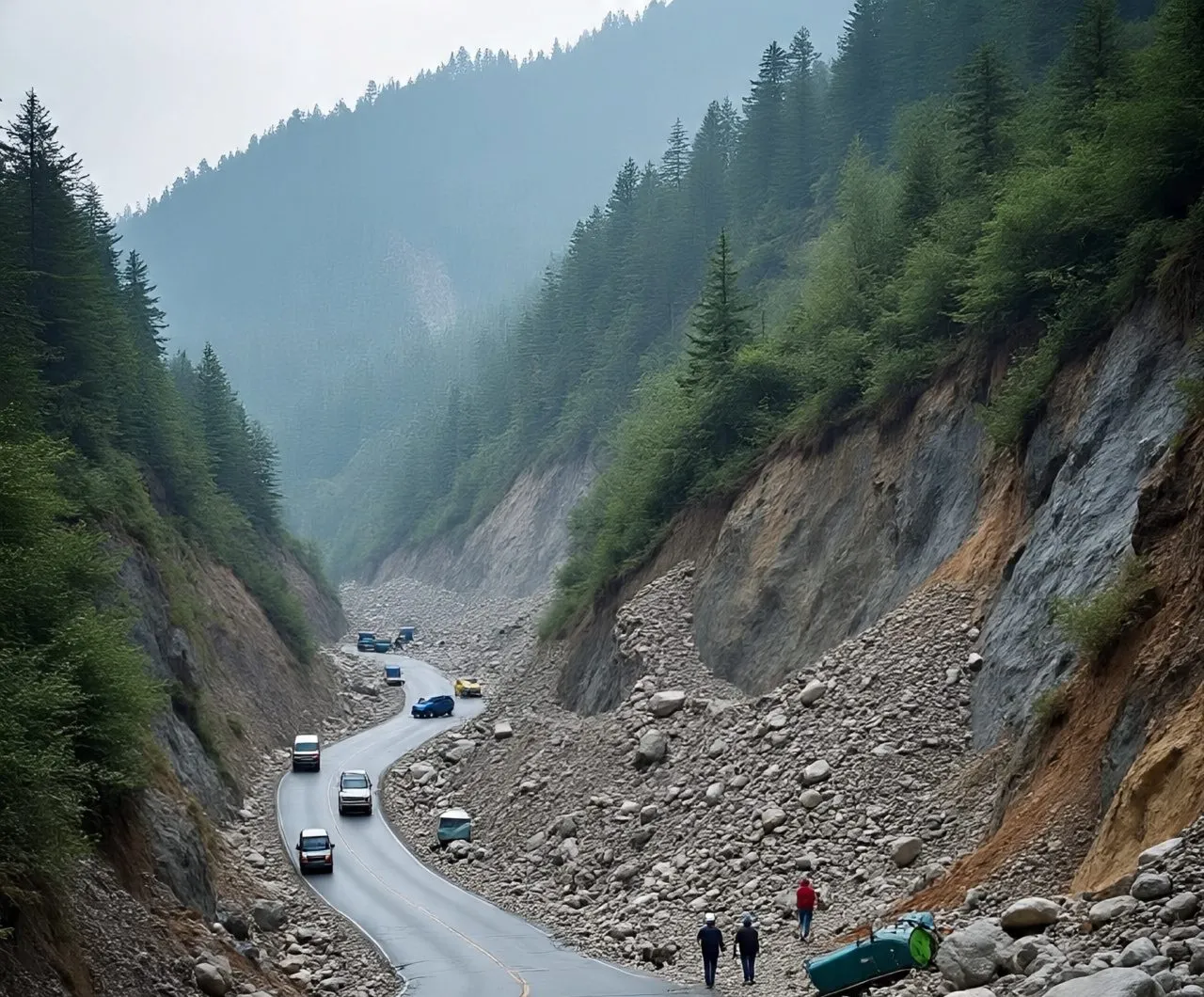






Srinagar, Dec 30: It was built to defy winter, not weather wrath.
In 2025, the mountains reclaimed the Srinagar-Jammu National Highway.
Repeated landslides and floods shut Kashmir’s only highway for weeks, exposing how aggressive construction, fragile geology, and ignored warnings turned the highway into a collapsing lifeline.
The highway, Kashmir’s only surface link to the outside world, endured one of its most turbulent years in 2025, repeatedly disrupted by landslides, flash floods and shooting stones despite being touted as an all-weather road.
The year’s warning signs appeared early.
In April, incessant rainfall triggered landslides at more than 20 locations along the Banihal-Ramban stretch.
Several vehicles were buried under debris, some were swept into the Chenab gorge, residential houses collapsed, and three people were killed.
The highway remained closed for over three weeks, cutting off Kashmir completely.
The situation worsened during the August-September monsoon, when intense rainfall and cloudbursts battered large parts of Jammu.
While multiple districts reported damage, the Srinagar-Jammu National Highway remained repeatedly blocked, forcing long detours and trapping travellers for days.
In early September, massive landslides and flash floods severely damaged the Srinagar-Jammu National Highway at Bali Nala and Thard in Udhampur district, forcing repeated closures for several days.
The highway stayed shut for nearly 45 days during peak trading months.
The extreme weather also triggered deadly flash floods across Jammu’s mountainous districts, including Kishtwar, Doda, Rajouri, Poonch, Udhampur, Reasi, and Kathua, where over 200 people lost their lives.
The most tragic incident occurred in Kishtwar’s Chasoti village of Paddar in August, where a flash flood during the Mata Machail Yatra swept away more than 80 yatris and locals into the Chenab River.
“These were not random events,” a senior official said. “The damage followed a pattern, especially where the terrain had been heavily disturbed.”
ECONOMIC LIFELINE DISRUPTED
The repeated shutdowns severely affected Kashmir’s economy.
Apple trucks heading for markets outside Kashmir were stranded for days, leading to large-scale spoilage.
“Fruits rotted on the highway, and shortages pushed up prices of essentials,” said Ajaz Ahmad, an apple trader from south Kashmir.
Supplies of fuel, vegetables and medicines were also disrupted, worsening public hardship.
FRAGILE GEOLOGY, AGGRESSIVE CONSTRUCTION
Experts say the highway’s repeated failures reflect a mismatch between ambitious construction and geological reality.
“The mountains along Srinagar-Jammu National Highway are geologically young, fractured, and unstable,” a geologist at the National Institute of Hydrology, Jammu, Riyaz Ahmad Mir said. “Unscientific slope cutting, blasting, and debris dumping have made even moderate rainfall dangerous.”
Mir said the Chenab Valley lies in Seismic Zone IV, crisscrossed by faults and shear zones.
“When rainwater infiltrates these weakened slopes, especially where tunnelling is ongoing, slope failure becomes inevitable,” he said.
Veteran highway workers say such risks were well known.
“This terrain required careful planning,” said a senior highway worker, recalling the 2022 tunnel collapse that killed 10 labourers. “The warnings were ignored.”
LIVING WITH RISK
For residents of Ramban and Banihal, the highway has become a seasonal threat.
“From March to September, every rain brings fear,” said Altaf Ahmad, a Ramban resident. “We never know when the mountain will give way.”
Shams, a teacher from Banihal, said locals were not opposed to development.
“But development must be guided by science,” he said. “Ignoring geology only increases danger.”
ENVIRONMENTAL COST
Environmental activists blame deforestation and illegal dumping of construction debris.
“Debris is dumped along the highway and even into the Chenab,” said an environmentalist. “When rains come, it gets washed downstream, worsening floods and landslides.”
He said that trees stabilise slopes and, by removing them recklessly, collapse is inevitable.
The environmentalist called for an independent environmental audit of the project.
ALL-WEATHER CLAIM TESTED
While new tunnels have improved winter connectivity, residents say the Srinagar-Jammu National Highway remains most vulnerable during the rainy months.
“Even light showers now trigger landslides,” said Abdul Rashid, a shopkeeper from Ramban. “The road no longer feels reliable.”
A FRAGILE ARTERY
The Srinagar-Jammu National Highway sustains Kashmir’s economy, healthcare, education, and security, and its repeated failure affects millions.
“These disasters are no longer accidents,” said Ghulam Hassan of Digdol. “They are the result of careless planning. Until development respects the mountains, this will continue.”
As 2025 draws to a close, the Srinagar-Jammu National Highway stands as a stark warning: in the Himalayas, infrastructure built without geological and environmental caution can quickly turn from lifeline into liability.