







Jammu, Dec 30: Ringing out the old so as to ring in the new, Jammu and Kashmir is witnessing 2025 bequeathing a ‘mixed-bag’, as its legacy, to its successor 2026.
The outgoing year had everything in its kitty. It had all the elements and emotions to make it – one of its kind – as it would go down and be recorded in the realm of history.
Ecstasy, terror, tragedy, action, plight, despair, surprise, suspense, wholesome (political) drama and the resilience with optimism and hopes – everything was experienced on a quarterly basis.
For many, this was a bleak year, but for the realists, this was a year full of “life” in wholesome – in its crude form – imbuing its varied shades, some overlapping and some outweighing others.
ECSTASY DEFINES FIRST QUARTER
The first quarter of 2025, though impregnated with swinging hope and despair in the wake of political and administrative challenges as 2024 legacy, struck a positive note in general – saw J&K brimming with happiness, enjoying the dividends of peace amid surging tourism with record breaking tourist footfall, though with occasional minor hitches.
The phase also saw the inauguration of the strategically vital Z-Morh tunnel in Sonamarg by Prime Minister Narendra Modi in January.
It was not that the political and administrative cacophony, shadow boxing, being witnessed after the 2024 assembly elections, had come to an end during that phase. Everything was simultaneously going on – in the democratic space, delineating the beauty of the “We, the people” regime.
Union Territory enjoyed all these shades during its maiden yet very animated budget session in March-April in Jammu. Chief Minister Omar Abdullah, as the Finance Minister, presented his first budget of Rs 1.12 lakh crore for the year 2025-26 for J&K as a UT.
This was the first budget by any elected government (in the UT set-up) in seven years.
Markedly, following the countrywide trend, the focus was on freebies!
Chief Minister in his maiden budget announced 200 units of free electricity per month to all Antyodaya families besides 10 kg additional ration per person for AAY beneficiaries from April 1, 2025; free ride for all women in J&K on government owned public transport, including e-buses; enhanced pensions for over 10 lakh vulnerable persons in J&K; hiked marriage assistance for AAY girls from Rs 50,000 to Rs 75,000; zero stamp duty for property transfer within blood relations proposed Rs 50 crore for establishing National Law University in J&K.
SECOND QUARTER UNFOLDS TERROR, TRAGEDY, SURPRISE, ACTION
While J&K was confidently marching forward, much to the envy of the “neighbours”, the ecstatic spell was suddenly perforated by a ghastly Pahalgam terror attack on April 22, claiming 26 innocent lives, including 25 tourists.
Shock, anguish, and anger pervaded the air and sliced 2025 into two halves, at least for J&K, for sure – pre-Pahalgam attack and post-Pahalgam attack.
Post-attack hurly burly unfolded- what many described as an “unseen facet of J&K – Kashmir in particular.”
Amid the gloomy spectre, it emerged as a bright streak of light, surprising even many naysayers.
Entire Jammu and Kashmir in unison condemned the grisly act, failing the nefarious designs of terrorists and their handlers, across the border, to use religion to create discord in communal amity.
“Not in my name” was the rallying cry as people, representing all sections of society, came out, with candles in their hands, holding peace marches – condemning the act unequivocally. The local Masjids, through public announcements, exhorted the people to join protest marches against the attack.
The overwhelming gesture, which had a healing effect, won the praise it deserved. It drew accolades from different sides – the Prime Minister, Union Home Minister, the Lieutenant Governor and the Chief Minister led those lauding the spirits.
It was unimaginable, never heard or seen before, and this would be a defining moment in Kashmir’s history – the echo of the Chief Minister Omar Abdullah at every available platform and even in the J&K Legislative Assembly, which convened a special day-long session on April 28 to pass a resolution against the terror act.
As anticipated in the evolving and changed scenario, full-blown firepower action between India and Pakistan, followed Pahalgam terror-attack in the form of “Operation Sindoor” in the month of May, which charted a new paradigm shift in India’s strategy to retaliate against terror attacks, originating from Pakistan or being sponsored by it.
As “Operation Sindoor” was a fallout of a terror act that took place in J&K, the Union Territory and its inhabitants suffered again badly in the ripple effects – this time in the shelling by Pakistan, which witnessed deaths and destruction in India’s all-out retaliatory action against the terrorists and their infrastructure there (in Pakistan).
As India and Pakistan were engaged in an intense tech-driven four-day-long war (from May 7 to 10), J&K – mainly parts of the Jammu region (Rajouri, Poonch and Jammu districts) lost over a dozen civilians in Pakistan shelling, which also damaged hundreds of houses, religious places, and schools.
Terrorists had hurt the tourism and economy of J&K through the Pahalgam attack, but they could not harm its spirits, which remain unscathed.
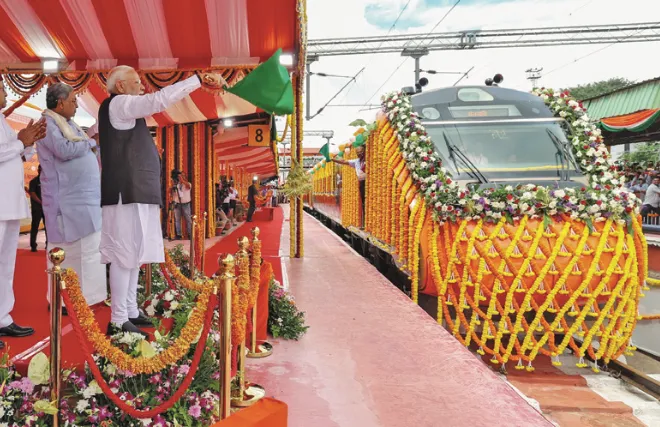
In June, bruised J&K yet again demonstrated its resilience with a clear message for the entire world that its journey to progress and transformation was unstoppable. Manifestation was in the form of end of decades’ end-of-decade-long wait for connecting Kashmir to the rest of India through train as the Prime Minister Narendra Modi flagged off the “state-of-the-art – Vande Bharat Express” from Katra to Srinagar, besides inaugurating the iconic Chenab bridge and Anji bridge – intrinsic parts of the Udhampur-Srinagar-Baramulla Rail Link (USBRL) project.
THIRD QUARTER WITNESSES NATURE BRINGING DEATH, DESTRUCTION, MISERIES
As J&K started limping towards normalcy, slowly and gradually coming to terms with the losses it had incurred in the second quarter, in the third quarter, it saw an onslaught from the invincible force, in the form of natural calamities.
Though nature’s fury was visible across J&K, it was mainly the Jammu region which was at its receiving end.
The months of August and September proved to be simply devastating for various parts of the Jammu region. Devastation was of enormous scale – the first of its kind in many decades. First, on August 14, over 100 people, mainly the Machail Mata pilgrims, lost their lives or went missing in the flash floods triggered by the cloudburst incident in the Chisoti area of Kishtwar district.
Within a fortnight, an unprecedented spell of rains, triggering landslides and flash floods, beginning from August 26, brought another spate of devastation in J&K.
This time again, it was the Jammu region which mainly bore the brunt as its eight districts (except Rajouri-Poonch) were badly affected as the monsoon created havoc.
35 persons, mainly Vaishnodevi pilgrims, lost their lives in the Adhkuwari landslide incident in Katra of Reasi district on August 26.
Jammu, Samba, Kathua, Udhampur, Reasi, Kishtwar, Doda and Ramban witnessed damages of unprecedented scale in the monsoon fury, which continued till September 10. Around a dozen lives were lost in the spate.
In all, the third quarter in J&K consumed over 200 lives and damaged over 2000 structures besides vital infrastructure like bridges, road (including National Highway), and rail sections in the spate of natural calamities.
FOURTH QUARTER WITNESSES J&K DEMONSTRATING RESILIENCE
The fourth and last quarter saw J&K yet again demonstrating its resilience. It was back in its elements with wholesome political drama, which had the quotients of suspense, intrigue and surprise as October and November witnessed a flurry of electoral activities.
In the Rajya Sabha biennial election in October, the National Conference snubbed its alliance partner Congress, yet it (NC) could win only three seats (out of four) despite the number game in its favour. As the BJP managed to win one seat, the Congress had the last laugh. It (Congress) got another opportunity to see its partner (NC) eating humble pie after it (NC) lost its bastion, Budgam, to the People’s Democratic Party in assembly polls in November.
BJP won the Nagrota seat as its candidate Devyani Rana retained her illustrious father Devender Singh Rana’s constituency for the party in her maiden venture in politics.
In the meantime, the chorus of dual power centres, statehood, and business rules kept on resonating in the political corridors. The end of December finally broke the dry spell in J&K also – invoking the spirit of Alfred Tennyson’s quote: “Ring, happy bells across the snow; The year is going, let him go…”