

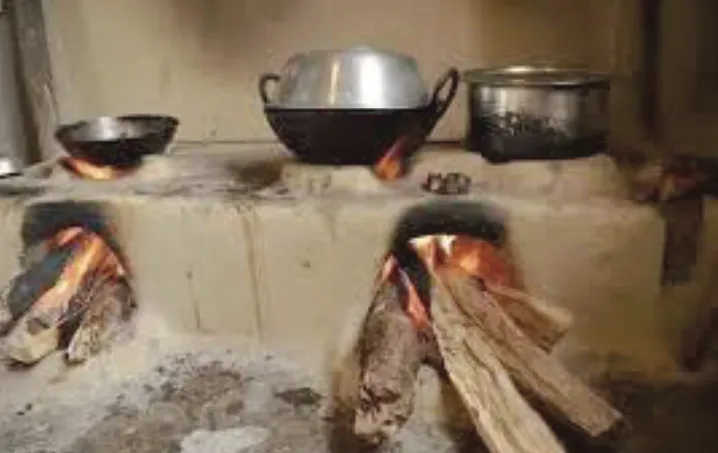






The DAAN sits where it has always sat—in the corner of the kitchen, its mud-plastered surface still warm from the morning’s fire. My mother’s hand moves across it with the reverence of ritual, the mixture of fresh mud and water becoming a thin coating that seals yesterday’s soot, renewing what must be renewed each dawn.
There is a geometry to poverty that the comfortable never quite grasp. The daan is not picturesque. It is necessity shaped by hands that know cold.
My earliest memory is warmth. Not comfort—warmth. The difference matters. The daan gave us both fire and purpose. Before school, I would watch my mother coax flame from wood gathered the previous afternoon, her breath gentle against kindling that had to catch because there was no alternative. The first chai of the morning tasted of wood smoke and patience.
We cooked everything on that fixed altar of clay. Rice that stuck slightly to the bottom and was relished the next morning with chai. Vegetables that carried the faint char of open flame. Bread that emerged with ash-blessed edges. The soot that sometimes fell into our food was not contamination but communion—we were eating what kept us alive.
In winter, the daan’s secondary gift revealed itself. After the cooking ended, my father would carefully gather the hot coals with iron tongs, placing them in our kangris with the precision of someone handling something precious. Because they were precious. Those embers, nested in their wicker cradles, were the difference between sleep and sleepless shivering. We would tuck the kangris under our pherans, holding captured warmth against our bodies while the wind howled outside.
The daan asked everything of us and gave everything it had. It demanded wood, which meant hours of gathering. It demanded attention, because neglect meant disrespect. It demanded the daily renewal of mud-painting, that ancient contract between earth and need. And in return, it gave heat, sustenance, and the coals that carried us through nights when winter felt like a siege.
There was dignity in this arrangement, though I didn’t understand it then. The dignity of knowing exactly what keeps you alive. Of understanding the relationship between effort and survival. Of being able to trace your warmth back to your own hands gathering wood, your own breath coaxing flame, your own patience waiting for water to boil.
The rich speak of simplicity as a choice. For us, it was the condition of existence. But there was grace in that condition—the grace of sufficiency, of waste being impossible because there was nothing to waste. Every flame mattered. Every coal counted. The daan taught us the arithmetic of survival: that abundance is having enough, and luxury is when the fire catches on the first try. I remember the faint glint it brought in my mother’s eyes, glimpsed from the corner of the room; I would soothe her with paeans to her mastery, if only to hide the gratitude that pierced my soul.
I live differently now. Gas burners that ignite with a click. Heating that requires no gathering, no tending, no intimate knowledge of how fire breathes. But sometimes, when winter arrives, I remember the specific warmth of kangri coals born from the daan’s heart. That warmth had texture—it was earned, it was known, it was ours.
The daan is still there in my village home, though we use it rarely now. Its mud surface cracks between paintings, its shape settling deeper into the floor it has occupied for generations. But it remains what it always was: a declaration that humans can make warmth from earth and wood, that poverty does not preclude grace, and that sometimes the barest minimum contains everything essential. Our blessed DAAN embodies a whole philosophy, one that our present age of manufactured scarcity and performative minimalism has largely forgotten.
I loved that daan the way you love things that keep you alive. Not sentimentally, but truly. With the knowledge that between its clay walls lay the difference between a family fed and a family hungry, between a night survived and a night suffered.
It was enough. It was everything. It was ours, our beloved DAAN.