

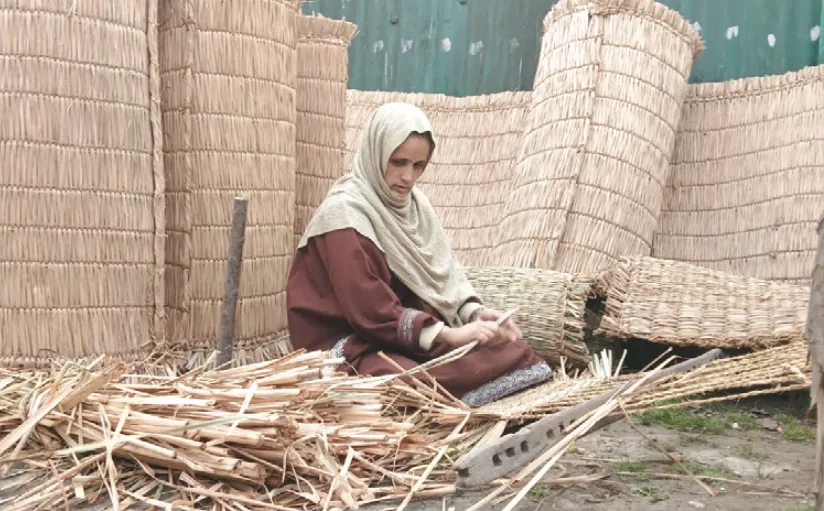






Srinagar, Jan 04: The courtyard is still half-asleep when the day begins. Cold hangs heavy in the air as dawn breaks inside a modest one-storey house at Mir Behri, in the interiors of Dal Lake. With temperatures below zero, Zameer Hussain Bhat and his wife, Ruksana, are already at work.
Seated low on the ground, their hands move steadily through bundles of dried reeds and rice straw. A few women work alongside them in near silence, eyes fixed on the mats taking shape, strand by strand. Conversation is sparse; the work follows its own rhythm.
The small, functional courtyard—shaped by years of use rather than design—is where Waguv is still made, away from shops, exhibitions and loud claims of revival. Here, the reed mat continues quietly, as it always has.
Waguv, once inseparable from Kashmiri domestic life, is among the Valley’s oldest crafts. Dating back nearly three centuries, with references traced to the Mughal period, it was never ornamental. Made by entwining dried rice straw with reeds known locally as peich, harvested from wetlands around Dal Lake, Waguv provided insulation in winter and cooling relief in summer. Spread across floors and placed beneath bedding and carpets, it softened cold surfaces in homes and houseboats alike.
British civil servant Walter R. Lawrence, in The Valley of Kashmir, wrote of how Kashmiris put every plant to use, describing *peich* as a fibre that produced “excellent matting.” For generations, Waguv defined domestic comfort, particularly for poorer households.
There was a time when more than 500 families in Srinagar alone depended on Waguv weaving. In Akhoon Mohalla, just across the water, over fifty families practised the craft. Children learned early; not knowing Waguv weaving was once considered a failing.
Zameer grew up in that world. “I don’t remember a time when Waguv was not around me,” he says, tightening a rope of straw. His family has been associated with the craft for nearly two decades. He witnessed years when demand was steady and buyers predictable, and then the slow unravelling.
“Modern carpets came, mattresses came, and Waguv slowly disappeared,” he says. “People stopped asking for it. Then they stopped remembering it.”
By the late 2010s, Waguv had almost vanished from everyday homes, surviving mainly as a rustic accent in hotels and restaurants. In 2019, Zameer chose to return to the craft deliberately, despite low demand, uncertain income and intense physical labour.
“There was a time when no one even wanted to hear the word Waguv,” he recalls. “But I felt if we stopped completely, it would never come back.”
Encouragement from friends outside Kashmir—financially stable and emotionally invested—helped him persist when resources were thin. “Sometimes you need someone to tell you that this work matters,” he says.
For Ruksana, the work carries a deeper meaning. “This is not just earning,” she says softly, her hands never pausing. “This is how our elders lived. If we leave it, what will remain of them?”
The process has not changed. Reeds and rice straw are collected from swampy areas around Dal Lake, Chak Bagh, Anchar and Ganderbal. After drying, the straw is twisted into rope and woven entirely by hand. Two people are required to complete a single Waguv, a task that demands patience and coordination.
“It takes hours, sometimes days,” Ruksana says. “You cannot rush it.”
Despite the labour involved, Zameer has kept prices intentionally low. “If it becomes expensive, people will see it as a luxury,” he says. “Waguv was never a luxury. It belonged to everyone.”
A shift came when the Handicrafts Department intervened. Under the Karkhandar Scheme, Zameer was able to formalise his work, and exhibitions at Lal Chowk brought renewed visibility. “People stopped at the stall and watched us work,” he recalls. “Some said they hadn’t seen Waguv in decades.”
Orders followed from different parts of Srinagar and beyond, including Anantnag. Some buyers ordered mats for entire rooms; others spoke of better sleep and reduced back pain—beliefs long associated with Waguv’s natural texture and firmness.
Another quiet change has been the involvement of young women learning the craft. In small courtyards and rooms, they weave to earn, keeping the knowledge alive while supporting their households.
In early 2025, Waguv received Geographical Indication status alongside other fading Kashmiri crafts such as Namda and Shikara. The recognition formally linked Waguv to Srinagar’s wetland regions and acknowledged the communities around Dal Lake that have sustained it for generations.
Zameer welcomes government support but remains realistic. “Schemes can support us,” he says, rolling up a finished mat, “but Waguv will survive only if people bring it back into their homes.”
“This craft doesn’t need celebration,” Ruksana adds quietly. “It only needs space to live.”