

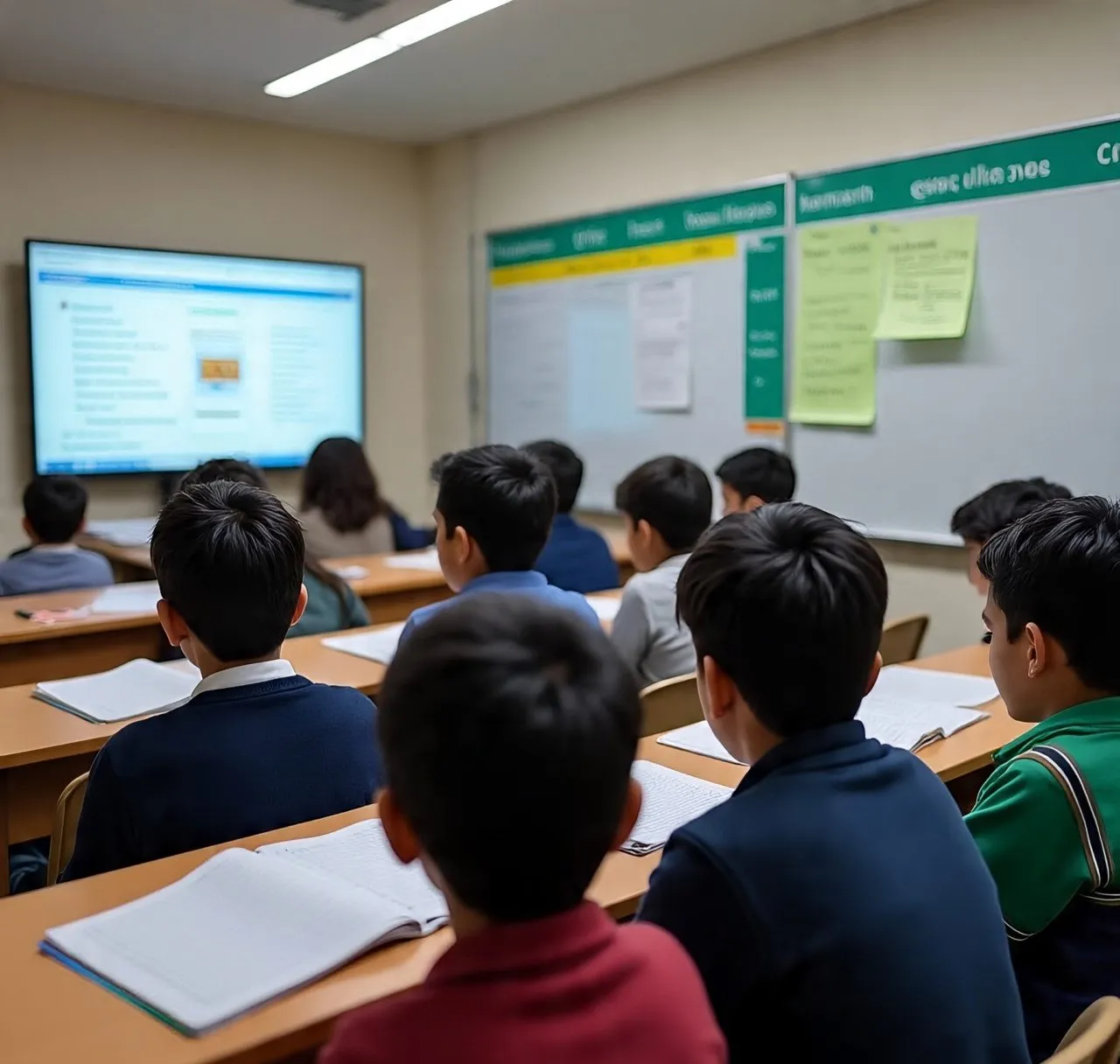






Srinagar, Jan 2: The year 2025 unfolded as a tale of contrasts for Jammu and Kashmir’s education sector—marked by institutional achievements alongside persistent academic challenges that exposed vulnerabilities across all levels of learning.
From schools grappling with shortened academic sessions to universities earning prestigious national rankings, the year witnessed both breakthrough moments and systemic disruptions that continue to test the region’s educational resilience.
At the school level, the academic session suffered significant setbacks with decreased working days, forcing the government to announce a 15 percent syllabus relaxation for classes 10-12 ahead of annual examinations—an unprecedented concession that raised questions about learning standards.
The disruptions stemmed from multiple crises: prolonged school closures during Operation Sindoor, flood-like conditions, and a summer heatwave that kept students away from classrooms for extended periods.
Compounding these challenges, the National Achievement Survey (NAS) conducted in November 2024 and released in July 2025 revealed poor learning outcomes among students. The School Education Department responded by launching district-wide programmes to assess learning gaps and develop long-term remedial measures.
Amid these difficulties, the JK Board of School Education (JKBOSE) achieved a historic milestone by declaring results for both Class 10 and Class 12 annual examinations on the same day—announcing outcomes for 248,979 students (145,671 in Class 10 and 103,308 in Class 12) without technical glitches.
In an unprecedented move, JKBOSE also conducted two full annual examinations in a single year for classes 10, 11, and 12. The 2024 batch appeared for exams in February, while the 2025 batch sat for their papers in November—a logistical feat aimed at normalizing the academic calendar.
The board also accelerated textbook distribution to educational zones to ensure books reach students promptly when schools reopen in March 2026.
The School Education Department stirred controversy with plans to introduce Sanskrit as a mandatory subject in Kashmir’s schools from classes 6-10. After initiating an extensive exercise to assess teacher availability and vacancies, the department quietly shelved the proposal following media scrutiny.
The Higher Education Department recorded a nine percent increase in overall college admissions this year, but newly established Government Degree Colleges struggled with enrollment. Government Degree College Allochi Bagh faced closure due to zero student enrollment, forcing the transfer of eight faculty members to other institutions.
Universities delivered the year’s brightest success stories. The University of Kashmir secured an A++ grade from the National Assessment and Accreditation Council (NAAC) with a CGPA of 3.68—becoming the first J&K institution evaluated under NAAC’s revised, more rigorous framework.
KU jumped from 45th to 34th position in the National Institutional Ranking Framework (NIRF) 2025 university category, marking its third consecutive year among India’s top 50 universities. It also ranked 59th in the overall category and 8th among state public universities nationwide.
The university mobilised Rs 50 crore in research funding, with its Centre for Interdisciplinary Research & Innovations receiving Rs 6 crore from ICMR for cancer studies. Additionally, 38 candidates from KU’s residential coaching programme cleared JKCCE Prelims 2025, while engineering students secured BEL placements with Rs 12 lakh annual packages.
KU earned national recognition for translating India’s Constitution into Kashmiri for the first time—a work released by the President of India.
The Central University of Kashmir reached a major milestone as the Ministry of Education approved a revised cost estimate of Rs 998.62 crore for its permanent campus at Tulmulla, Ganderbal, including Rs 400.80 crore for capital expenditure (2025-28) and Rs 146.98 crore for recurring costs.
The Islamic University of Science and Technology received the prestigious 6th National Water Award from the President in November and achieved a historic first by placing in the 151-200 band in both university and engineering categories, and in the 51-100 band among state public universities in NIRF 2025.
However, the National Institute of Technology Srinagar remained without leadership throughout the year, as the Ministry of Education failed to fill the director’s post.
A critical year ahead as the contrast between progress and persistent challenges sets the stage for a defining year ahead. Whether 2026 can transform ambitious plans for “Academic Excellence” into sustained, measurable improvements remains the critical question facing J&K’s education sector.