

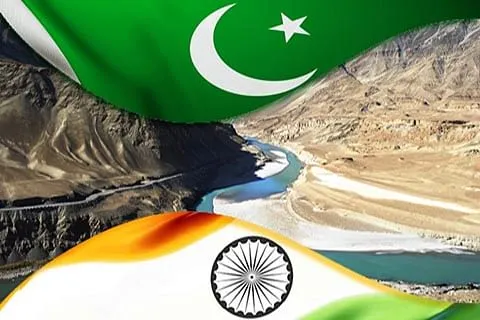






The four-day high intensity India-Pakistan of May 2025 has been listed as one of the most significant events of the world of the outgoing year. Its roots have been traced to Pahalgam terror attack that spotlighted Kashmir.
West is working overtime to project more dangerous clashes in the region, sidestepping the question of cross-border terrorism through which Pakistan has been staging murderous brutalities in the country, particularly Jammu and Kashmir.
The west is dragging the suspension of the Indus Waters Treaty, announced by Delhi on April 23, a day after horrific tragedy of Pahalgam attack; into the conflict without censuring Pakistan for what all it had been doing to India for over decades. This is a typical western mischief. The Pahalgam incident is just one example of that.
Terrorists had massacred 26 civilians, 25 of them tourists in Pahalgam on April 22, 2025. The attack had sent shockwaves across the country. The incident was sponsored by Pakistan-based Lashkar-e-Taiba. It was for the first time that India reacted to the terror attack in an unprecedented manner – the earlier response to the terror assaults in Uri in 2016 and Pulwama in 2019 were left far behind. This year it was an unimaginable punishment for terrorists and their patrons in Pakistan.
Operation Sindoor, the military action launched in small hours of May 7 was directed at terror infrastructure and terrorists in Pakistan and Pakistan occupied Kashmir to punish perpetrators and backers of the terror. Now it has evolved into an international brand of counter-terrorism.
The definition of this operation assumed wider meaning only after it has achieved its initial purpose of destroying terror infrastructure and terrorists across the border and Line of Control. Pakistan escalated it to a war level, and paid a heavy price for this misadventure. It had also not calculated the cost of the misadventure in Pahalgam, nor did it when it retaliated to the destruction of its terror assets. It lost on both ends. The immediate losses have been assessed in terms of what its defense system suffered; its airbases, air stations were crippled. However, it has transpired now that Pakistan suffered much more than just the military assets. It is on a territory where it can be hit again even when it might be planning for the attack.
Two points emerge out of it. India is keen to tell the world what it can do when its citizens are targeted. The history is full of chapters in which Kashmir has been in the focus of terror-promoting machines from across the world. Delhi, through its strong action against the terror sanctuaries is making it clear that all threats will be dealt with to make Kashmir safe. In fact, that work is nearly complete, as in the past over six years, it has corrected many misperceptions that Kashmir can stay with India only if it offers political and economic concessions to those who live and promote the agenda of dispute and doubts.
Some of the leading foreign policy experts, however, look it through different prism. They are still stuck with the past and narrative of the times that “Kashmir is the most dangerous place in the world,” as it was described by President Bill Clinton in 2000. This essentially is the view of American experts who are keener to prove that India-Pakistan conflict is due to Kashmir and refer to it as a dispute. They have for long argued on the lines that Pakistan’s terror acts were due to the unresolved issue and refusal of India to acknowledge that could create potentially dangerous situation in south Asia. Now they have added suspension of the Indus Waters Treaty in the wake of Pahalgam attack as one of the things that could escalate tensions between the two nations. James M Lindsay, renowned foreign policy analyst working with Council of Foreign Relations listed Indo-Pakistan clash of May 2025 as one of the ten most significant events of the world in 2025, and titled it “ The Water’s Edge”.
He referred to Pahalgam attack and the “likely” involvement of Lashkar in this incident. He opened the essay with a quote of US President Bill Clinton in 2000, in which he called Kashmir as the most dangerous place in the world. “The simmering tensions between India and Pakistan over the region erupted into open conflict in May; two weeks after five terrorists killed twenty-six people near Pahalgam in Indian administered Jammu and Kashmir. Lashkar-e-Taiba , the Pakistan based terrorist organization that carried out the 2008 Mumbai terrorist attack that killed 175 people , likely sponsored the Pahalgam attack. In 2008, India declined to retaliate. This time, it struck what it called terrorist infrastructure.” He goes on to describe how Pakistan retaliated to Indian strikes, but suffered destruction of defense system at the hands of India.
Lindsay wonders whether India’s decision to suspend its participation in the Indus Waters Treaty of 1960 means it will curtail the flow of water in the Indus River system that supplies 80 percent of Pakistani farms.
There is not so hidden attempt by the western media and experts to suggest that continued suspension of the Indus Waters Treaty would hurt Pakistan’s agrarian economy and for that India would be responsible. It, in a roundabout way, is to condone the terrorist attacks that Pakistan mounted in India and bled its citizens to death. That’s why there is a comparison to Mumbai terror attack. India did not retaliate that time, but this time it launched military action of unprecedented scale and scope in response to the terror attack of April 22. It implies that despite such a terror atrocity in 2008, India did not retaliate, leave alone taking any action on IWT. The comparison in the number of victims of the two terror incidents 17 years apart , and different reactions, is a typical western attitude and approach toward rising India.
It was only last week that Union Home Minister Amit Shah had reviewed the work in progress of diversion of waters of the three rivers of J&K flowing to Pakistan. It made India’s plans clear that it is not going to change its decision. Prime Minister Narendra Modi has already made it abundantly clear that India will not compromise on its security. The announcement of keeping the Indus Waters in abeyance is interlinked to the country’s security. The suspension of the treaty came a day after Pahalgam attack. The sequence and chronology is self-evident.