

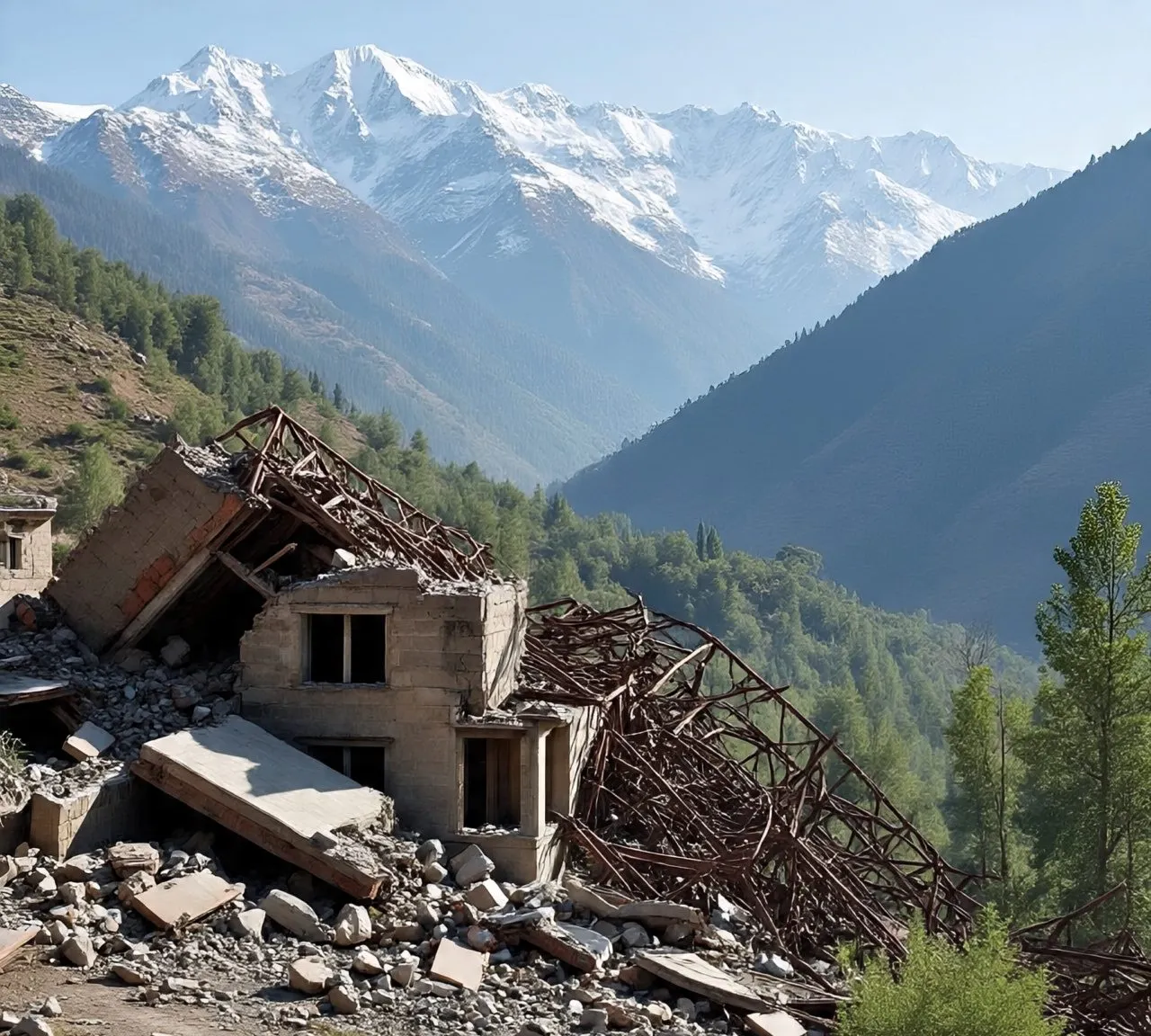






A recent scientific study has now pushed Jammu and Kashmir into a newly defined Seismic Zone VI, the highest risk category, signalling a future of stronger shaking and greater destruction if preparedness remains inadequate.
The study, published in Communications Earth and Environment by Lin Liu, Danian Shi and Simon L. Klemperer, reveals that the Indian tectonic plate below the Tibetan Plateau is literally tearing apart at depth. This deep tectonic damage is believed to be increasing stress across the Himalayan belt, with implications for seismic activity from Ladakh to the Kashmir Valley. For a region already known to be overdue for a major earthquake, the findings are scary.
Recent tremors in Ladakh and Doda—measuring 4.5 and 4.4 respectively—may not have caused widespread damage, but their frequency has heightened public anxiety. They are reminders that Kashmir sits precariously at the collision zone of the Indian and Eurasian plates. The devastating 2005 earthquake, which killed over 80,000 people and flattened entire towns, remains a painful reference point. Yet, nearly two decades later, lessons from that tragedy appear only partially learned.
One of the most worrying trends is the way the houses in Kashmir are built. Modern construction across the Valley often prioritises speed, and cost-cutting. Many homeowners remain unaware of what earthquake-resistant construction actually entails, or assume it is prohibitively expensive.
Ironically, Kashmir’s traditional architecture had long addressed seismic realities. The taq system and dhajji diwari style, with their extensive use of timber and flexible frameworks, allowed buildings to absorb shocks rather than collapse under them. Organisations like INTACH have repeatedly stressed the need to adapt these principles to modern needs, instead of blindly importing cement-and-marble designs better suited to other parts of India. In cold, fragile places like Kashmir and Ladakh, such architecture is not just inefficient, it is dangerous.
The upgrade to Zone VI should act as a wake-up call. Earthquake resilience cannot be left to individual choice alone. The government must enforce stricter building codes, ensure proper monitoring of construction, and invest in retrofitting existing structures, especially schools, hospitals and public buildings. Just as importantly, sustained awareness campaigns and regular workshops in educational institutions can help cultivate a culture of preparedness. Earthquakes cannot be prevented, but their human cost can be reduced.