

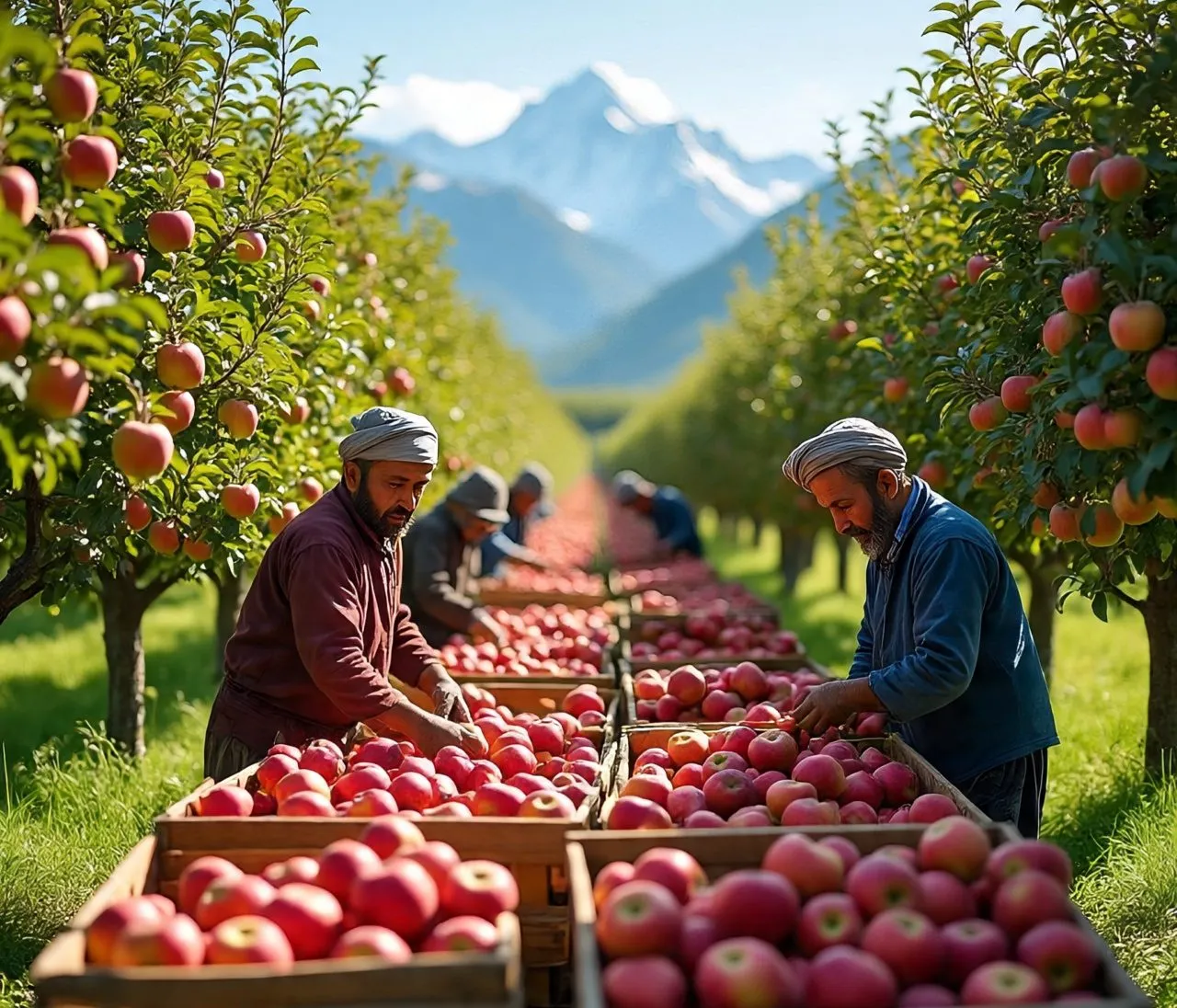






The reduction of import duty from 50 to 25 percent alters the contours of the apple business in Kashmir. This holds true even though it is not a blanket reduction of import duty on all apples from New Zealand.
The India-New Zealand Free Trade Agreement, concluded just yesterday, represents a calibrated and cautious opening up of the market. It has thoughtfully introduced a Tariff Rate Quota (TRQ) system specifically designed to protect domestic producers from undue competition.
Under this arrangement, up to 32,500 tonnes of New Zealand apples in the first year— increasing gradually to 45,000 tonnes by year six— will qualify for the reduced duty of 25 percent. This concession is, however, subject to a Minimum Import Price (MIP) of USD 1.25 per kg to ensure a level of price discipline.
Any imports that exceed this quota will continue to face the standard 50 percent duty (or a 50 percent margin of preference in certain descriptions) along with a significantly higher MIP of USD 2.50 per kg. This acts as a strong deterrent against excessive inflows.
Importantly, the preferential access has been deliberately limited to the counter-seasonal window, from April to August. This is the period when Kashmiri apples are not in harvest, thereby minimising direct overlap and competition with the domestic produce.
The Kashmir Valley remains the heart of India’s apple production, contributing the majority of the country’s output. It produces approximately 2.05–2.06 million tonnes in 2024–25, accounting for around 75–80 percent of the national production of roughly 2.55 million tonnes. This dominant position makes the sector highly sensitive to any form of import competition, especially since it directly supports the livelihoods of 7 to 8 lakh families and countless others in the allied ecosystem.
As the quota gradually rises over the medium term, the availability of cheaper New Zealand apples could lead to a marginal increase in total imports. This, in turn, has the potential to exert some downward pressure on domestic prices, particularly in premium segments or during shoulder seasons. Historical precedents, such as the duty reductions on U.S. apples in 2023, had triggered widespread protests from Kashmir growers. They rightly feared lower farm-gate prices and a consequent squeeze on their already thin incomes.
In this context, the government and the growers must collaborate closely to fully leverage the built-in safeguards— the TRQ limits, the Minimum Import Price mechanism, and the strict seasonal restrictions— to effectively contain any adverse impact on the local industry.
However, going forward, growers will inevitably face mounting pressure from the overall growth in total imports. India’s apple imports are projected to reach around 600,000 tonnes in 2024–25, while Kashmir alone produces close to 2 million tonnes. This growing import volume underscores the need for proactive measures.
To mitigate these challenges and build long-term resilience, policy focus has to shift decisively towards yield maximisation through better horticultural practices, cost reductions via efficient inputs and logistics, and stringent quality control measures that allow for full traceability from orchard to market. Such steps will not only strengthen the competitiveness of Kashmiri apples but also ensure sustainable livelihoods for the farming community.