

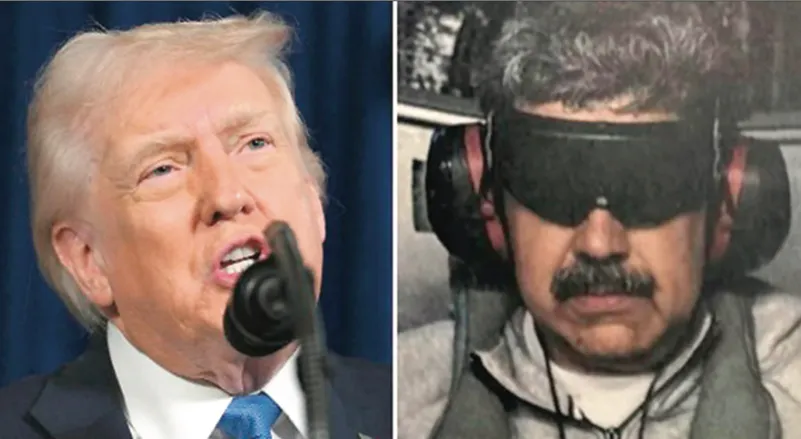





In a pre-dawn operation on Saturday, US special forces seized Venezuelan President Nicolás Maduro, flew him out of his country, and placed him in a New York jail. Video of a handcuffed head of state, still legally in office, was released by the US president Donald Trump himself to show off the US power.
Maduro is no symbol of democratic virtue. His elections have been widely questioned, his rule has hollowed out Venezuela’s economy, and millions have fled the country under his watch. But none of that answers the larger question now hanging over global politics: who gets to decide when sovereignty no longer applies?
For decades, the United States insisted that no country had the right to invade another, topple governments, or seize leaders at will. It made that argument forcefully in Iraq’s invasion of Kuwait, in Russia’s actions in Crimea, and most recently in Ukraine. Again and again, Washington has said that borders matter and that force cannot replace law.
Yet in Caracas, the United States did exactly what it condemns elsewhere: crossed borders with bombs and helicopters, snatched the head of state, and openly spoke of “running” another country.
The damage is not limited to Venezuela, as precedents travel fast. China, Russia, and others will not struggle to cite this moment when they next act unilaterally. Smaller states will take note too, learning that international rules offer protection only until a major power decides otherwise.
Perhaps most striking is how casually the old language has been discarded. There was no attempt to cloak the operation in multilateral approval or legal process. There was no pretense of collective action. Power spoke plainly.
The United States did not build the international order in a single moment; it assembled it brick by brick, through institutions, norms, and a belief, sometimes sincere, sometimes self-serving that rules mattered. When the architect begins pulling those bricks out so openly, the structure does not partially collapse. It eventually gives way entirely. And when that happens, it will not be Venezuela alone that pays the price.