







Srinagar, Jan 2: Kashmir’s business community has welcomed the Joint Electricity Regulatory Commission’s (JERC) order rejecting any power tariff hike for 2025-26, particularly the Time of Day (ToD) surcharge that had drawn widespread criticism.
The Kashmir Power Development Corporation Limited (KPDCL) had filed a petition before JERC, which, while not proposing a general tariff increase, included a 20 percent ToD surcharge during peak hours—a move that sparked strong opposition from traders and manufacturers across the valley.
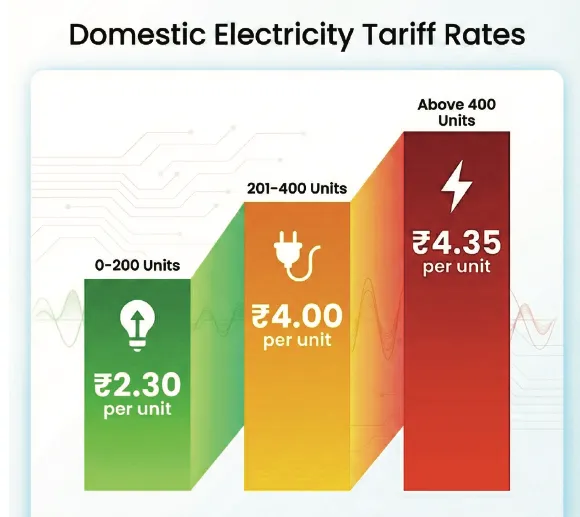
On Thursday, JERC issued an order explicitly stating that ToD charges will not apply to domestic consumers, effectively meaning no power tariff hike for households.
Welcoming the decision, Javid Ahmad Tenga, President of the Kashmir Chamber of Commerce and Industry (KCCI), said the Chamber appreciates putting ToD on hold until the end of March but strongly demands that the proposal be abandoned permanently.
“There is no perceptible improvement in the economy, as evidenced by continued trends in GST collections. An increase in tourist footfall during the New Year and Christmas period is no reason to hike power charges through ToD,” Tenga said.
“We have filed detailed objections before JERC opposing the peak-hour surcharge on multiple grounds, including the lack of adequate power infrastructure to justify differential pricing, the absence of smart metering systems to accurately track consumption during specific hours, and the additional financial burden it would place on businesses already struggling with high operational costs,” he said.
Kashmir Traders and Manufacturers Federation, President Mohammad Yaseen Khan, described the announcement as “much-needed relief for traders, manufacturers, small businesses and households, especially when input costs across sectors remain under pressure.”
Khan emphasised that affordable and predictable electricity pricing is crucial for economic stability and business confidence in the region.
“Importantly, Jammu and Kashmir did not witness any routine power curtailment schedules this year, which for decades had been a harsh reality for businesses and consumers. The absence of regular, pre-announced power cuts marks an improved shift from the past and has contributed to smoother business operations, reduced losses and improved quality of life,” Khan said.
He noted that curtailment schedules were treated as the norm in Kashmir for decades, severely impacting trade, industry and daily life. “It is encouraging to see a move away from that legacy.”
KTMF urged the government to continue strengthening power infrastructure, improving distribution efficiency and ensuring uninterrupted supply, particularly during peak winter and business hours, to enable sustainable economic growth.
President of the Kashmir Trade Alliance, Aijaz Shahdhar, also welcomed the decision, noting there is a need for amnesty for commercial consumers as well.
“It is a good move that there is no increase in power tariff,” he said.