







Srinagar, Jan 3: The government of India has announced a comprehensive Rs 7,295-crore financial support package aimed at making it easier and cheaper for exporters, particularly small and medium enterprises, to access credit and compete in global markets. For Kashmir’s handicraft, horticulture, and manufacturing exporters, this could be a significant opportunity to expand their international presence. Here’s what the package entails and how local exporters can benefit:
What Does the Package Include?
The package has two main components to be rolled out over six years (2025-31):
Interest Subvention Scheme (Rs 5,181 crore): This provides a direct subsidy on the interest rates exporters pay for pre-shipment and post-shipment export credit. Currently, MSMEs pay between 9.5 per cent and 12.5 per cent for export credit. Under the scheme, eligible MSME exporters will receive subsidy benefits ranging from 2.75 per cent, significantly reducing their borrowing costs.
The subsidy is capped at Rs 50 lakh per firm annually, but this will still cover 75 per cent of all product categories—over 12,000 tariff lines. The scheme has been resumed after a one-year gap, with the previous scheme having expired in December 2024.
Collateral Support (Rs 2,114 crore): This addresses another major hurdle for small exporters—the lack of collateral to secure loans. Under this measure, the government will provide credit guarantee support for export-linked working capital loans up to Rs 10 crore per firm. Micro and small exporters will get up to 85 per cent guarantee coverage, while medium exporters will receive up to 65 per cent coverage.
Kashmir Context: Who Can Benefit?
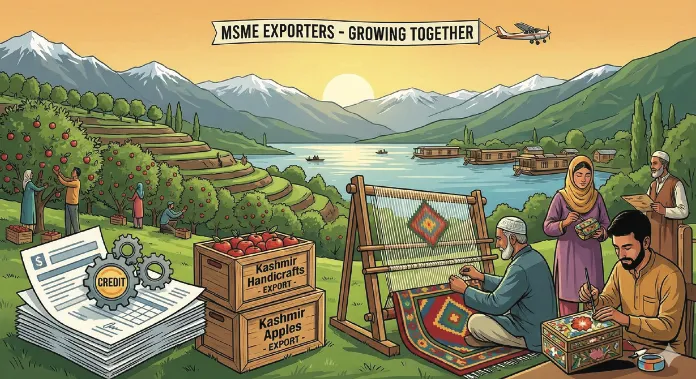
Kashmir’s export sector, dominated by MSMEs in handicrafts (carpets, papier-mâché, walnut wood carving, pashmina), horticulture products (apples, saffron, dry fruits), and emerging manufacturing units, stands to gain substantially from these measures.
Local exporters have long struggled with high credit costs and collateral requirements, often relying on personal assets or foregoing expansion opportunities altogether. The package directly addresses these pain points, potentially enabling Kashmir’s artisans and traders to access working capital at more competitive rates.
For instance, a Srinagar-based carpet exporter or a Sopore fruit trader seeking pre-shipment credit can now avail loans at substantially reduced interest rates, improving their margins and competitiveness in international markets like the US, Europe, and Gulf countries.
The collateral support is particularly significant for Kashmir’s small-scale exporters who often lack adequate assets to pledge against loans.
How Will It Work?
The interest subvention rates will be reviewed biannually in March and September based on domestic and global interest rate benchmarks. When policy rates fall, the subsidy will also decrease proportionately. Additional benefits will be provided to MSMEs exporting to new and emerging markets, though details are yet to be notified—a provision that could particularly benefit Kashmir exporters looking to diversify beyond traditional markets.
The Reserve Bank of India will implement the interest subvention scheme along with the Directorate General of Foreign Trade, whilst the Credit Guarantee Fund Trust for Micro and Small Enterprises will handle the collateral support. Both measures will initially be rolled out on a pilot basis with scope for refinement based on feedback.
The schemes apply to exports from a selected positive list of products, including defence and SCOMET (Special Chemicals, Organisms, Materials, Equipment and Technologies) products. However, restricted items, waste and scrap, and products already covered under production-linked incentive schemes are excluded.
Kashmir’s traditional export items like handicrafts and horticulture products are expected to be covered under the positive list, though final guidelines will clarify the exact scope.
This package addresses two critical challenges faced by Kashmir’s MSME exporters: high borrowing costs and lack of collateral. By reducing the cost of credit, local exporters can price their products more competitively in international markets, particularly important at a time when global trade faces headwinds from high tariffs imposed by countries like the United States.
Kashmir’s handicraft sector, which employs lakhs of artisans and contributes significantly to the local economy, has often been constrained by limited access to affordable finance. The package could enable carpet weavers, papier-mâché artists, and pashmina traders to scale up production, meet larger international orders, and explore new markets.
Similarly, horticulture exporters from Sopore and Shopian, dealing with perishable produce, require quick access to credit for packaging, cold storage, and transportation. Lower interest rates and easier collateral norms can make these operations more viable and profitable.
The measures are part of a larger Rs 25,060-crore Export Promotion Mission approved in November 2025. The first component—market access support worth Rs 4,531 crore—was rolled out on December 31, 2025, making this the second major intervention.
Local exporters should stay informed about the detailed guidelines to be released by the RBI and DGFT. The pilot rollout phase will be crucial for providing feedback on implementation challenges specific to Jammu and Kashmir, such as connectivity issues, documentation requirements, and awareness gaps.