







Close your eyes for a moment and imagine a boy who grew up being bullied and mocked. A fresh-faced college dropout, trying to survive on part-time gigs after moving to Srinagar. Learning to walk with dignity, he is trying to carve out a place for himself in a world that offers no applause. The person he adored the most is gone from his life. He is almost abandoned and emotionally damaged. His phone rarely rings. He has been written off, even by some of his very ‘own’.
This young man had two options: sink or swim. He decided to swim against the tide. This below-average student from Baramulla is now at the same table as minds from Columbia and Cornell, LSE and Oxford. He earned highly prestigious national and international scholarships and fellowships. The first book he co-authored in 2024 is published by a European think-tank. His readers, colleagues and clients are scattered across six habitable continents. This doctoral researcher just represented 1.46 billion fellow citizens, 18% of the world population. The simple answer to how he got here is that he stopped believing other’s opinions were destiny. Now open your eyes. That boy is writing to you from Nairobi.
Roy. Resilience. Runaway.
Six flights, five cabs, several shuttles and in between I finished reading Arundhati Roy’s recently published memoir Mother Mary Comes to Me. The title is taken directly from the lyrics of the Beatles song “Let It Be,” specifically the line: “When I find myself in times of trouble, Mother Mary comes to me.”
Her words felt heavier, especially when she said she left home with nothing but pain, something I know too well. “Even the very poor had families, communities. I had nobody.” That line stayed with me. So did “Get out of my home.” In Roy’s book, it is more than a mother’s thorny diktat. It is an invisible wound. One that does not heal with time. Roy left Kottayam when she was 18 for never to return, I left little later, with a shoestring budget, perhaps for never to return to the same space. I, too, learned to live like a bird on the wire — alert, prepared, always ready to fly.
Stamp, Smiles and Sauna.
Unlike my previous foreign travels, immigration experience was pretty smooth. When the officer at Delhi airport asked, “Why do you want to go to Kenya?” I slipped out my sponsor’s invitation letter. “I am speaking about migration, refugees, border crisis, big tech authoritarianism and of course India’s digital revolution,” I replied. She smiled, stamped my passport, and the three words that escaped her lips warmed my midnight exhaustion: “Best of luck.” I carried those words like a blessing at terminal 03 of Indira Gandhi International Airport at New Delhi, the world’s most polluted city, as per IQAir, the Swiss air quality firm.
Hopping on the connecting flight from Sharjah, I reached my hotel and was greeted by smiling receptionists decked out in professional style. The staff told me about the air conditioning, the Wi-Fi, the complimentary steam bath, swimming pool, Sauna and the massage services and that I could come back to the front desk or call anytime if I needed anything. It was only 4 PM local time, but my day was done. Jetlagged and running on fumes, I collapsed into bed and slept, confident that the daze and disorientation of travel would fade after a night’s rest. The next morning, the staff served mango, orange and cocktail juice; then came doughnuts, muffins, pineapple and watermelon. The nightly room price was just US$300 including a hot breakfast. (Wait a minute, are you converting the currency? Please dont. INR is now Asia’s worst performer as reported by Reuters. On December 16,2025 Rupee hit an all-time low, historic 90.93 to a dollar. Another masterstroke.)
At a dinner table in a seven-star hotel, the Palestinian fellow spoke of his bleeding homeland. My Ugandan colleague recalled being hung upside down by teachers as a child. Another friend from Sudan remembered not being allowed to open his lunch box until 2 PM. Unkind teachers know no geography. Tyranny wears different uniforms but the wounds feel similar.
Wait for your Clock
My room was bigger than dreams I once buried. On my king size bed loneliness finally felt soft. When the housekeeping staff changed body lotion, shampoo, shower gel and dental kit every day, it sometimes felt too good to be true. I liked the rain shower. It feels so soothing and relaxing. But I reminded myself: privilege is never permanent.
Slow down. Life becomes easier when you don’t rush. Everyone has their own time zone: Some succeed early and fade fast. Some bloom late and shine longer. I know some meritorious brains now struggling to find love, even at home. I know people who were belittled in life but they started small and now doing exceptionally well in their lives. I know some people who married young, they are living miserable lives. I know some people who married ‘late’ are enjoying life. The clock is yours. Walk or crawl but at your own pace. Life is about waiting for the right moment, the right person and trusting your journey. Because if you want to grow fast, you should know where to go slow.
I understand this because I am a “mofussilite” who grew up poor till I turned 25. I experienced poverty but education became my passport to explore the world bigger than where I was born. When you choose to walk alongside people who are smarter than you, you grow automatically. As firebrand parliamentarian Aga Ruhullah Mehdi, addressing students at Jamia Milia Islamia on December 20, 2025 said, “ Do not settle for ordinary, aim for excellence.”
Why don’t we travel?
Travel is a kind of school. No attendance sheet. Just skies that keep asking who you are becoming. In one of the International conferences I attended pre-Covid, I had a chit-chat with a Malaysian delegate. He was 25 and had been to 26 countries.
And our 30-year-old graduates chase government jobs, degrees upon degrees for a meagre sum which comes at the cost of the lofty dreams. And worse, it becomes a narrative, that clerical job which pays you 30K bucks gets you a tag ‘settled in life’ and makes you a docile zombie. There is no challenge, no uncommon thrill in life.
Some people in my network are not globe-trotters but they travel to experience and they have so much to talk about places and ideas. He was born to a Chinese father and a Lebanese mother in London, studied in Italy, lived in Tbilisi for some time, and now works for a US based company in Belgium. Someone was born in Jordan, married to an Australian and now works in Canada.
In Kashmir, when a boy from Kulgam likes a girl from Sopore, they date and promise to be together for the rest of their lives. The marriage proposal is turned down by either of the parties. Why? Itna door nahi karengay. Come on. For heaven’s sake, it is just a 100 minute drive. It is fine to get stuck in a traffic gridlock for over an hour but it is not okay to marry your daughter with a person of her choice who happens to live 50 miles away. Rethink your decisions, travel often and see how the world operates.
Kibra’s Kashmir connection
Kibra is Africa’s largest slum, a place crowded with poverty and struggle. Yet it was not always like this. Long before the cramped shacks and muddy lanes appeared, Kibra was an untouched forest on the fringes of Nairobi. When the first group of Nubians, originally from Sudan and serving under the British colonial forces, were settled here, the land was green, quiet and full of life. In the Nubian language, “Kibra” simply meant forest.
As the city expanded, politicians in the 1960s began eyeing areas where they could increase their influence. Different tribes were pushed into Kibra because the land was vast and affordable. Over time, the Nubians, the original custodians, became a minority in their own home. Even the name changed subtly — people added another vowel, turning Kibra into “Kibera,” and the forest gradually disappeared under the burden of overcrowding and neglect.
I learned that Kibra carries an Indian footprint. The Nairobi–Kisumu railway cuts through the infamous Lunatic Line. British colonisers dragged Indians here to build it in brutal conditions. Many never returned. Thousands died so resources could be hauled from neighbouring Uganda. Progress, even then, was built on broken bodies.
Back home, in this unforgiving winter, the story repeats itself in another form. While many of us sleep warm under heavy quilts at minus five, hundreds without homes fight the teeth-chattering cold on pavements, in shrines, hospitals, mosques, wherever a little shelter exists, as reported by this newspaper on December 01. We speak of moon missions but our government fails to execute PM Awas Yojna-Grameen which promises shelter to every citizen of this country. India calls itself the world’s fifth-largest economy, but ranks 136 out of 200 in GDP per capita — a fact (that we are a poor nation) flagged in Parliament on December 9,2025 by Kairana’s Iqra Choudhry.What exactly are we celebrating? We have every right to question this façade.
The City within a City
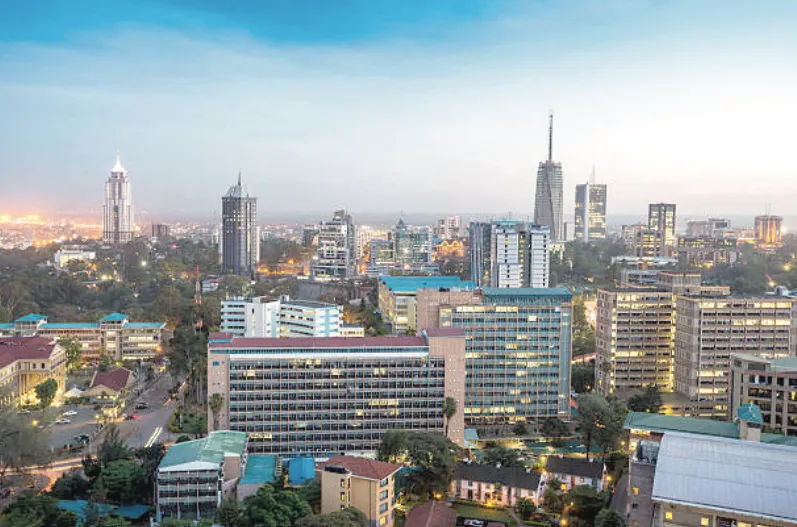
Every urban landscape is divided between slums and exclusive neighborhoods or posh colonies. It is a clear division between haves and have-not’s. In one of the counties we visited one evening, in the outskirts of Nairobi, we saw kids playing at sundown. This, sadly, doesn’t happen in our city, Srinagar-the restless city of contradictions, unresolved tensions and suppressed emotions, the city with deeply buried taboos and silences. Nairobi, at least on the outside, carries a lighter heart. Nairobi is a gorgeous city. Fun fact: it is the only capital in the world with a national park within the city.
Unwanted Dogs
Security checks are essential, and every traveller understands the importance of following airport protocols. However, in an age where artificial intelligence and advanced surveillance systems like Lavender, Azure, and Red/Blue Wolf are reshaping global surveillance standards, it was surprising to see sniffer dogs still being relied upon so widely at a major East African airport. I haven’t encountered this method elsewhere in my earlier travels. Watching the dogs carefully inspect luggage felt out-dated, especially when modern screening technologies could perform the same tasks more efficiently and with far less strain on the animals. Let the poor dogs take rest.
Travelling teaches
This trip humbled me further. I had the honour to share a dinner table with a Nobel Peace prize Nominee and Directors of organizations who are working for asylum seekers and refugees and making the world a better place to live. When we went out for lunch the other day, I ordered Lebanese falafel, and my co-fellows ordered the food of their choice. As we prepared to leave, the way my director asked for the bill made me rethink how we treat our servers in local eateries. “Sorry for bothering you, Could you please get us a bill.” There was so much respect in his tone.
I could see the people from different parts of the globe enjoying meals and music on that terrace. No awkward glances, no ugly stares. Something that is so common in my city.
The Return of the Native
The Kashmiri saying goes: Cholmut chu ewaaan, golmut chuni ewaan (The fled turn up but the dead don’t). As my aircraft touched Srinagar soil, I was reading The Declaration of Love, the last chapter of Roy’s memoir. People jumped up the moment wheels kissed ground — pushing, shoving. Why the rush? It’s the same luggage belt. The same wait. Maybe we Kashmiris are always running — from delays, from life, from ourselves. My chest tightened as I came out of the aerodrome to claim my luggage.
Coming home is not always comforting. Sometimes it is a reminder of who wasn’t there to welcome you. I whispered into the air: “One day… I will belong somewhere.” I felt loveless, barren and deserted while reading Mother Mary’s last text to Arundhati, “There is no one in the world whom I have loved more than you.”
I clutched the book, too afraid to admit that I, too, have longed for someone to say that to me. I reached my native land, home to 7.5 million beating hearts, and headed to my tiny apartment, with a heart full of gratitude. As a dogged diarist, I always document what (Ernest) Hemingway calls “bleeding” on a blank screen. When your world is collapsing, you hold on to whatever gives you a sense of meaning. For me, that was/is the craft of writing. As Emily Dickenson has beautifully put it, “I know nothing in the world that has as much power as a word.”
As we breathe in the first week of the second quarter of the 21st century, I am enjoying organic Makki di Roti prepared on dambur (traditional hearth), beyond Firkiyan, in the warm Keran sector. As you finish reading my 69th piece for this esteemed daily, I am reading Josh Maliabadi, a fiery voice of freedom:
Muflis hoon magar waris-e-fitrat hoon main
Asrar-e-payambari ki daulat hoon main
Ae lamha-e-maujood, adab se paish aa
Aainda zamane ki amaanat hoon main
I may be poor, but I am the true heir to nature
and the treasure of the prophetic secrets;
O present moment, be reverent to me
For I am the wealth that belongs to the future.
The author is a Doctoral Fellow.