

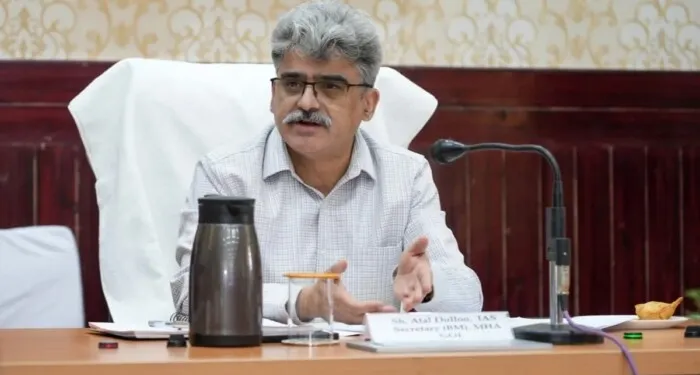






Jammu, Jan 5: Chief Secretary Atal Dulloo on Monday stated that there was no coordination-related issue vis-à-vis All India Institute of Medical Sciences (AIIMS) Kashmir, and delay was only on the execution front, yet it was likely to be ready by the end of 2026.
“I think by this year’s end, it should be ready,” Dulloo stated, in response to a question about AIIMS (Awantipora) Kashmir, in a press conference organised by the Press Information Bureau (PIB), Jammu in collaboration with the Department of Information and Public Relations (DIPR) on Pro-Active Governance and Timely Implementation (PRAGATI) platform in accelerating infrastructure development in J&K.
About the deadline target lapse in case of many high-priority J&K projects like Delhi-Katra Expressway (with its completion deadline March 2023 and now revised to 2027); AIIMS (Awantipora) Kashmir project, which too jumped many deadlines, the Chief Secretary said that the execution and not coordination was the major issue (behind the delay).
“In the execution of any project, the delay occurs on two accounts – one related to coordination issues, like different perspectives of forest, revenue, executing departments, UT and central governments. So, the projects confront many bottlenecks due to coordination issues. Second reason behind delay is pace of execution of project – like it may be marred or affected by shortage of labour, contractual issues, etc.,” he said.
However, Dulloo stated, following intervention through PRAGATI, there were no coordination issues.
“Like in the case of AIIMS Kashmir, there is no coordination issue. Issue relates to execution – it is up to the executing agency to see how they can expedite its pace. Yes, they did confront problems during the last year after the Pahalgam terror attack followed by rains-induced floods leading to the migration of labour. Similarly, during winters also, the labour moves out of Kashmir,” he explained the reason behind inordinate delay in completion of AIIMS Kashmir project, running far behind its schedule.
Regarding the Katra-Amritsar Expressway, the Chief Secretary said that its work also remained stalled for around one to two months due to floods and the labour fled.
“But there is no coordination issue with any department, UT government or any ministry in case of both these projects i.e., Katra-Amritsar Expressway and AIIMS Kashmir,” he asserted.
Responding to a question about the measures to ensure security of labour working on high priority projects and the action taken against companies for violation of labour laws with particular focus on security and health insurance (for labour), the Chief Secretary said, “I’ll give you some hints as I cannot deliberate on all aspects of security in the press (conference). For their (labour’s) security, all necessary steps are being taken. It (security aspect) is strictly monitored. Executing agencies, UT dispensation and Police – all are responsible for it (security).”
He evaded a query about the status of Sawalkote project, stating that the press conference was focussed on the J&K projects on PRAGATI platform. “This issue can be discussed somewhere else post presser,” he said.
What were other challenges in executing high-priority projects in J&K and how did the PRAGATI platform help in resolving those tangles besides sorting out the problem of inter-departmental coordination?
Responding to it, the Chief Secretary, in particular, mentioned the Udhampur-Srinagar Baramulla Rail Link (USBRL) project.
“The railway project had several thorny issues. It had disputes related to land acquisition, access besides matters related to environmental clearance and above all, geological. Keeping in view all such factors, the PRAGATI mechanism was used consistently for resolution of all the issues – one by one,” he said.
“Similarly, in the case of AIIMS Jammu, there was an issue related to shifting of utilities. The use of the PRAGATI mechanism expedited that (shifting) process. Likewise, in the case of the Kishanganga hydro-electric project (HEP). There were several issues related to agencies viz., forest clearance, environmental clearance, land acquisition, besides issues of local people. Here again PRAGATI platform helped resolving all these issues,” Dulloo informed.
He stated that among the nine high-priority projects being monitored through PRAGATI platform also included National Highway 44 projects (Jammu to Banihal section); Pakal Dul HEP; 4G coverage scheme under Universal Service Obligation Fund (USOF) besides Delhi-Amritsar-Katra Expressway and AIIMS (Awantipora) Kashmir.