







New Delhi, Jan 5: As the world marks World Braille Day on January 4, India’s expanding policy framework is steadily strengthening access to Braille as a cornerstone of inclusive education and equal participation for persons with visual disabilities, according to information shared by the Press Information Bureau (PIB).
PIB said India’s approach to Braille is anchored in a rights-based ecosystem led by the Rights of Persons with Disabilities (RPwD) Act, 2016, and reinforced through education reforms, assistive schemes, and digital platforms. Government initiatives such as the Accessible India Campaign (Sugamya Bharat Abhiyan), the National Education Policy (NEP) 2020, and Sugamya Pustakalaya align closely with the United Nations’ disability inclusion framework, reflecting India’s commitment to the principle of “leaving no one behind”.
Observed annually on January 4, World Braille Day highlights Braille not merely as a reading system, but as a gateway to education, dignity and social inclusion. PIB noted that while Braille was introduced in India in 1887, a major milestone came in 1951 with the adoption of Bharati Braille as a single national standard for Indian languages. According to the 2011 Census, India has over 50 lakh persons with visual impairment, many of whom face barriers in accessing education, healthcare and employment. In response, Braille has been embedded into India’s policy and institutional framework as both a literacy tool and a public accessibility norm.
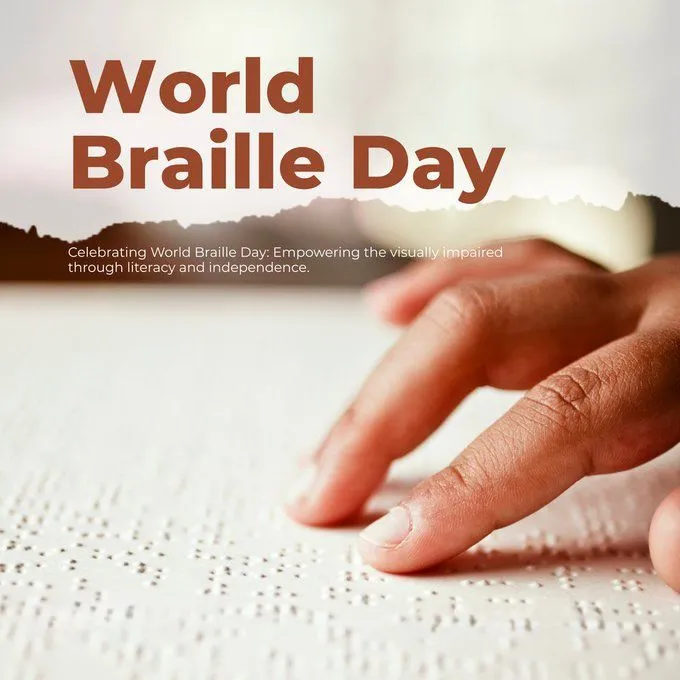
Braille is a tactile reading and writing system based on a six-dot cell arranged in two columns. Different combinations of raised dots represent letters, numbers and symbols, enabling people who are blind or have low vision to read through touch. Named after its inventor Louis Braille, the system is not a language but a code that can be applied across multiple languages.
PIB highlighted that the RPwD Act, 2016 provides the legal backbone for Braille access in India. The Act mandates inclusive education, requires government-funded or recognised institutions to ensure accessible infrastructure, and emphasises education in appropriate modes of communication, including Braille. It also provides for free learning materials and assistive devices for students with benchmark disabilities up to the age of 18.
The National Education Policy 2020 further integrates Braille into mainstream education by calling for accessible teaching-learning materials, including Braille textbooks, and prioritising the participation of children with disabilities. NCERT, under NEP 2020, is responsible for enabling the production of Braille and other accessible-format textbooks.
The government recognises Bharati Braille as the unified Braille script for Indian languages. PIB said that on January 4, 2025, a Standard Bharati Braille Code with Unicode mapping was published under the aegis of the Department of Empowerment of Persons with Disabilities and the National Institute for Empowerment of Persons with Visual Disabilities (NIEPVD). The standard, adopted after public consultation, enables digital compatibility, including use in screen readers, Braille displays and software applications.
Building on this, NIEPVD has validated revised Bharati Braille tables for technological integration and prepared Draft Bharati Braille 2.1, which is being placed in the public domain on World Braille Day 2026 for stakeholder feedback. The institute is also conducting regional-language Braille training programmes, including in Tamil, Malayalam and Odia.
PIB said the Accessible India Campaign, launched in 2015, has taken a holistic approach to accessibility by focusing on built environments, transport systems and information and communication technologies. This includes Braille signage at public buildings and railway stations, and national website accessibility guidelines.
In higher education, structured accessibility practices are being strengthened through initiatives such as Sugamya Pustakalaya, a digital library offering books in accessible and digital Braille formats. The platform, developed through collaboration between NIEPVD, Tata Consultancy Services and the Daisy Forum of India, embeds accessible formats into institutional workflows rather than limiting them to disability offices.