

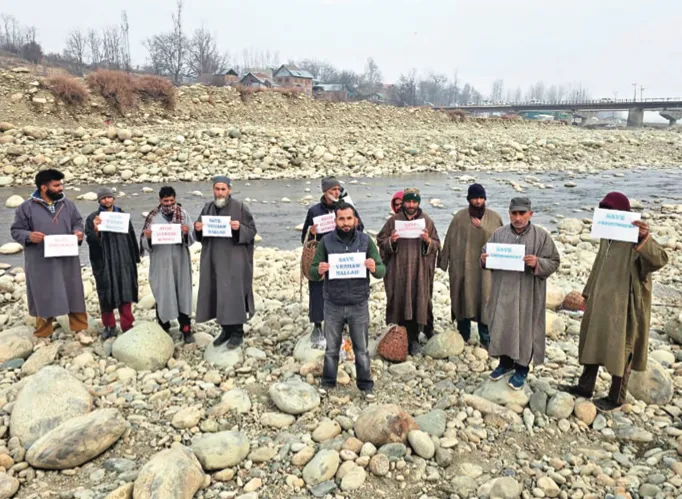






Kulgam, Jan 2: Fishermen and residents living along the Vaishaw stream in south Kashmir’s Kulgam district came out carrying placards around the waterway to voice concern over what they described as unscientific and illegal mining that is degrading one of the region’s most vital rivers.
Placards reading ‘save Vaishaw Nallah,’ ‘save water bodies, ’ ‘stop illegal mining’, and ‘save fishermen’, were displayed as locals demanded an immediate halt to the use of heavy machinery for extracting sand and boulders from the stream.
“This river is a lifeline for Kashmir,” said a local environmental activist, Yasir Ahmad. “We are not opposed to legal mining, but unscientific extraction in violation of National Green Tribunal (NGT) orders and Jammu and Kashmir mineral rules must stop.”
The Vaishaw stream, a major tributary of the Jhelum, originates from the Kausarnag-Aharbal area and joins the river at Sangam.
It carries the highest discharge among Jhelum’s tributaries and supplies nearly six million gallons of drinking water daily to more than 100 villages in south Kashmir.
The stream also supports agriculture, horticulture, and fisheries across Kulgam and parts of the Anantnag district.
Residents alleged that heavy machinery, including JCB excavators, LMTs, and cranes, is being used indiscriminately, often during the night and wee hours, to extract riverbed material.
“There is no objection to limited manual extraction at designated sites,” Ahmad said. “But deep mechanised mining has lowered groundwater levels and polluted the water.”
The National Green Tribunal (NGT) in August 2024 took cognisance of a December 16, 2024, Greater Kashmir report, ‘Vaishaw stream gasps for breath amid mining, pollution.’
The report documented how unchecked mining, agricultural runoff, and waste discharge were rapidly degrading the stream.
The matter is pending before the tribunal.
The report warned that continued deterioration could threaten trout and other sensitive fish species, compromise drinking water supplies, and increase flood risks in downstream villages.
Licensed fishermen said their livelihoods have been severely affected.
“We depend entirely on trout fishing,” said fisherman Sajad Ahmad of Pahloo village. “Polluted water and damaged aquatic life have reduced our catch.”
Residents also raised concerns about garbage dumping along the streambanks.
“There isn’t a proper dumping yard or waste segregation system,” said Bashir Ahmad, a local. “People are forced to dump waste near the stream, worsening pollution.”
Locals warned that excessive mining had weakened river embankments, increasing the risk of flash floods.
“Deep mining makes embankments fragile,” said Sayar Ahmad. “Entire villages could be washed away, like what happened during the 2014 floods.”
Environmental experts cited in earlier reports cautioned that mining during the trout breeding season, combined with pesticide-laden runoff and illegal extraction, has sharply reduced fish populations, degraded water quality, and heightened long-term ecological and disaster risks.
Residents urged the authorities to strictly enforce environmental regulations and protect the Vaishaw stream before the damage becomes irreversible.