

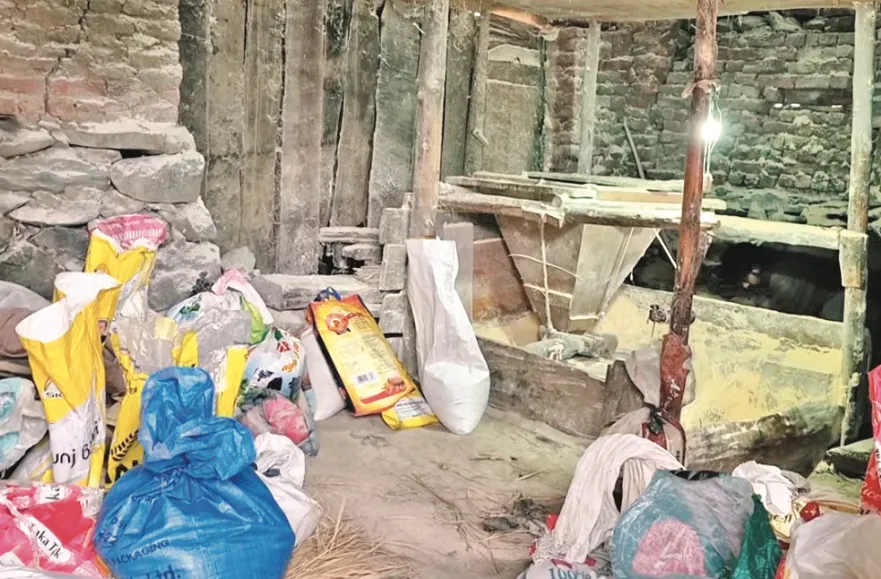






Ganderbal, Jan 5: In Kashmir’s hinterland, traditional water mills, known as “Aab-e-Gratta”, are on the brink. However, a few such mills continue to operate in far-flung and remote villages.
These ancient mills, powered by fast-flowing streams and rivers, have been grinding grains into flour for centuries. Due to uneven flow of water owing to climate change, modernisation, and neglect, many are struggling to survive.
The once-thriving mills, which were the heartbeat of community life, now stand idle, their wooden structures worn out, and their wheels motionless. The changing climate has altered the water patterns, causing streams to dry up or become unpredictable, making it challenging for the mills to operate. However, despite the challenges, some mill owners and locals are determined to preserve this traditional practice. They highlight the benefits of Aab-e-Gratta, including the production of chemical-free and healthier flour.
However, with the current state of affairs, it remains uncertain whether these traditional mills can be saved. The mechanism that utilizes running water to grind wheat, rice, and maize are environment friendly. People living around the foothills of the valley live in a fresh and peaceful environment, which may in part have motivated them to keep centuries old traditional watermills (Gratta) operational. They use the traditional method of grinding grain into flour because, in their opinion, the flour produced is of better quality and taste compared to mass produced flour.
The environment-friendly watermills are scattered across villages on the outskirts of Ganderbal district dotted with streams and canals.
The traditional water mills are the living proof of how energy can be harnessed without any environmental degradation, and these iconic water mills need a new lease of life. Prospering our traditional water mills will be an integral part of our authentic agricultural elements and cultural heritage, say local residents in Kangan.
One such watermill is operated by Mohammad Iqbal Kasana , 60, in Surfraw vialleg of Kangan in central Kashmir’s Ganderbal district. He has been operating the watermill since his childhood and is determined to continue his forefathers’ business. ” These mills had a great significance to the village in the old times. A gratta owner had a better social status in the village, for the family could afford both food grains and money, as a service charge on grinding” Kasana said.
He said, “Water mills are environment friendly but they are largely forgotten. With the outset of industrialisation, a gratta is rapidly losing the demand. The modern have outshined the good old gratta to an extent that we have been dragged out of business and water mills have attained a grinding break as the majority of them have been discontinued for the lack of demand of consumers.”
He explains how the water mill operates. ” These mills are powered by fast-flowing water channeled from streams, which turn the heavy grindstones, producing flour. Traditional watermills do not directly pollute the atmosphere, nor do they require electricity or fossil fuels” he said. Residents of surrounding villages visit Kasana’s ‘ water mill. He charges in kind rather than cash, taking a share of the flour from his customers.
Kasana said, “I wish to keep my family’s traditional business alive and after me, through my children.” He claimed that his family was attached with the business for the past many generations. Before him, his father, grandfather was attached with the business, he said. “The watermill is a symbol of our centuries-old culture, which is gradually disappearing due to the introduction of new technology,” he said.
“There is a need to keep this alive in order to introduce future generations to these environment-friendly mills,” he added.
How a watermill functions:
The water mill uses eco-friendly energy i.e water to function. The water from a nearby stream, water tributary is diverted towards the watermill through a wooden tunnel, a canal that then pushes the turbine fixed in the lower section of the water mill. The turbine is made of wood while the shaft is made of iron. The water mill also contains two grinding stones that remain in a small room of the mill.
The shaft is connected to the turbine that runs and turns the upper section of stone. The lower section is stationary, and grain stored in a wooden case above the stone drops the grain at a slow speed through a hole in the upper stone to lower stone via a feeder mechanism. The grain then is ground in between the two massive round shaped stones. The rotating of stone crushes the cereal to fine powder- the flour, which is later on collected and stored in gunny bags.