

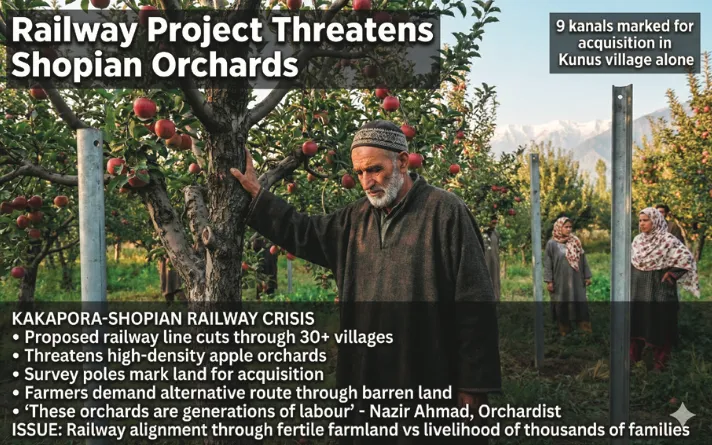






Shopian, Dec 28: Tears streaked down faces lined with age and hardship as farmers and orchardists in south Kashmir’s Shopian and Pulwama districts appealed to authorities to halt land demarcation for the proposed Kakapora–Shopian railway line.
Viral videos circulating on social media show elderly farmers weeping as they stand beside newly planted poles, fearing the project will swallow their orchards—the only source of their livelihood.
The proposed alignment will slice through fertile farms across more than 30 villages between Kakapora in Pulwama and Shopian, an area known for its high-density apple orchards that feed thousands of families. Fresh land marking has begun over the past few weeks, with railway teams installing 2.5-foot iron poles across agricultural fields, signalling the start of acquisition.
“These orchards are not just land; they are generations of labour,” said Nazir Ahmad, an orchardist from Shopian, in a video widely shared online. “If the railway track cuts through my farm, it will take away my small patch of land. I will be left with nothing.”
Farmers are demanding that the railway line be laid through barren land instead of productive orchards.
Farooq Ahmad, a farmer from Kunus village, about 7 km from Shopian town, said around nine kanals of his land have been demarcated for the railway project. “We live off the land. We have no other source of income,” he said.
Ahmad questioned whether the railway would actually reduce travel time or distance. “The government must conduct a fresh survey to explore alternative routes that spare our orchards,” he said.
Many farmers, including women and elderly villagers, have started gathering around fields during demarcation work, hoping to stop survey teams.
“What will we eat if our land goes? How will we survive? We are not against development, but it cannot come by destroying our lives,” said a woman whose family orchard lies in the alignment zone. “Let them show us an alternative that doesn’t destroy our livelihoods.”
For now, the poles stand like scars across the orchards—silent markers of a future the farmers never asked for, and a battle they fear they cannot afford to lose.