

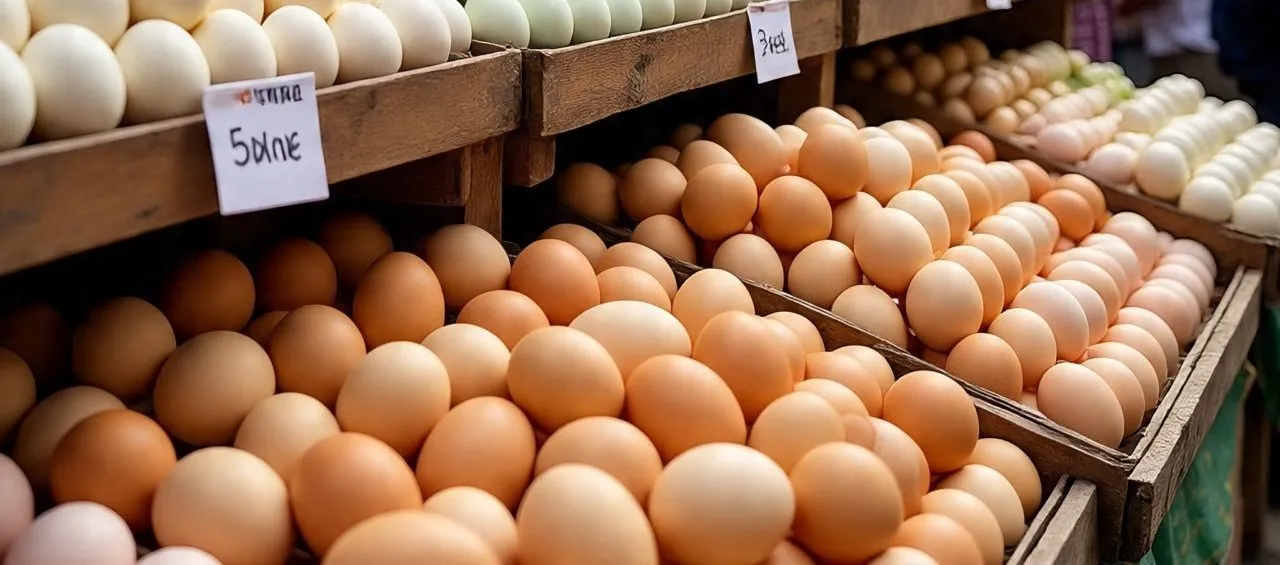






Srinagar, Jan 5: Eggs are back on plates but not on budget.
Prices swung wildly after the “egg scare”, but deregulation now shields sellers, not buyers.
Over the past month, since egg-scare caught Kashmir following the ‘Eggoz’ brand egg controversy, prices have undergone a roller coaster of change.
Back on Kashmiri plates, eggs have become at least 20 percent costlier in just a month, and there is no way consumers can complain about it, thanks to the deregulation of commodity prices in 2023.
All poultry eggs, irrespective of variety and quantity, used to cost at least 30 percent cheaper just a month ago.
When an egg brand ‘Eggoz’ hit the headlines for alleged contaminations and health concerns, consumers in Kashmir went into a frenzy.
Egg trays were returned to local stores, while many discarded their egg trays in panic.
Prices dropped drastically, a tray selling for Rs 100 in some areas.
However, soon after, when it was reiterated by the Food Safety and Standards Authority of India (FSSAI) that eggs continue to remain safe, consumers turned to their eggs again as a source of affordable protein in their diets.
Soon, the cost of eggs surged dramatically.
Individual eggs are selling for Rs 8 to Rs 11 per piece.
There has been a 25 to 40 percent increase in some areas.
Kashmir consumers expect the government to intervene and control the prices of eggs.
Joint Controller, Legal Metrology, Kashmir, Tanveer Ahmad, when asked why the prices of eggs cannot be regulated by the administration, said that as per an SO issued in 2023, prices of essential commodities like meat, meat products, fish, fish products, milk, milk products, poultry, and eggs have been decontrolled.
“There is a clear-cut order that no authority will fix the price of any essential commodity. Therefore, the prices of eggs are not under our control,” he said.
He was referring to SO 300 issued by the J&K government on June 1, 2023.
Currently, a box of eggs with seven egg trays costs anywhere between Rs 1500 and Rs 1700.
An egg tray, with 30 eggs, the regular farm white egg variety, can cost Rs 200 to Rs 280.
The organic eggs cost Rs 200 to Rs 300 per dozen.
The egg prices also vary by the area in which they are sold.
Eggs cost cheaper in old parts of the city, in market hubs like Maharaj Bazaar, Safa Kadal, and Batamaloo, compared to Rawalpora, Nishat, and other areas.
In villages, prices vary by distance from town, customarily increasing as the distance increases. In Jammu, an egg tray costs anywhere between Rs 190 and Rs 250.
Over the past week, egg prices have seen a downward trend in Jammu, while the Kashmir division is recording a spike.
A consumer, Danish Ahmad, told Greater Kashmir that he buys eggs in bulk for the family, as his parents have been advised a high-protein diet, while he himself is also a gym trainer.
“Compared to last year, I have to pay Rs 200 extra per box now. Why is no one checking the market?” he said.
Many critics point to a lack of market regulation in winters in Kashmir, as well as disruption in the supply of eggs due to highway impediments.
Why Govt can’t fix egg, meat, poultry prices
In June 2023, the J&K government issued a notification (S O 300, dated June 1, 2023) that revoked the J&K Mutton (Licensing and Control) Order, 1973, that had been issued vide SRO-646 dated December 19, 1973.
This order was prompted by a clarification from the Ministry of Consumer Affairs, Food and Public Distribution (Government of India). The clarification declared that the foundational notification S O 145(E) dated February 15, 1990, which gave price regulation powers to J&K, was no longer valid.
It directed all relevant authorities, including the Directorates of Food, Civil Supplies and Consumer Affairs J&K to refrain from issuing or enforcing any price notifications or controls on livestock products.
This effectively deregulated prices for key livestock essentials such as mutton, poultry, and eggs.
Without the legal authority, there is no framework to fix maximum retail prices or penalise overcharging.
It is impossible for the government or consumer protection bodies to cap escalating costs. The prices are determined solely by market forces of supply, demand, transportation costs, seasonal factors, and trader discretion.