

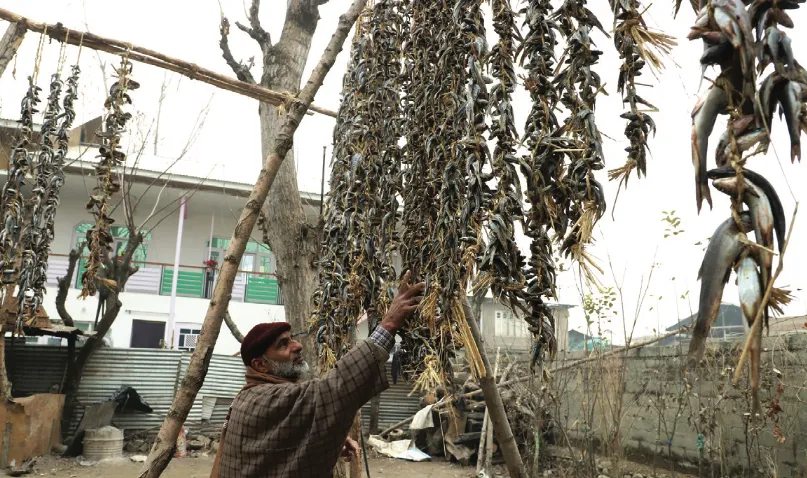






Srinagar, Jan 5: As winter sunlight pierces the fog hovering over Wular Lake, a few strands of fish sway gently on wooden frames outside scattered homes in north Kashmir. Once a defining feature of winter across fishing villages, this sight is now rare. The fish are being dried to make Hoggard—Kashmir’s traditional sun-dried fish—an age-old winter staple that is fast fading from kitchens, memories and tastes.
“In our time, winter did not begin until Hoggard was ready,” says 68-year-old Ghulam Hassan of Bandipora, pointing to an empty courtyard where rows of fish once hung. “The smell would spread through the mohalla. No one complained. It meant we were prepared.”
Hoggard, derived from Hokh (dry) and Gadda (fish), evolved as a survival strategy in a land where winter snowfall once sealed off villages for months. With roads blocked and fresh food scarce, families depended on preserved foods—dried fish, turnips and vegetables—to get through the cold season.
“People talk about Wazwan and grand feasts,” Hassan says, smiling faintly. “But it was food like Hoggard that kept poor families alive.”
The preparation of Hoggard begins months before winter. Fishermen from the Hanji community catch snow trout and other local fish during late summer and autumn. The fish are cleaned, lightly roasted, wrapped in cloth and hung under the sun to dry gradually.
“It takes patience,” says Fatima Begum, 56, who has been preparing dried fish since her teenage years. “You must know when the sun is right, when moisture is low. One mistake and the fish spoils.”
She adds that women traditionally handled much of the drying and storage. “Our mothers taught us by showing, not by explaining. Now there is no one to teach.”
When winter sets in, the dried fish are soaked, washed and cooked in mustard oil with garlic, tomatoes, red chilli and fennel. The dish—*Hoch Gaade*—is unmistakable in smell and taste.
But that powerful aroma no longer finds favour with many young Kashmiris.
“My children don’t like it at all,” Fatima says. “My daughter tells me, ‘Don’t cook it when I come from Srinagar. The smell stays in the house.’ It hurts, but what can we do?”
The generational divide is stark. Younger people, accustomed to year-round vegetables, chicken and fast food, find preserved fish overwhelming. “They want pizza and noodles,” Hassan says. “This food belongs to another time for them.”
Improved connectivity has also reduced the need for preservation. Trucks carrying fresh produce now reach even remote villages in winter. “Earlier, we had no choice,” says resident Abdul Rashid. “Now, why struggle with drying fish when vegetables are available?”
For fishing communities, however, the decline of Hoggard is not just about taste—it is about identity.
“This is who we are,” says Mohammad Ashraf, a fisherman whose family has lived off Wular Lake for generations. “When Hoggard disappears, our connection to the lake weakens.”
Ashraf says environmental degradation has made the practice increasingly difficult. “Earlier, our boats returned full. Now, sometimes we come back with almost nothing. Pollution, silt, weeds—the lake is dying.”
According to fishermen, dwindling catches mean there is barely enough fish for daily meals, let alone drying for winter. “How can we make Hoggard when there is no fish?” Ashraf asks.
Many fishermen have already left the trade. “Some work as labourers, some drive autos,” he says. “When fishing goes, the tradition goes with it.”
Observers warn that Hoggard may vanish quietly, without notice. “This is not restaurant food, so no one markets it,” says a Srinagar-based food researcher. “But it tells us how Kashmiris survived winter before electricity, before highways.”
She adds that preserving such traditions is as important as saving monuments. “Once this knowledge is gone, it cannot be revived from books.”
Despite the decline, a few households still prepare Hoggard every winter, holding on to habit and memory. For them, the smell carries comfort.