

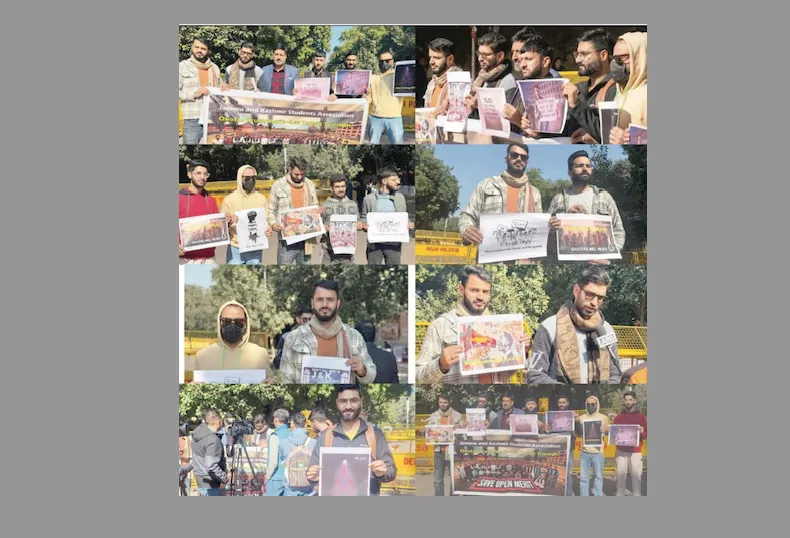






The quiet halls of the Jammu and Kashmir Services Selection Board (JKSSB) and the Jammu and Kashmir Public Service Commission (JKPSC) are currently the scene of a profound social tragedy. The young people of the Union Territory, and especially those from the General Category, are now presented with a calculated, data-driven despair instead of the dream of a government job, their primary social mobility engine for a long time in this region. Following the controversial reservation amendments of 2024, Jammu and Kashmir has developed a recruitment system where merit is a liability, and the “Open Merit” status has been transformed into a structural glass ceiling.
The Math of Despair
To realise the magnitude of this systematic exclusion, one must go beyond the political arguments and the cold numbers of recent recruitment advertisements. During the last eighteen months, which ended on December 31, 2025, a large number of notifications were issued by JKSSB, which can be considered as an empirical map of this displacement. A detailed study of the sixteen major notifications of JKSSB discloses an astonishing fact: only 4,136 out of the total 10,248 posts were earmarked for Open Merit (OM). This might seem approximately 40% in terms of figures; however, the “Open Merit” category in J&K is not a protected category, but rather a strained area where the General Category, which comprises around 60 to 70% of the population, is being forced into non-existence.
The largest recruitment drives of 2024 and 2025 illustrate this institutionalised shrinkage perfectly. In the July 2024 advertisement for 4,002 Police Constables, only 1,600 seats were available for Open Merit. This 40% share was then subjected to a secondary “horizontal” erosion. Under S.O. 288 and S.O. 339, 15% is earmarked for women, 6% for ex-servicemen, and further percentages for Special Police Officers (SPOs) and Volunteer Home Guards (VHGs). When these horizontal slices are carved out of the already thin OM slice, the “pure” competitive window for a non-category aspirant, the demographic majority of the Valley, dwindles to a dismal 25-28%.
The late 2025 period saw a hectic “end-of-year rush”, which created an even stronger wave for this trend. The recruitment agencies posted 3,600 job openings, comprising Finance Accounts Assistants, as well as various Constable ranks in the home department, all under the Controversial reservation rule, from November 24 until the very last minute of December 31, 2025. This rush coincided precisely with the Jammu and Kashmir Cabinet reportedly working on a new policy that would bring back a more equitable Open Merit ratio. By pushing these advertisements through just before the Lieutenant Governor’s final approval, the state has effectively barred the General Category from accessing these thousands of jobs for several years or even decades. Even the posts that are purely technical and administrative, like the 75 Naib Tehsildar posts (just 30 for OM) and the 508 posts in PWD and Jal Shakti (only 203 for OM), are being subjected to this inflexible 40% cap, ensuring that merit is compromised across all sectors of governance.
J&K vs. The Centre
The “dismal picture” gets even worse when the Union Territory of Jammu and Kashmir’s structure is compared with that of the Central Government in terms of standard setting. At the central level, the reservation policy, grounded in the Indra Sawhney (1992) ruling and the subsequent 103rd Amendment, maintains a balance where the Unreserved population (comprising around 20-25% of India’s population) competes for approximately 40.5% of the seats. This results in a Population-to-Opportunity Ratio of 1:1.6, which allows for a comprehensive range of merit-based competition. According to the 2011 Census, nearly 70% of the population (including Ladakh) in Jammu & Kashmir belongs to the General Category, yet they are legally confined to a competitive space of only 30-40%.
The administrative management of the 4% reservation share allocated to the ST category in the Ladakh region was also a contributing factor to this decline. After the reorganisation, the 4%, which should have logically been returned to the Open Merit pool to reflect the demographic change of the UT, was instead moved to and added to other reserved categories. This was a calculated decision to keep the Open Merit floor low. No other state in India with a population of 70% would not expect a corresponding share of the open pool. In Jammu and Kashmir, for every 100 General Category aspirants, there are only 43 notional seats, which are the seats they would have to share with the high-scoring reserved category candidates who “migrate” to the open pool. This “merit infiltration” results in the General Category having no exclusive space, while the reserved categories have exclusive access to 60-70% of the pie, plus the right to occupy Open Merit. We are not asking for a favour; we want to have equal opportunities in proportion to our population size.
The Geography of Disempowerment and the EWS Mirage
The exclusion is not just a social occurrence; it is a geographic tool. The data revealed during the 2025 Legislative Assembly session, as a result of MLA Sajad Gani Lone’s inquiry, provides the “smoking gun” for the unevenness between regions. Over the course of the first nine months of 2025, the issuance of 215,863 category certificates took place in the Union Territory. The division by region is shocking: the Jammu division received 71.8% (155,072) of the certificates, while the Kashmir division received only 28.2% (60,791) of them.
Since Kashmir mainly consists of the General Category and does not have a Scheduled Caste status (which is assigned to certain religions as per the 1956 Order), the young people of the Valley are compelled to enter the Open Merit pool, which is very competitive. On the other hand, the Jammu division, which is the major supplier of SC, ST, and ALC/IB certificates, occupies nearly all of the reserved 60-70% of the job market. By continuing with a centralised recruitment model and not restoring District and Divisional recruitment, the state allows candidates with category certificates from one division to take a limited share of the “Open” category in another. The 40% Open Merit is, in fact, a second quota for the reserved classes of the Jammu region, causing the Kashmiri general aspirant to be a disenfranchised majority.
The situation in the Valley is very desperate, even for those who want to take advantage of the Economically Weaker Section (EWS) quota. The stringent “Asset Criteria” has caused extremely high rejection rates for EWS certificates in Kashmir. The rule of having only 1,000 sq. ft. for residential purposes does not apply to the Valley, which has high-density ancestral housing structures, where families may be economically poor but, in a technical sense, own “assets” that are larger than the limit. As a result, they are caught in a “blind spot.” They are too poor to survive without support, but at the same time, they are too “propertied” to be eligible for anything more than the 30% Open Merit quota.
Conclusion: The Institutionalised Exodus
The numbers speak for themselves. A situation where 70% of the population is legally confined to a corner that constitutes only 30% is definitely not a case of social justice; rather, it is a “Math of Despair.” The systematic exclusion of the General Category in Jammu and Kashmir is driving doctors, engineers, and scholars, whose numbers constitute a whole generation, to seek their livelihoods outside the Union Territory. By rushing recruitments under a lopsided ratio in late 2025, the administration has signalled that merit is a secondary concern to demographic engineering.
A society that penalises its brightest minds because they lack a “category” certificate is a society destined for a massive brain drain. The Jammu and Kashmir government will be judged as the one that has allowed the institutionalisation of the exodus of the best citizens, in the case it does not promptly re-establish a balanced Open Merit floor corresponding to the population. It does not revive District/Divisional recruitment as a means to protect local talent. For the General Category youth of 2026, the message is clear: the system isn’t broken; it was constructed this way to keep you out.
Shabir Ahmad Bhat, Research Scholar Political Science, KU.