

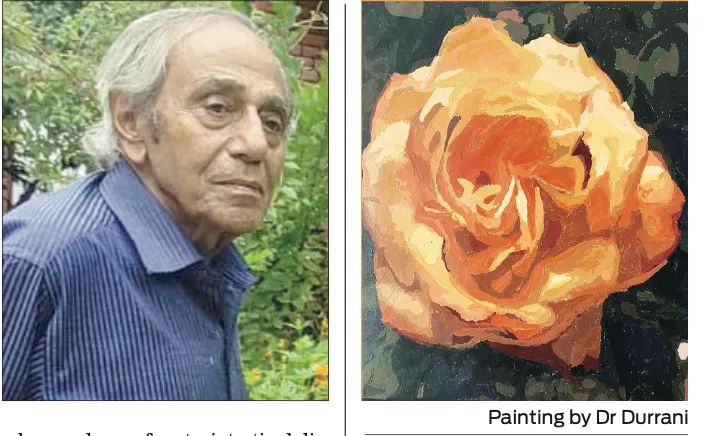






As a student of Government Medical College, Srinagar in the turbulent 90’s, I witnessed its struggle and survival amid chaos and trauma. The college was held together by a bunch of brave men and women who worked in difficult situations and kept the candle of medical education burning in Kashmir. I remember Dr. Hamid Ali Durrani as one such professor who stood firm in those troubling times, doing what he loved the most- teaching medicine and treating patients. I have a vivid memory of his clinical classes in one of the rooms adjacent to the cardiology ward of SMHS hospital where he would sit with poise and charm and we all would stand around him in an arc- all aware, awake and attentive. He would listen to us, correct us, teach us about history taking and clinical examination. Soft and serene, polite and focused-his clinical class had an aura of its own. It was wholesome, informative and interesting.
Fate had brought Dr. Durrani to Kashmir for service that would be remembered by generations of his students and his ever-thankful patients. Born in Ballia, UP on March 7th, 1934, to Mr. Nadir Ali Khan Durrani and Hamida Begum, Dr. Durrani studied at Lucknow Christian College. He was a bright alumnus of the prestigious King George Medical College (KGMC) Lucknow where he completed his MBBS and MD Medicine. He met his future wife, Dr. Masarat-a Kashmiri medico pursuing medicine at KGMC and after marriage, shifted to Kashmir. He joined GMC Srinagar in 1966 as an Assistant Professor of Medicine and continued to work there till his retirement in 1992 as a professor.
The field of medicine in this part of the world is seen as tough and is known to mask talent, suppress creativity, as doctors are surrounded by pain and agony of others. There is hardly any time to discover one’s own talent. However, to the overburdened lives of medical students, Dr. Durrani brought with him an era of entertainment, excitement and plenty of extracurricular activities. Dr. Durrani gave the students a handy platform to exhibit their talent in diverse fields. He was instrumental in establishing CASS union (Cultural Academic Sports and Social union). He had an excellent chemistry with students, gelled well with them, acting as a vital link between students and the administration. He would talk, listen, understand and sort out the problems confronting the students. Those who have worked with him would call Dr. Durrani as soft spoken, cultured and a well-dressed gentleman.
Dr. Durrani was an ace clinician credited with starting separate Gastroenterology services in SMHS hospital. He could foresee that medicine at SMHS needed diversification. To tackle a huge volume of gastrointestinal diseases in the valley Dr. Durrani conceived advanced Gastroenterological services at SMHS hospital. He received advanced training in Gastroenterology from the US and a fellowship in Gastroenterology from Canada. He successfully organized a National conference in Gastroenterology in 1983 at GMC Srinagar bringing experts from all over India to Kashmir. Prof. Showkat Zargar, the eminent Gastroenterologist of the valley and former Director of SKIMS, calls Dr. Durrani a great star of Medical College Srinagar. He credits Dr. Durrani with starting Gastroenterology at SMHS and performing the first endoscopy there,he inspired generations of doctors to pursue this branch as a superspeciality. He also credits him for starting the GUT CLUB of Kashmir. Many other prominent clinicians have called him the ‘Father of Gastroenterology in Kashmir’.
Dr. Durrani spent his post-retirement life nourishing his own hidden talents. He wrote poetry in chaste Lucknowi Urdu, drew sketches, took to watercolor painting and spent his leisure hours in fruitful and engaging pursuits. As I contacted him for his profile for my book ‘Warriors and Falcons’, he sent his handwritten profile, plenty of excellent photographs, many of his paintings and his self-composed couplets. His imagination at an age when most people of his age go into hibernation was incredible. The photos and paintings were so impressive that I incorporated many of them into my book after his due permission.
He was in love with Kashmir, its people, its beauty and its flowers. He would adore his garden with beautiful flowers, capture them in his camera, draw their sketches, paint them and their intricate details and never forget to share them with his friends and dear ones. His paintings carry a deep meaning and soul-stirring messages, many of them drawn during Covid time when he had a lot of spare time.
Deeply immersed in Urdu poetry, Dr. Durrani carried within him the ghazals of Ghalib, the nazms of Faiz, and the soul-deep verses of Mir, many of which he had memorized. His love for poetry came alive as he recited nazms and ghazals in his deep, soulful voice, recordings of which he shared on Facebook.
Dr. Durrani was a sensitive soul-deeply connected to Kashmir. According to Prof.Showkat Zargar, he would go to Lucknow in winters to escape the cold of Kashmir and to be with his loved ones,but he did not go this year perhaps he had the intution that he might not survive this winter.He wanted to be laid to rest alongside his wife and did not thus move away from Kashmir. When Dr. Durrani was asked why he prefers living here even when most of his relations were settled elsewhere, he would promptly say-“UP is my birthplace but Kashmir is my home”. This sensitive soul would fondly remember his friends and colleagues with whom he had spent a greater part of his life. I reproduce a message he sent to me when he had stopped by the residence of his dear friend Dr. Syed long after he had left this world. In that emotional upheaval, he remembered Ghalib and he wrote this,
“Passed along Dr. Mohammad Syed Sahab’s home-Taskeen, just these two stanzas of a poem came to my mind;
Taskeen ko ham na roein jo zoaqe nazar miley,
Mairey patey sey ghair ko kyoun tera ghar miley.
Dr. Durrani has been an impactful figure on the map of medical history of Kashmir. His contributions to healthcare and medical education are herculean. But what defines him the most is his love for Kashmir and his drive to do purposeful work even at the dusk of his life. His students, colleagues and patients will miss him and so will many of us whose lives he touched …This Deedavar came from a faraway land to inspire us.
Dr Rumana Makhdoomi,
Professor, Dept of Pathology, SKIMS, Srinagar, J&K.