

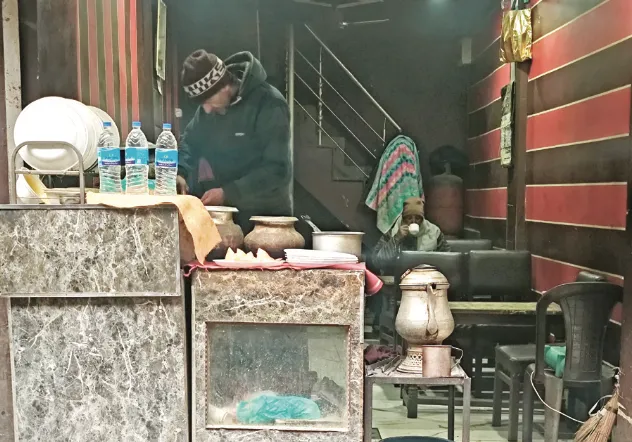






Baramulla, Dec 21: As winter tightens its grip over Kashmir, a narrow stretch in Baramulla’s historic Urdu Bazar quietly comes alive with warmth, aroma, and memory.
Known locally as Noon Chai Street, this unassuming lane has for decades remained the pilgrimage site for devotees of Kashmir’s iconic pink salt tea—a brew that carries within it centuries of tradition, trade routes, and the simple comfort of ritual.
For 70-year-old Haji Abdul Rashid, the street is more than just a tea stop. It is a ritual. Visiting Baramulla town from his native village, Sheeri, Rashid rarely misses an opportunity to pause here, even on the coldest mornings.
“This place never disappoints,” he says, gently warming his hands around a cup of steaming salt tea. “When someone wants to drink authentic Noon Chai, this is where they come. The tea served in a traditional samovar has its own taste—nothing compares.”
Noon Chai, Kashmir’s famed pink salt tea, is believed to have travelled into the Valley centuries ago via the Silk Route from Central Asia. Over generations, Kashmiris adapted the brew, adding local milk, salt, and bicarbonate of soda to create its distinctive rose hue, creamy texture, and robust, slightly savoury flavour.
The magic lies in the method: traditionally prepared and repeatedly boiled in a samovar, the tea is considered best when brewed slowly, allowing time to work its alchemy on the leaves.
The Urdu Bazar area, where several small eateries continue this time-honoured tradition, carries echoes of Baramulla’s bustling past. Some octogenarians recall that the street was active even before the 1947 Partition, when Baramulla served as a major trading hub connecting Kashmir to markets beyond. “This used to be a storage and transit point for goods arriving by river from across the border,” recalls Ghulam Rasool, a resident of Old Town Baramulla, his voice carrying the weight of lived history. “Traders and labourers would stop here, and tea sellers opened small shops to serve them salt tea. That tradition never faded—it only deepened.”
Amongst the most familiar names on the street is a modest tea shop founded nearly six decades ago by Abdul Aziz. Though Aziz passed away years ago, his legacy continues through his son, Rafiq, who now runs the establishment with the same quiet dedication.
“My father started this shop about 60 years back,” Rafiq says, stirring a pot that has witnessed generations pass through its doors. “We still serve traditional Noon Chai along with Kashmiri breads like chochwor and bakirkhani. Nothing has changed in the way we prepare it—not the recipe, not the method, not even the samovar.”
Despite shifting food habits and the growing popularity of modern cafés serving cappuccinos and cold brews, Rafiq insists the charm of Noon Chai remains undiminished. If anything, he says, it has gained new admirers.
“From locals to tourists, anyone fond of salt tea comes here,” he explains. “People may eat wazwan or any other elaborate meal elsewhere, but when it comes to salt tea, they return to this street. It’s not about convenience—it’s about authenticity.”
Regular visitors say the authenticity lies not just in the ingredients, but in the intangible qualities that only tradition can impart. The way the tea is poured from the samovar’s brass spout. The weight of the cup in your hands. The unhurried pace with which it’s consumed, often accompanied by animated conversation or comfortable silence.
For Rashid and countless others like him, Noon Chai Street represents something increasingly rare in modern Kashmir—a place where time moves differently, where the old ways are not merely preserved but lived daily, and where a simple cup of pink tea becomes a connection to something larger: history, community, and the enduring rhythms of a culture that knows the value of slowing down.