

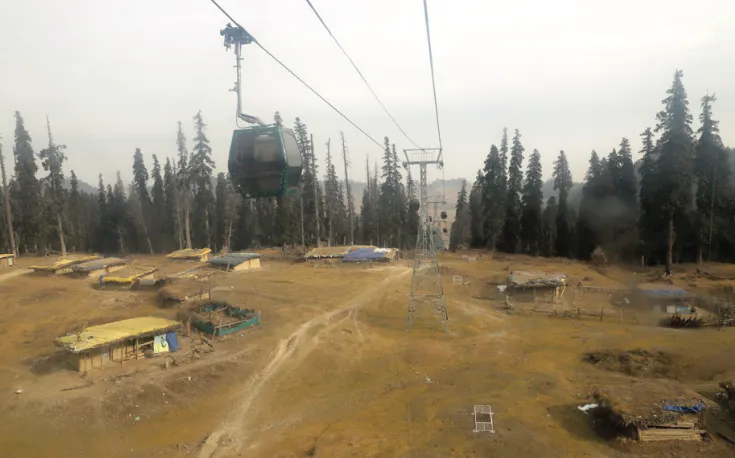






There is an environmental emergency in Jammu and Kashmir which the newly elected UT government is apparently not noticing, despite repeated red flagging by experts, activists, columnists and NGOs. Inexplicably, we don’t hear the CM or any of his ministerial colleagues saying anything consequential on the subject.
What does environmental emergency mean to us in Jammu and Kashmir?
Glaciers, the main source of our water in rivers and streams are fast retreating and it is estimated that if these continue to melt at the current rate, they will lose about 75 % of their size by the end of this century. So, in seventy five years or earlier we in Jammu and Kashmir will be almost totally dependent on rainfall which for Kashmir does not come from the annual monsoon unlike rest of India, thereby making Kashmir a potential drought prone and water crisis ridden land. Imagine a scenario when there will be just one fourth of water in Lidder, Sindh, Jhelum in comparison to the present till rains augment the flow. Imagine the impact of extreme and chronic water shortages for a population of 15 to 20 million. Glacial retreat is no doubt partly due to global warming and reduced precipitation as snow during winter, but reasons for faster retreat are also to be found in the local factors like human interference, annual yatras moving close to glaciers, fossil fuel burning, vehicular emissions and all other activities causing rise in average temperatures across Jammu and Kashmir.
Hundreds of springs, large and small, have depleted and gone dry in Jammu and Kashmir over the last fifty to sixty years. Major causes include deficient precipitation, silting and lack of maintenance by the local communities. Many of these lost springs can be revived by restoration of their aquifers, removal of silt and better maintenance by the concerned panchayats and municipalities but nothing is being done because there is no direction to them regarding revival or to spend for the effort. Facilitating rain and snow to be absorbed around the springs to charge the aquifers is the way to go about. Experts may have other suggestions for revival based on local topography and soil structure.
Agriculture land is fast disappearing under residential houses and commercial buildings. Thousands of kanals of agriculture land is lost to construction every year. There is no policy or direction to halt this trend. Large scale conversion of agriculture land for non-agriculture purposes has implications not only for food production and farm income but also for the ecology which may give rise to health related challenges. Kashmir valley is fast transforming into an ugly ‘concrete jungle’. No alternate housing solutions are being provided nor is the sector being regulated to any noticeable level. SKUAST Kashmir recently issued a warning against raising constructions on wetlands and against ‘unplanned urbanization’ resulting in loss of what were once ‘natural sponges for flood regulation’. Wetlands in Kashmir are generally in a state of decline including the ones recognized under Ramsar convention.
Forests have long been forgotten. There is no visible program or effort, at least not in public domain, to rejuvenate degraded forests. The department is drawing satisfaction from the fact that illegal felling of trees for timber and firewood by people living near forests has reduced substantially in recent times and therefore forests are regenerating on their own. But, it is also a fact that large tracts of forest areas are being given away for construction of roads and other government projects without any credible environment impact assessment (EIA) and without any questions asked when it comes to projects and works for security and security forces. Forest protection law was amended in 2023 to exempt security related infrastructure from any prior clearance when using forest land or felling trees for the purpose.
Another important indicator of overall environmental deterioration (health related) are the rising pollution levels in almost all urban areas including Srinagar city. Recent reports about dangerous levels of air quality index (AQI) have drawn no official explanation so far from the higher levels in the UT government. One of the reasons often cited by growers for poor saffron yield in Pampore bowl is the cement dust from the many privately owned cement factories operating in nearby Khrew and Khonmoh areas. This industrial activity also seems to be going on without much regulation.
Condition of Wular, Manasbal and Anchar lakes has to be seen to be believed. No encouraging announcement has come so far from the elected UT government about these dying water bodies which were once upon a time the pride of Kashmir, Wular as the largest fresh water lake in Asia. Some of us went to assess the condition of Wular lake last year as part of the delegation from the Group of Concerned Citizens (GCC) only to feel extremely worried about its survival. Dal and other lakes in Srinagar city also need great expert care and handling, de-weeding, cleaning and anti-encroachment vigil. J&K Lakes conservation and management authority (LCMA) of the UT government seems to be inadequately equipped and funded to undertake the task for all the lakes in Srinagar city. Condition of Jhelum, its tributaries and the well known kuls in Srinagar city is pathetic.
The irrigation and Flood control department is often seen to be largely unaware of its responsibilities towards the protection, conservation, desilting and cleaning of the water bodies under its charge.. Their funds are earmarked and often deficient. So, when enquired why trash barriers have not been installed freely on Jhelum and its tributaries to catch the solid trash floating in the river, no proper explanation is forthcoming. One is not sure about the quality of drinking water being supplied by the concerned department but hopefully necessary measures are taken to ensure supply of acceptable quality.
Why is the UT government not visibly active on the environmental front?
The reasons for the relative silence of the UT government at the highest levels could be lack of political and administrative will to tackle environment related challenges, although the challenges relate to the future of Jammu and Kashmir and in particular Kashmir as a tourist hub required to retain its natural beauty, salubrious climate, clean air and water. Agriculture including horticulture and allied activities depend entirely on the agro-climatic conditions as have existed in Jammu and Kashmir for centuries and therefore any change in these conditions due to uncontrolled environmental degradation (man made) will wreak havoc to the life and economy of the inhabitants of Jammu and Kashmir. Surprisingly, the UT government is showing little inclination to promise big action on agriculture, horticulture, handicrafts, handlooms and small scale industry although this is where the core competencies of Jammu and Kashmir lie. Promoting tourism in Jammu and Kashmir without protecting its natural resources and environment is like putting the cart before the horse.
It’s still not late for the UT government to pursue strong environment action (ESG)
ESG (Environmental, Social, Governance) model of governance relates to environmentally sustainable development with focus on larger social good, maximum good for maximum people and ethical, clean and transparent governance. This is what the J&K’s UT government needs to do, adopt ESG model of governance. In respect of big development projects, whether central or UT, environment impact assessment (EIA) and stake holder consultation must be the first pre-execution test to be cleared before the start of execution. A strong political will to protect Jammu and Kashmir’s natural resources and beauty is the sine qua non for any representative government in Jammu and Kashmir to its claim to be there for the good of the people and worthy of their support. Otherwise, questions will always be asked.
As part of ESG, the UT government needs to have a water tight climate action plan, UT level targets under the ‘nationally determined contributions’ (NDCs) as committed to the last Conference of Parties (COP), an action plan under ‘life style for environment’ (LIFE), solid waste management plan including for municipal waste, e-waste and hospital waste and plastic action plan including implementation of ban on single use plastics. All these have to be part of the environment protection and environment action discussed in the previous paras. A high level committee under the chairmanship of the chief Secretary is needed to be constituted to oversee and monitor the implementation of the environment protection and environment action spanning all departments that have substantial development or regulatory work to do, and environmental consequences of their work. CM’s commitment to ESG, environment protection and action and periodic monitoring by him is critical to ensuring effective and people centric governance in Jammu and Kashmir.
Khurshid Ahmed Ganai is a retired IAS officer of the erstwhile J&K cadre and a former Advisor to the Governor, J&K