

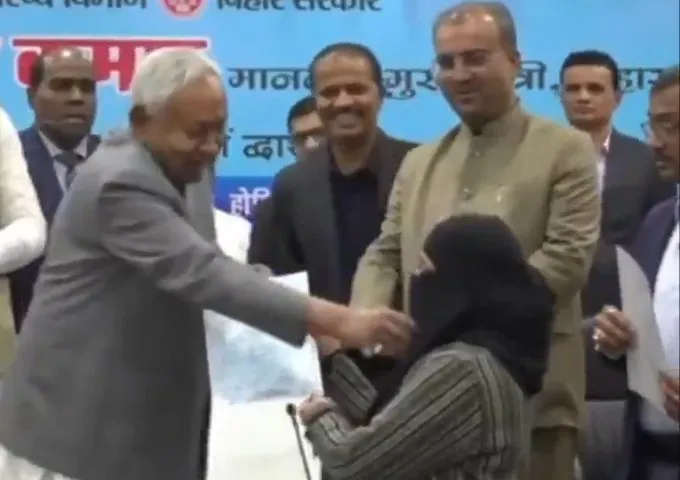






On 15 December 2025, during an official appointment ceremony at the Bihar secretariat, a moment unfolded that deserves to be read not as an awkward lapse but as a political symptom. A video circulated widely showing Chief Minister Nitish Kumar publicly interfering with the hijab worn by Dr Nusrat Parveen, a young doctor receiving her appointment letter. As cameras recorded the scene and officials looked on, a Muslim woman’s bodily autonomy and religious self-presentation were treated as objects of inspection and correction by the state’s highest elected authority. What was enacted was not governance but spectacle: a small, cruel performance staged to remind its audience who may be humiliated with impunity.
The episode matters less for its choreography than for what it reveals about the moral economy of contemporary Indian politics. Public humiliation—once the by-product of communal violence or bureaucratic indifference—has increasingly become a leadership technique in its own right. The aim is not persuasion but degradation: the conversion of vulnerability into visibility, and visibility into warning.
Power, not accident
To explain the Patna incident as senility, misjudgement or cultural misunderstanding is to misrecognise the nature of political power. Power is most clearly exercised not when it governs neutrally, but when it marks bodies as available for correction. Kumar’s gesture toward the hijab, accompanied by the question ‘What is this?’, was not an inquiry but a declaration: that Muslim difference remains permanently provisional, always subject to the majority’s approval.
Political philosophy offers little ambiguity here. From Aristotle’s insistence that public office requires ethical restraint to Kant’s injunction never to treat persons merely as means, leadership has long been understood as a moral practice before it is a technical one. Modern democratic theory sharpens the obligation further: leaders wield not only institutional authority but symbolic power, shaping what forms of conduct are thinkable, permissible and repeatable.
Measured against even minimal standards of ethical leadership, Kumar’s conduct fails. It contradicts the constitutional promise of equal citizenship, runs counter to the spirit of religious freedom, and violates the expectation—fundamental to any democracy—that the state will not treat its citizens’ bodies as sites of demonstration. Yet the deeper violation lies elsewhere: in the casual ease with which humiliation was enacted, observed and absorbed.
A pattern, not an exception
The Patna episode sits within a longer and increasingly coherent pattern. The 2022 hijab controversy in Karnataka, where Muslim schoolgirls were excluded from classrooms and subjected to organised harassment, established a template: religious observance recoded as defiance, exclusion justified as neutrality, humiliation reframed as discipline. Courts equivocated, administrations complied, and hundreds of girls quietly withdrew from education rather than submit.
Digital spaces have extended the same logic. The ‘Sulli Deals’ and ‘Bulli Bai’ applications, which circulated photographs of Muslim women for mock auctions, translated older fantasies of domination into technological form. Though arrests followed, the episode confirmed how easily Muslim women’s dignity could be converted into a public resource for amusement and intimidation.
These moments do not require equivalence with the mass violence of earlier decades to be politically significant. What distinguishes the present is not the scale of brutality but its routinisation. Humiliation has migrated from the riot to the ceremony, from the mob to the ministry.
Leadership by contempt
Senior political figures have increasingly normalised dehumanising language about Muslims, describing them as demographic threats, cultural infiltrators or conditional citizens. Such rhetoric does not merely reflect prejudice; it performs instruction. Social learning theory reminds us that when leaders model behaviour, it cascades downward, shaping the conduct of institutions and individuals alike.
When a chief minister can publicly interfere with a Muslim woman’s attire without immediate consequence, a message is transmitted far beyond the hall in Patna. It tells police officers, administrators and street-level officials that differential treatment is acceptable; that Muslim dignity is negotiable; that correction may masquerade as concern. This is leadership by example, but the example is contempt.
The response of the surrounding ecosystem only reinforces the point. Ministers laughed. Officials hesitated. The ceremony continued. Dr Parveen was briskly escorted away, her visibility extinguished as efficiently as it had been produced. Silence functioned as consent.
The politics of normalisation
The danger of such episodes lies not in outrage but in repetition. Each unpunished humiliation recalibrates the baseline of acceptable conduct. What would once have provoked institutional crisis becomes background noise. Data on rising hate speech and attacks on religious minorities suggest that this recalibration is already well underway, particularly during electoral cycles.
Opposition reactions that frame incidents like Patna as personal aberrations—questions of age, temperament or decorum—miss the point. This is not about individual pathology but about political design. Humiliation has proved electorally profitable, morally inexpensive and administratively survivable. That is why it persists.
Beyond apology
The question raised by the Patna incident is not whether Nitish Kumar owes an apology, though he does. It is whether a constitutional democracy can endure when its elected leaders treat degradation as a legitimate instrument of rule. When humiliation becomes policy by other means, citizenship itself is hollowed out.
To be a Muslim in contemporary India is increasingly to receive a conditional invitation: tolerated, scrutinised, correctable. The theatre of degradation relies on an audience trained not only to watch but to laugh, or at least to look away. Democracies rarely collapse in a single act; they erode through rehearsed indignities that teach citizens which injuries no longer count.
If there are no consequences—legal, political or moral—this theatre will continue its performances, expanding its cast while narrowing the meaning of equality. The bill will not be paid by its authors, but by the very idea of citizenship they claim to defend, motivational bromides notwithstanding.
Author’s Note
This essay interprets a publicly circulated video and places it within a broader political and ethical context. It does not claim to adjudicate legal guilt, nor does it rely on conjecture about private intent. The argument concerns public conduct, symbolic power and the responsibilities of elected office.
Descriptions of the Patna incident are framed deliberately in terms of interference and humiliation rather than legal characterisation, recognising that visual evidence can be contested while its political meaning remains clear. References to patterns of discrimination and rhetoric draw on widely documented public record, journalistic investigations and human rights reporting.
Criticism of political leaders is not an attack on voters, regions or religious communities. It is an insistence that democratic authority carries ethical obligations, and that violations of dignity—especially when normalised—deserve sustained scrutiny rather than episodic outrage.