

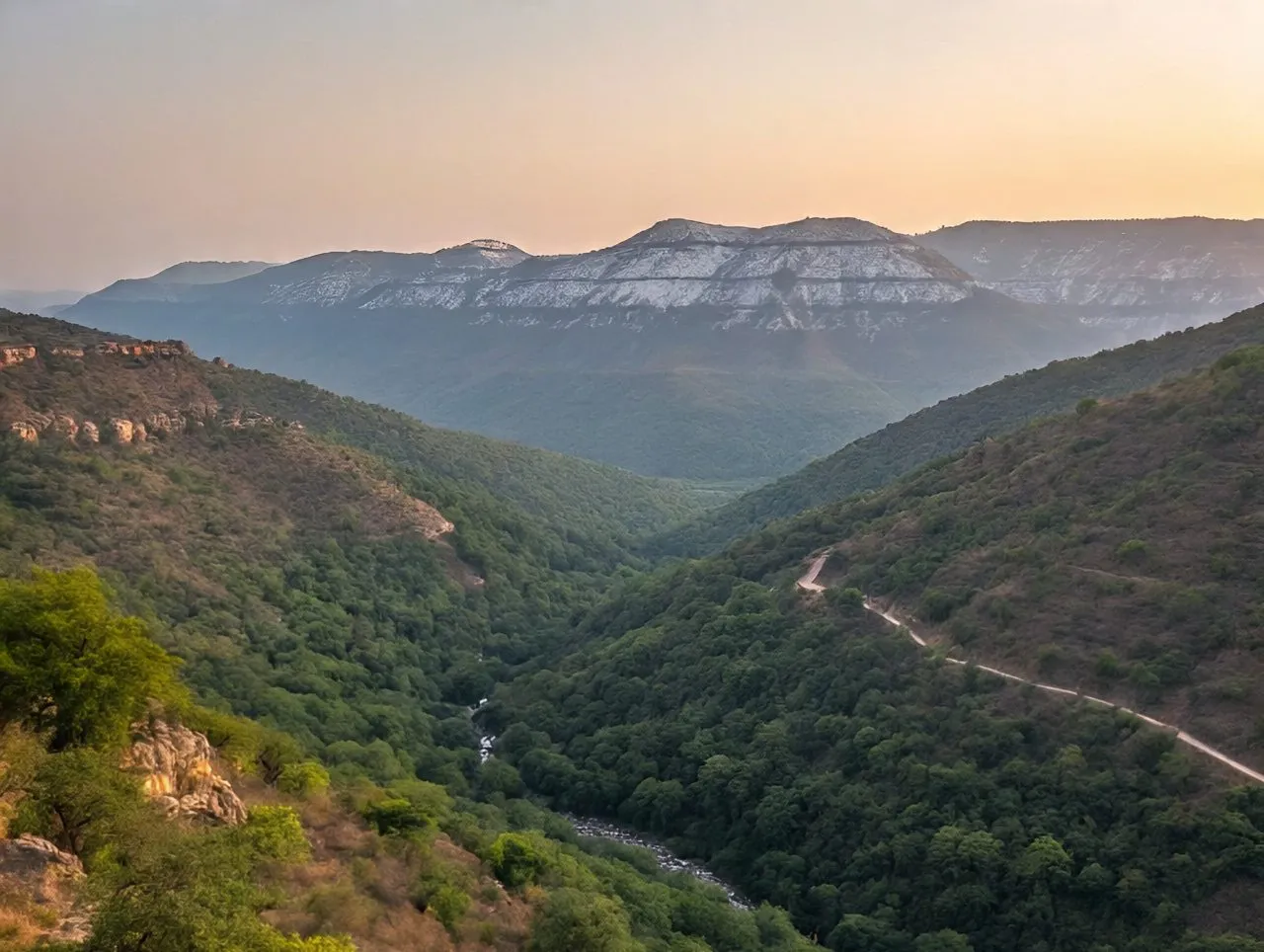






The Aravalli range is among the oldest geological formations on Earth, more than 1.5 billion-year-old. Stretching across Gujarat, Rajasthan, Haryana and the National Capital Region, these ancient hills have never been dramatic in height or appearance, yet their quiet presence has shaped the ecology, climate and human life of north-western India for millennia. Aravallis are not merely hills, they are an ecological system that moderates climate, stores water, anchors soil and supports biodiversity in one of the most fragile landscapes of the subcontinent. Over time, natural erosion has reduced their height, transforming what were once tall mountains into low ridges, hillocks and undulating plateaus. Unlike younger mountain ranges, the strength of these hills lies not in towering peaks but in continuity a network of connected landforms that work together to slow desert expansion, regulate groundwater recharge and stabilise regional climate patterns. Historically, these hills protected settlements, guided trade routes and sustained agriculture in regions where water scarcity would otherwise have made large-scale habitation difficult.
In recent years, increasing pressure on land and minerals has brought the Aravallis into legal and administrative focus. For decades, the absence of a uniform and scientific definition of what constitutes the Aravalli hills created ambiguity in governance. Different states interpreted the term differently, relying on varying revenue records, outdated maps and inconsistent classifications. This lack of clarity often complicated regulation, enforcement and judicial oversight, particularly in matters related to mining and land use. The Supreme Court’s recent decision to adopt a scientific criterion based on a minimum of 100 metres of elevation above local ground level must be viewed against this background. The intent of the ruling is to introduce consistency, objectivity and enforceability into environmental regulation. By relying on measurable parameters, the Court has sought to remove long-standing uncertainty and ensure that decisions are grounded in data rather than discretion. Such judicial clarity is essential in a system where overlapping laws and administrative interpretations have frequently weakened environmental protection. At the same time, the ecological concerns expressed by environmentalists, scientists and local communities arise not from opposition to science or the authority of the Court, but from the unique nature of the Aravallis themselves. These hills do not function ecologically in isolation. Many low-lying ridges, seasonal stream beds, forested slopes and shallow catchment areas may not meet a strict elevation threshold, yet they perform essential environmental functions. In semi-arid regions, even modest landforms can influence groundwater recharge, rainfall absorption and soil stability.
One of the most critical roles of the Aravallis is in sustaining groundwater systems. Rainwater that falls on these hills slowly percolates through fractured rock and soil layers, replenishing aquifers that supply water to towns, villages and cities across Rajasthan, Haryana and the NCR. Disruption of these recharge zones, even on a limited scale, can have long-term consequences for water availability. Similarly, the vegetation cover supported by these hills reduces surface runoff, prevents erosion and limits the frequency of dust storms that increasingly affect northern India. They also serve as a natural barrier against desertification. Their forests and scrublands stabilise soil and slow the eastward movement of desert conditions. Over decades, scientific studies have linked degradation of these hills to rising temperatures, declining soil fertility and more extreme weather patterns. These changes often occur gradually, making them easy to overlook until they reach a critical point. This is why ecological caution tends to emphasise prevention rather than remediation.
It is important to recognise that the present debate is not about questioning the intentions of the judiciary or the government. Both have repeatedly affirmed their commitment to environmental protection and sustainable development. The concern is about ensuring that implementation reflects ecological realities as closely as it reflects legal clarity. Ecology operates on connectivity and function, not solely on height or slope, and environmental safeguards are most effective when they account for this complexity.
The current framework provides an opportunity for constructive evolution. Scientific mapping exercises associated with the ruling can incorporate additional ecological layers such as groundwater recharge zones, wildlife corridors, forest cover and catchment areas. Landscape-level planning, rather than site-specific classification alone, can help ensure that protection extends to the ecological systems that sustain the Aravallis as a whole. Local communities, who have lived alongside these hills for generations, also possess valuable knowledge about seasonal water flows, soil behaviour and vegetation patterns that can complement technical data.
Periodic review mechanisms can further strengthen the process. Environmental understanding evolves with new research, climate data and ground realities. Allowing space for refinement ensures that regulation remains responsive rather than rigid. At the same time, strict enforcement against illegal mining and unauthorised construction remains essential. Historically, unregulated activity has caused far greater ecological damage than carefully monitored and scientifically assessed use of resources. India’s development aspirations and environmental responsibilities are not mutually exclusive. Long-term economic stability depends on ecological resilience, particularly in water-stressed and climate-vulnerable regions. Protecting them is not only about preserving nature but about safeguarding livelihoods, agriculture and urban water security for millions of people.
India’s developmental needs are real, as are its environmental responsibilities. The challenge lies not in choosing one over the other, but in ensuring that growth does not erode the natural systems that sustain it. These hills remind us that ecological security is not an abstract ideal it is directly linked to water availability, climate resilience, and human well-being.
The Aravallis have endured geological epochs, climatic shifts and human civilisation itself. Their future now depends on how modern institutions interpret and protect landscapes that are subtle rather than spectacular. This moment calls for cooperation rather than confrontation a shared effort by courts, governments, scientists and citizens to ensure that clarity in law is matched by depth in environmental stewardship. If handled with care, the 100-metre rule can become not a point of ecological anxiety, but a foundation for stronger, more holistic environmental stewardship; one that honours both science and the silent wisdom of ancient hills. Present decision can strengthen, rather than weaken, the long-term protection of one of India’s most ancient and indispensable natural systems.
The Writer is a social activist and columnist working at the grassroots level to bridge public concern with policy action.