







In one of the largest democracies of the world-India – evaluating a year gone is not easy. When the state or the ruling dispensation takes upon itself to base political fortunes on these complexities through the nerve of emotions and sentiments, the evaluation becomes both complex and easier. Yes, it sounds dichotomous but it is a reality which has to be taken into account as one looks at the nation’s travel through 2025.
Easier because the conflicts become visible on the streets to the utter discomfiture of the nation. Complex, because it is difficult to evaluate its long term effects in easier terms.
What is the marker for such an evaluation in a bubbling democracy, but facing the ignominious onslaught on its basic fundamentals?
Primarily, and more importantly, it has to be the state of the social and political fabric on which hinge the parameters of economic and other successes. The societal pell-mell primarily fomented by the politics of conflicts – a mechanism being overtly and overbearingly pursued by the current dispensation, and to some extent by regional satraps of different hues.
The year 2025, as evaluated or reviewed in this backdrop, has certainly left a bad taste in the mouth. Despite the BJP failing to garner even simple majority in the 2024 Lok Sabha elections and heavily depending on allies to run the Union Government, it has not made any difference to its standing. Conflicts, controversies and confusions apart, both politics and society- Modi has remained to be the dominant figure.
Unfortunately, the year saw the constitutional institutions finding themselves further entrapped in controversies which are inimical to the national or public interest. And were definitely avoidable. There has always been a question mark on the autonomous functioning of these institutions with tendency of the successive Central governments to interfere and dominate their working. It was more pronounced in 2025 with Election Commission of India (ECI) taking the centre-stage.
After the 2024 Lok Sabha elections, the state elections remained the battlegrounds. The BJP won Delhi, Haryana, Maharashtra and Bihar assembly elections – as the year was about to fold – contrary to what political pundits, psephologists and independent observers had projected. This naturally drew sharper battle lines between the BJP and the opposition. Ever since, the charges have been flying thick and high alleging manipulation by the ruling BJP-led dispensation.
The hurried manner in which the Special Intensive Revision, popularly called SIR, of electoral rolls in Bihar to remove names of the voters, lock, stock and barrel followed by other states to remove what the BJP leaders have described as the “illegal immigrants or voters” from the voter lists, resulted in the political atmosphere getting more vitiated. It was more disturbing, not seen happening before so glaringly, to find authorities in some of these institutions openly taking a political stance. Rather than convincingly address the opposition allegations of voters-lists being “manipulated” to help the ruling party at the Centre, the poll panel demurred.
If Mr Modi emerged stronger after the 2014 poll setback, the year 2025 saw further decimation of the opposition unity. Not that it was on a stronger footing at the start of this year, but the conflicts and contradictions and leaders’ inflated egos further weakened the I.N.D.I.A bloc with total debacle in Bihar sounding like a death knell.
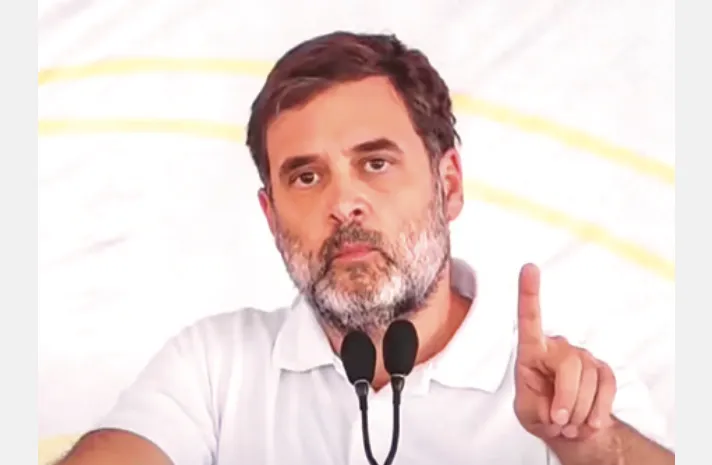
From the opposition point of view, it continued to be a solo show or fight by Leader of Opposition in Lok Sabha, Mr Rahul Gandhi. Neither could he achieve the opposition unity nor the cohesiveness within his own party structure. As a result, 2026 will start for him and the opposition on a very challenging note.
There was total absence, for reasons best known to them, of regional leaders and I.N.D.I.A partners such as Trinamool Congress chief, Ms Mamta Banerjee, Nationalist Congress Party (SCP-faction) supremo, Mr Sharad Pawar, DMK chief, Mr Stalin and other parties’ leaders from the opposition unity graph. A fractured opposition was what was left at the end of the year.
This was despite the fact that the Congress’s “Vote Chor, Gadi Shor” nationwide campaign led by Mr Gandhi which culminated in a successful rally at Delhi’s Ramlila Maidan, did manage to corner the ruling dispensation. It certainly saw the government and the BJP distressfully defending their poll victories in the states. This could become a good take-off point for the Congress and more so for Mr Gandhi in 2026 provided remedial measures are taken to strengthen the organization.
A highlight of the year 2025 was Operation Sindoor carried out by the Armed Forces against Pakistan in retaliation to Pak-backed terrorist attack in Pahalgam. The Operation turned out to be unconventional in the sense that it, for the first time, saw a sample of technological warfare coming into use rather than the past artillery and infantry dominated combats backed by air and sea warfare.
Yet another controversy involving the high Constitutional office of the Vice President was witnessed during the year. It was on account of unceremonious stepping down of the incumbent Mr Jagdeep Dhankar, who no doubt had courted controversies due to his conduct as Rajya Sabha Chairman and in some cases his public conduct which many alleged was political and partisan.
It was a bad and black chapter written in the democratic history of India in 2025. His sudden resignation from the high-post on “health reasons” combined with total silence of the Government till date, and his going into oblivion from the public gaze, to suddenly appear briefly before the year ended, made the issue look more mysterious.
Mr Dhankar was combative in Rajya Sabha which saw him frequently being pitted against the Opposition thereby ceding no ground to them. It led to the first-ever no-confidence motion having been brought against a Vice President. Expectedly the Opposition opposed him, the Government and the treasury benches unexpectedly left him in lurch. At the end it created an embarrassing situation for the nation resulting due to the high-handedness of the ruling dispensation.
With the spectre of no-confidence looming large and the government in no mood to defend him, it resulted in his resignation in a huff. Mr C P Radhakrishnan was elected his successor in September, with ruling National Democratic Alliance’s (NDA’s) numerical strength ensuring a smooth transition. While the resignation did not trigger institutional instability, it strongly reflected the growing friction between the executive, legislature, and Opposition within Parliament.
The author is a veteran journalist and a political analyst with over 40 years experience. He has worked with leading national and regional newspapers and currently is also a multi- media expert.