

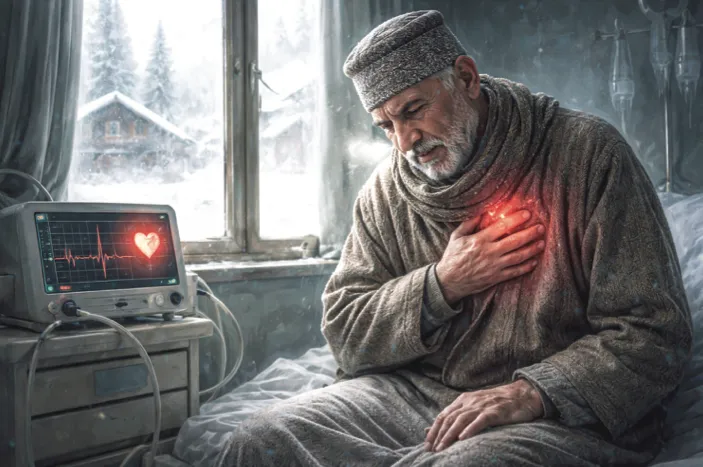






In our valley, endurance often passes for strength. Sometimes, it is simply the way we forget to ask for help.
Winter does not begin here with a single snowfall. It seeps in quietly, like fatigue at the end of a long day. One morning the tap hesitates before running; another, the latch burns your fingers. Breath stays in the air like unfinished speech. At dawn, smoke rises from hamam chimneys and hangs above the lanes in low ribbons. Houses seem awake before the people inside them. By the time the calendar approaches the twenty-first of December, our bodies have already surrendered—half willingly, half by habit.
From far away, winter looks cinematic. Snow lays its hand on everything—roofs, roads, even worry. Chimneys breathe evenly, and the valley appears calm. But inside that calm, everything slows. Doors resist as mornings stretch longer than they should. We wear the pheran indoors and outdoors; taking it off feels unnecessary, even insecure. The kangri sits beneath it, glowing against the chest, a mix of comfort and mild danger. Inside the body, blood thickens, vessels tighten, and the heart works harder without complaint. It has learned what we have learned—to keep going.
By the time people come to seek our consultation , winter has already taken residence inside them. Their hands are cold when they touch ours. Their faces carry a dull heaviness that rest no longer lifts. Blood pressure readings rise because of altered physiology, nonetheless , nobody looks surprised.
“Sorry to trouble you.”
“It’s nothing.”
“Just the cold.”
Here, pain rarely arrives loudly; it is softened before it is spoken. Worry is postponed—until the snow melts, until the road clears, until spring loosens the air. Even the heart is asked to wait its turn.
A man in his fifties came one morning wrapped in his pheran. He said he still climbed the stairs at home, though he now paused halfway—“just to take a breath.” He smiled, embarrassed, holding his kangri like a shield. His blood pressure was high.
“It’s only the weather,” he said. “Otherwise, I am fine.”
He wasn’t avoiding the truth. He was explaining it. But winter is never only weather.
Cold narrows blood vessels and arteries. Dark evenings keep people indoors. Meals turn heavier, water intake shrinks, and medicines are forgotten—not always by choice, but quietly, as routines dissolve. By January, the body adjusts to what it shouldn’t and calls it normal.
In textbooks, these changes are tidy: vasoconstriction—the narrowing of blood vessels—leads to increased blood pressure, compounded by inactivity. In real life, they appear as delay: a pain ignored because it fades, a visit postponed because the road might close, a walk skipped because warmth feels too good to leave. We are trained to endure, and very often that training saves us. But not infrequently, it costs too much.
I often think of one of my patients, Shafi Sahib, a retired teacher. For two weeks he felt pressure in his chest every morning but told himself it was smoke from the kangri. He didn’t want to worry his son, who worked far away. When I finally saw him, the heart attack had already occurred, damaging the fragile musculature of his heart.
He looked at me, calm and confused.
“But I was managing,” he said.
“Yes,” I told him. “You were. And so was your heart—until it couldn’t anymore.”
Winter does not break the heart suddenly. It works slowly, the way neglect does—step by step, one small delay at a time. A missed pill, a postponed appointment and a stretch of days without movement. Each reason sounds harmless on its own—together , they narrow the margin for recovery.
Inside the cath lab, arteries look the same in every season. But in winter, the stories that arrive with those arteries feel heavier—pain that lasted too long, damage that had time to deepen. Outside, snow lies untouched but inside another stillness forms—a heart that has been doing too much for too long. And still, there is something here to be proud of.
Our health system holds through winter. Hospitals stay lit even when power fails. Emergency rooms remain open when roads disappear. Our Cath labs and theatre warm before dawn, and ambulances crawl through snow where streets once were. Doctors, nurses, and technicians show up every day, often sleeping in hospital corridors because it is safer to stay than to drive home. They show up because hearts within bodies cannot wait for clear skies.
That quiet, unadvertised faith is what saves lives in the valley every winter. When patients finally come—late, frightened, apologetic—the door is still open. That is our victory.
We survive on small, stubborn habits and a sense of humour that outlasts bad weather. A patient once said, “Doctor, electricity came before the pain today—maybe the government is improving.” We both laughed. Sometimes a small laugh delays despair.
Medicine teaches numbers—blood pressure, heart rate, flow but winter teaches observation: the hesitation before a word, the tightening around the eyes, the silence of a house conserving heat. When cold settles into the mind, discipline falters—tables are skipped as routines blur. Nothing fails at once—it accumulates quietly, like snow on a roof you stop noticing.
So we remind people gently. Take your medicines even when you feel fine. Check your pressure without shame. Walk indoors if you cannot go outside. Drink water even when thirst does not announce itself. These are not signs of sickness but acts of care—small rituals, silent promises between body and will.
Then April arrives, light lengthens and the pheran loosens. The kangri cools and the Hamam stones rest. People step outdoors laughing, saying how they “survived another winter” and speak of endurance with pride.
But the heart—quiet, faithful—remembers every long night it worked harder than it should have, every signal dismissed as weather. The holy and sacred heart forgives, but it never forgets.
Winter will return— it always does. Snow will fall, indifferent to readiness. The question is not whether we can endure it again, but whether we can notice sooner, listen earlier, and take care—before the heart learns silence too well.
Dr Showkat Hussain Shah, Consultant interventional cardiologist, GMC Anantnag