







The history of my family is etched into the rugged geography of the old Silk Road. My great-grandfather, Haji Syed Ghulam Mohammad Gilani, was a man of immense stature—a political agent for the British government and a flourishing tradesman who carved out a life of fortune in the prosperous town of Yarkand. He passed away in 1949, just as the political landscape of China shifted forever.
His eldest son, my grandfather Haji Syed Ahmed Gilani, inherited the family’s business. However, as the new regime took hold, life became untenable for the Gilanis. My grandfather and his siblings were eventually deported toward the Kazakhstan border. It was a journey marked by tragedy; my grandfather’s younger brother, Syed Abdul Qadir—the Imam of the main Kashgar mosque—was killed by border troops for his defiance. In the terror of that exodus, my grandfather was forced to leave behind his wife and daughter, Tarsoun Niaz, who had gone into hiding to escape the reach of the soldiers.
The Vanishing World of the Yarkand Sarai.
While my grandfather and his another younger brother Syed Abdullah Gilani eventually settled in Amman Jordan and Rawalpindi, a piece of Yarkand remained alive in Srinagar. Near the Yarkand Sarai in Safa Kadal, the “Yarkandi” community formed a vibrant bridge between cultures.
I vividly remember Ab. Gani Yarkandi, a man famous across the city for his culinary craft. He specialized in breads that were entirely different from our traditional” kandrou” varieties like lavasas or girdas. During Ramadan and on the Eids, we would seek out his Muntoose—spiced, hand-chopped mutton dumplings that carried the authentic flavors of Central Asia. Today, that community has largely vanished; many have moved to Turkey or Azerbaijan, while those who stayed have melded so deeply into the Kashmiri fabric that their native tongue has been forgotten.
A Voice from the East
The silence between our divided family was finally broken in 1970 when a letter arrived at our home in Malaratta. It was from my aunt, Tarsoun Niaz. She had survived the chaos, moved to Beijing for her studies, and was working as a teacher.
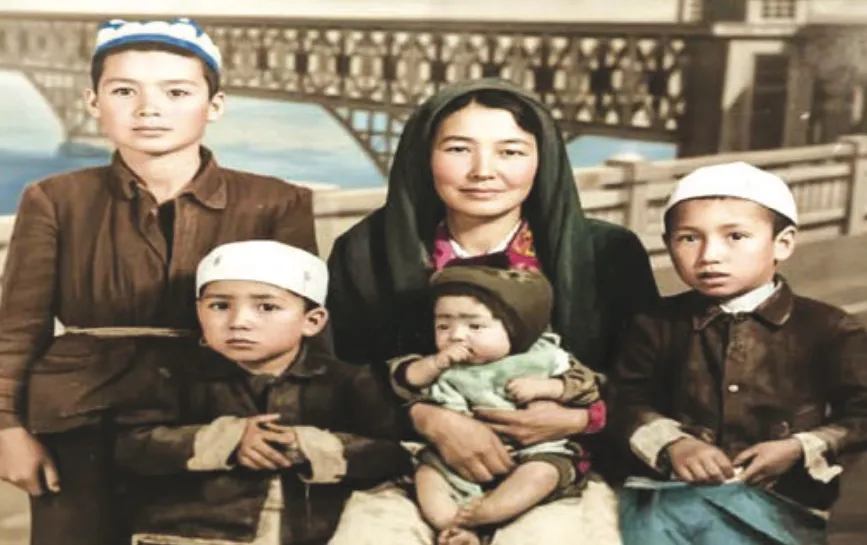
She sent a studio portrait of herself with her four sons and a daughter—a family frozen in time against a painted backdrop. The letter shared a “silver lining”: the government had briefly allowed them to reclaim their vast landed properties in Yarkand. Yet, this peace was fragile. As unrest grew in the region and the Uyghur people faced increasing oppression, the family was forced to retreat once more to Beijing.
A Decade of Silence
We tried for years to maintain this connection, but for more than a decade, there has been total silence. The digital tools that helped us finally translate her “crude” Turkistani script cannot reach across the current geopolitical void. As I look at the colorized photograph of my aunt and her children, I am reminded of the “Cross-Border Desire” that defined my grandfather’s life. I can only hope and pray that the family is safe, and that the long road from Srinagar to Yarkand might one day offer a final answer.
The writer is a former civil servant