

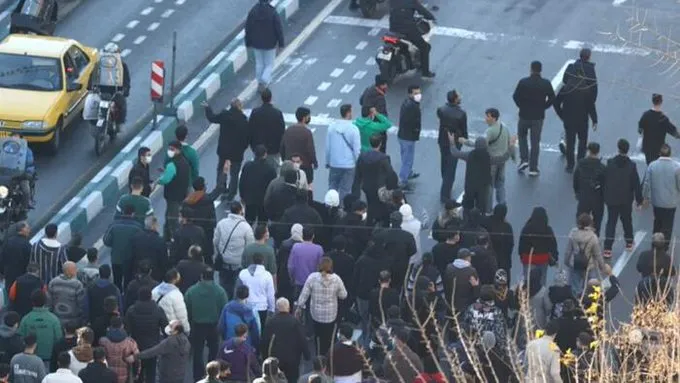






Iran is in the midst of growing protests against the government and the clerical leadership. They began on December 28 when traders in Tehran came on the streets because of the adverse economic situation which has impacted the currency and led to great inflation. Iran has multiple exchange rates which enables the regime to favour those it wants. However, ordinary traders have to get the currency in the open market and there it fell in the closing days of last year to all time low of 1.42 million Riyals to the US Dollar. This fall in currency value is making matters very difficult for the traders to do business. Inflation has reached over 40% with food inflation running at over 70%. This is also making life impossible for ordinary people. It is resulting in a loss of faith in the Iranian currency too. Consequently, even moderate value commercial transactions are taking place in gold or US Dollars. In these circumstances it is not surprising that the traders began protesting.
The protests spread to other parts of Iran and students and the youth are now joining them. Western media is reporting that these demonstrations are the most significant since the 2022 protests which occurred after a Kurdish girl died in custody. She had been arrested for not covering her head sufficiently. The 2022 demonstrations had become large scale but they were quelled by the regime with the use of force. On this occasion President Masoud Pezeshkian has called for talks between the government and the protestors so that their “legitimate demands” can be discussed by the government. However, Prosecutor-General Mohammed Mohavedi-Azad has threatened the demonstrators with a “decisive response” should the protestors seek to destabilise the country. Mohavedi-Azad’s warning can be considered to be a sign of the thinking of Supreme Leader Ayatollah Ali Khamemei. And, in Iran, it is Khamenei who has the last word.
Ever since Donald Trump assumed the Presidency for the second time in January last year, he has made no attempt to mask his continuing animus towards Iran. He would like nothing better than regime change there. He is not the only US President who has wanted this to take place. The US has pursued this aim since 1979 when ten months after the Khomeini revolution the Iranians stormed the US embassy in Tehran and took US diplomats hostage. They were kept in captivity for over four hundred days and were only released after the Presidency of Jimmy Carter had ended ignominiously because he was unable to secure the early release of the hostages. He also failed in his military attempt to secure their release. Iran became one of the main enemies of the US since then and the animosity has continued.
This sentiment was constantly fed by Israel too. It had enjoyed good ties with the Shah. However, the Islamic government showed implacable enmity towards the Jewish state. The Europeans and the rest of the world gradually accepted the clerical order in Iran but not the US. There was one issue, however, on which all the major powers were agreed. That related to reining in Iranian ambition to develop a nuclear weapon. On its part Iran has disavowed any ambition to have nuclear weapons. That did not deter the West, especially the US, from imposing sanctions on Iran.
In 2015 the US entered into a nuclear deal with Iran. The essence of the deal was Iran accepting for a period of ten years not to enrich uranium anywhere near nuclear grade and also to send its enriched uranium stocks abroad. In return US and international sanctions were to be lifted on Iran and its frozen assets would be gradually be given back to it. This deal was ratified by the major powers who joined it too. Trump tore up the deal and reimposed sanctions. He also bombed Iranian nuclear sites in June last year in the wake of Iran-Israel hostilities.
Khamenei became the Supreme Leader in 1989. He has held ultimate power ever since. He is now 86 years old. He has steered his country with the objective of maintaining the clerical order he inherited from the Islamic Revolution’s founder Ayatollah Khomeni. The premise of the revolution was that a ‘Rahbar’ should show the way not only on spiritual matters but should also hold ultimate temporal authority. This was contrary to traditional Islamic thinking, including those of the Shia clerics, who considered involvement in political matters may corrupt the clerical order. Hence, they thought that the role of the ‘Marjahs’ (those Ayatollah’s who are considered worthy of emulation) should be confined to the spiritual realm.
For forty-seven years Iran has followed the Khomeni system. It has been supported by the Revolutionary Guards who are its ultimate protectors. They have used force in the past to quell any real attempts to destabilise the system. Mohavedi-Azad has implicitly warned the protestors that the regime would be willing to use force now too. It remains to be seen if the present protestors who are driven by economic desperation will show greater staying power than their previous counterparts. Besides, presently there is no indication that the Revolutionary Guards are not as staunch supporters of the clerical system as their predecessors.
Khamanei is now 86. In a few years the Iranian system will have to consider appointing another Rahbar. That will be a crucial period for the clerical system. Till then unless an unexpected development occurs the present system should hold.