

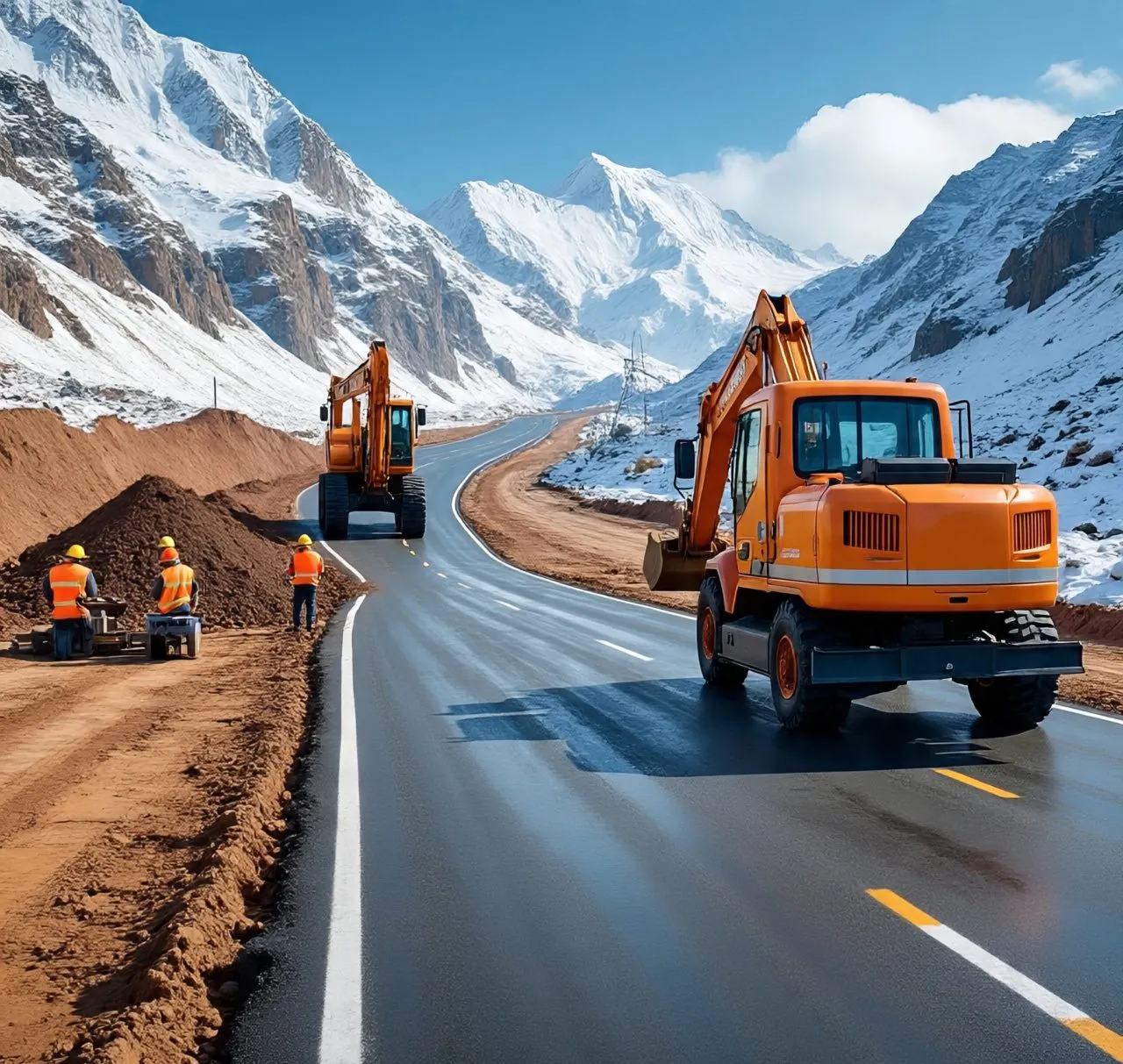






In Jammu and Kashmir, people often say that our roads rise every year while our homes sink a little more into the ground. It sounds like an exaggeration, but anyone who lives along the main roads of towns and villages knows how real this is. Every year, a fresh layer of blacktop is added on top of the old one. No one removes the damaged layer beneath. No one bothers to check the base strength. And no one seems concerned about how these rising road levels are slowly burying dozens of residential houses, shop fronts, drainage channels, and even small farmlands. This is not happening because we lack knowledge, but because we are not using it.
Across the world, road construction is a science and engineering. Damaged surface is removed, the base is checked, the slope is corrected, and fresh layers are added only after proper removal (milling) of the old surface. This process is standard in countries like Japan, Germany, and South Korea, where even a village road lasts 10–15 years without major repairs. But here in J&K, the system seems stuck in repeat mode. The same mistakes are made every year. Old roads are not milled. Drains are not cleaned. Waterlogging is ignored. And contractors often treat “blacktopping” as a quick annual routine, not a scientific task. This won’t be an exaggerated statement to say that roads in J&K are the major source of dust pollution.
The problem begins with a minds set. In J&K, road repair is seen as a yearly obligation, especially just before the tourist season or just before winter. The goal is not durability; the goal is to show that something has been done. When work is treated like a formality, quality becomes the first casualty. Machines used in advanced road engineering include milling machines, graders, hot-mix temperature sensors, compaction meters, and these are rarely used here. Instead, fresh asphalt is poured directly over the old surface. The old cracks, potholes, and bumps are simply buried under a new layer that looks good for a few weeks and then begins to crack again. It is like applying paint over a damp wall without repairing the leak.
The second issue is accountability. When a road develops cracks within months, who is responsible? In many regions, contractors are bound by performance guarantees. If the road fails within few months or a year, they must repair it at their own cost. But in J&K, many such clauses are rarely enforced with seriousness. The result is a road network that consumes crores of rupees but does not last even one season.
Another major concern is drainage. Roads everywhere in the world are built with proper drainage channels because water is the biggest enemy of asphalt. But in J&K, roadside drains are either missing, blocked, or constructed so high that water flows directly into homes instead of the street. When water remains under the asphalt, the surface weakens within days. This is one reason why potholes appear so quickly after the rainy season. Instead of repairing the drainage issue, we again add a new black layer on top.
This cycle of rising roads and sinking homes has created serious social and safety concerns. In many localities, homes now sit one to two feet below road level. Rainwater flows directly into living rooms and kitchens. Ironically, people who once lived on higher ground now live below the road simply because successive layers were added without milling. It raises another painful question: If the world has moved ahead, why is J&K still stuck in outdated methods?
Part of the answer lies in weak monitoring. Engineers are often overburdened, working across several projects, leaving little time for strict site supervision. Another part lies in the contract culture that rewards quick, visible work rather than long-lasting work. And part of it lies in the lack of public pressure. We complain about bad roads but rarely demand scientific standards. We accept yearly repairs as normal, not realizing that the same money, if used scientifically, could give us durable roads for years.
J&K has the opportunity to change this. The region now sees large infrastructural investments, tunnels, expressways, flyovers built using world-class technology. But at the local level, village and town roads still follow old habits. If a region can build the country’s most advanced tunnels through the Pir Panjal mountains, it can certainly build long-lasting local roads.
What can be done?
First, milling must be made mandatory before resurfacing any road. This is the standard worldwide. Milling removes the old damaged surface so that the new asphalt bonds properly. It also maintains the original road height and prevents the dangerous rise that harms homes.
Second, the sides of the roads (known as earthen shoulders or simply shoulders) are typically constructed using natural earth or granular materials, which includes layers of crushed stone aggregate and crushed stone dust. This is a very old practice all over India including J&K recommended in the manuals of PWD, and this is a main source of dust pollution. This practice needs to be replaced with dust-less options, preferably by using concrete materials.
Third, strict compaction standards should be enforced. Asphalt must be compacted at the right temperature and pressure. This requires working with modern compactors rather than rushing through work to finish it before sunset.
Fourth, drainage must be fixed before roadwork starts. Without drainage, no road can survive. Every road project should begin with clearing or constructing proper side drains, ensuring slope correction, and preventing water stagnation.
Fifth, performance-based contracts should be the norm. Contractors must be responsible for the road’s health for at least three years. If cracks or potholes appear, repairs should be at their cost, not the public’s.
Sixth, people’s participation is important. Locals must speak up when roads are raised dangerously or when unscientific work is being done. Community pressure can sometimes achieve what official orders cannot.
Seventh, a close coordination between PWD, PHE, and other departments which use roads to carry out their respective developmental works. A road maintained this year should not be disturbed or destroyed the next year for the works of PHE such as water pipe laying.
Finally, transparency must increase. When people know the cost, the method, and the standards of a project, there is less room for shortcuts.
Jammu and Kashmir deserves better roads that last, roads that are safe, and roads that do not punish homeowners. Good roads are not a luxury; they are a basic right. They carry school buses, ambulances, vegetables, tourists, and everything that keeps life moving. When a road fails, life slows down. When a road is built unscientifically, homes suffer and families suffer.
It is time to end this cycle of rising roads and sinking homes. It is time to bring science and engineering back into road construction. And it is time for J&K to implement the best practices the rest of the world already follows. Our people deserve nothing less.
Dr. Ashraf Zainabi is a teacher and researcher based in Gowhar Pora Chadoora Budgam J&K.