

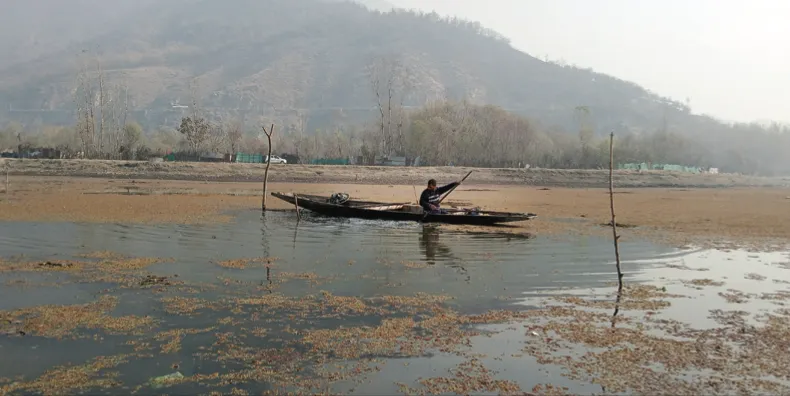






Bandipora, Dec 29: The Wular Conservation and Management Authority (WUCMA) has started a comprehensive revision of the Wular Lake Management Plan.
Officials announced on Monday that the update to the original 2007 plan was long overdue and is now being redesigned to address mounting ecological threats. The authority is working with the Bandipora district administration to create a new strategy that includes detailed feedback from local communities, stakeholders and experts. The decision was formally announced during a “Stakeholder Workshop for Discussion on Revision of Comprehensive Management Action Plan for Wular Lake: Past Measures and Future Strategies” held at mini secretariat in Bandipora, where stakeholders and officers of multiple departments held discussions on “holistic” development of the lake, going forward.
Speaking on the sidelines of the function, Altaf Hussain, DCF Coordinator Water Management, WUCMA, admitted that the review process should have taken place earlier but is now being prioritised to cover all aspects of the lake’s conservation. “The time for its revision is due; in fact, it should have happened a bit earlier,” Hussain said. He added that since they are now revising the plan, they invited all stakeholders “so that we can make this Management Plan holistic.” The authority has formally recorded about 16 to 17 major challenges facing the lake. While siltation remains a long-standing issue, Hussain said that solid waste has emerged as a critical problem that they are struggling to manage. “Solid waste is a big challenge we are trying to deal with,” he said.
Hussain also shared new data regarding the lake’s hydrology. While the Jhelum, Erin and Madhumati rivers are the known primary sources, the authority’s latest surveys have mapped a much larger network. “Along with them, we identified 22 to 23 other channels through which water reaches Wular,” Hussain said. “They need to be restored; that is a big challenge in front of us.”
The authority is also shifting its strategy for removing silt from the lake. While around 4.5 square kilometres of the lake were dredged in the previous cycle between 2020 and 2023, officials note that approximately 27 square kilometres of the lake remain critically silted. The department is now introducing a new operational model designed to be financially sustainable to tackle this vast area.
“The department is trying to revive desiltation again with a new model,” Hussain said. “We have devised that model with the consent of the government in such a way that the cost incurred will be very low, and we can still desilt many areas of Wular.” Due to the massive size of the lake, the authority has divided the critically silted areas into blocks to execute the work in phases. “We cannot do it all at once; it is a huge task,” Hussain said. “The first phase, which I hope we can start next year, we are doing from the Banyari side. After that, the Kanyari side will be our second focus.”
Local stakeholders welcomed the revision but raised pressing concerns about pollution and economic distress. Ghulam Hassan, President of the Bandipora Fishermen Association, who attended the workshop, said that unscientific waste disposal is destroying the lake. “Garbage from all districts flows into Wular,” Hassan said. He added that they discussed the issue and demanded that “dumping sites should be moved to places where the waste won’t enter Wular.” He urged the administration to listen to the local community because “the pulse of Wular is best known to the fishermen.” He also highlighted the severe economic impact of the lake’s decline on thousands of families. “Water chestnuts have decreased, fish have decreased,” Hassan said. “Our life is this Wular. We cannot let our children study or survive without it.” The revised plan also focuses on promoting tourism that does not damage the ecosystem. Hussain said the authority wants to build eco-tourism centres and small parks on the lake dykes, some of which are ongoing, but ruled out any heavy construction. “These will be absolutely eco-friendly; there won’t be big concrete infrastructure,” Hussain said. “We want to promote boat rides and water tourism with local communities in a sustainable way.” Bird watching is another key focus area. Hussain said they are training local youth to become bird guides so they can earn a livelihood. He noted that the annual bird census is scheduled for February. “Last year, the wetland network recorded more than 13 lakh birds,” he said, referring to Kashmir wetlands in overall. He added that the migratory birds continue to see the lake as a safe habitat, sharing an observation from Monday morning. “I feel there were at least 80000 to 90000 birds just in that group,” Hussain said. “This is an indicator that birds visit our wetlands and consider our wetlands a proper habitat.”