

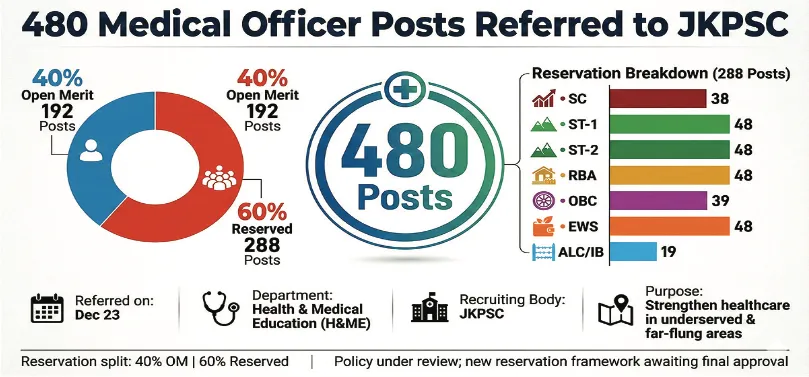






Srinagar, Dec 23: The J&K Health and Medical Education (H&ME) Department has referred 480 vacancies of Medical Officers to the J&K Public Service Commission (JKPSC) for direct recruitment, a critical and much-awaited step aimed at addressing doctor shortages in the healthcare system.
While the move has brought cheer to hundreds of doctors across Jammu and Kashmir, it has also triggered criticism over what many describe as a lop-sided distribution of unreserved posts.
On December 23, the H&ME Department, through communication number HD-Gaz0Gen/373/2025-02, referred 480 Medical Officer posts to the JKPSC. The communication states that the selected candidates will be deployed to strengthen healthcare delivery in underserved and far-flung areas of the Union Territory. Rural areas of J&K have long suffered from inequitable access to health services, with many hospitals facing an acute shortage of doctors. The induction of 480 Medical Officers is expected to ease this crisis, particularly in peripheral regions.
According to the communication, the distribution of posts has been worked out in accordance with SRO 294 dated 21-10-2002, S.O. 127 dated 20-04-2020, S.O. 176 dated 15-03-2024, and S.O. 305 dated 21-05-2024. Of the total posts, 192 have been allocated to the Open Merit (OM) category, while the remaining 288 fall under reserved categories. The reserved quota includes 38 posts for Scheduled Castes (SC), 48 each for Scheduled Tribe-1 (ST-1) and Scheduled Tribe-2 (ST-2), 48 for Residents of Backward Areas (RBA), 39 for Other Backward Classes (OBC), 48 for Economically Weaker Sections (EWS), and 19 for the ALC/IB category.
In percentage terms, 40 per cent of the posts have gone to Open Merit candidates, while 60 per cent are reserved. This skewed ratio has once again brought the reservation policy in J&K under scrutiny. Aspirants have long raised concerns over shrinking opportunities for Open Merit candidates, particularly in professional courses and government jobs.
While the incumbent Government constituted the Cabinet Sub-Committee (CSC) on Reservations in December 2024 to address the issue, the new reservation policy is yet to be formalised. This new revamped policy is expected to be notified ‘soon’, following the J&K Cabinet’s approval on December 3. The proposal has been forwarded to Lieutenant Governor Manoj Sinha for final approval.
The changes aim to rationalise quotas by reducing EWS from 10% to 3% and RBA from 10% to 7%, affecting OM’s share to 50% in jobs and education.
However, the referral of these posts that have been referred for recruitment are not recent vacancies. The medical officer posts have undergone recruitment processes many times in the recent past. In 2018, over 1000 such vacancies underwent ‘fast track recruitment’, nearly half of these remaining vacant. Many aspirants not belonging to reserved categories allege that the Government could have waited for the formalisation of a revamped reservation policy rather than rushing the posts.
Peoples Democratic Party (PDP) MLA Waheed Para voiced the popular sentiment on his X account. He posted: “Equality, new syllabus: 60% people, 40% opportunities.”
Vice-president of the All India Medical Students Association in J&K, Dr Mohammad Momin Khan, also criticised the allocation, stating that 70% of J&K’s population is forced to compete for just 192 out of 480 Medical Officer posts. He called it “discrimination”
A few other job recruitments that have been kick-started in J&K this year include 600 Accounts (Finance) Assistant posts advertised by J&K Service Selection Board, 508 Junior Engineer posts in Jal Shakti department (April 2025), 75 Naib Tehsildar posts in June 2025, 6and 21 paramedic and other vacancies in the health department.