

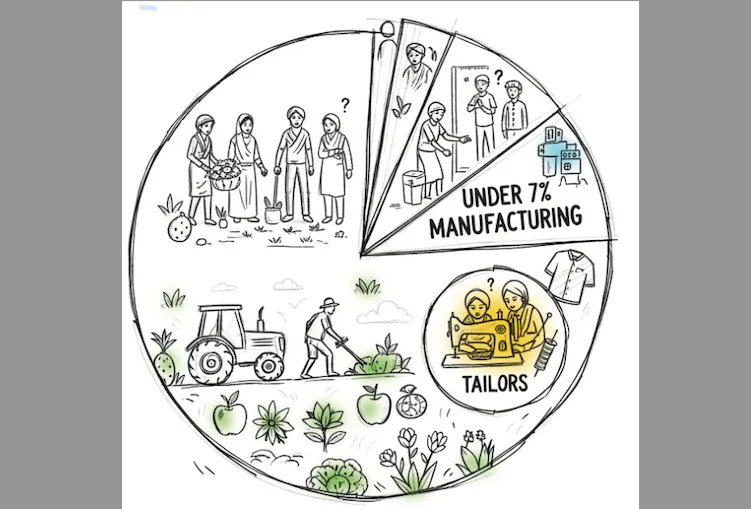






Srinagar, Dec 24: What does Jammu and Kashmir youth do for a living?
Unemployment, underemployment, and enterprises describe the generation amidst perpetually shrinking opportunities.
In J&K, one in every three individuals is unemployed. For women, it’s worse: one in every two is unemployed.
Agriculture and services engage a majority of the workforce, while the manufacturing sector is a minuscule part of the economy, employing less than 7 percent.
The urban youth unemployment in J&K is 32 percent for individuals aged 15-29 years in the July-September 2024 quarter, the latest available survey.
The figure is a rise from 29.8 percent in the same quarter of 2023, reflecting a 7.38 percent relative increase.
This marks the highest rate among all Indian states and union territories. In rural areas, although formal employment opportunities are limited, agriculture engages over 83 percent of rural male workers.
Rural unemployment in the 15-29 age group in rural areas is 12.3 percent.
Females fare worse.
In urban J&K, female youth unemployment is 53.6 percent, while in rural areas, self-employment has been listed as a source of employment by 70 percent of rural females in the survey.
Overall, female unemployment is 46.4 percent, while the male unemployment rate is 20.8 percent.
Education is no guarantor of employment.
A total of 39.5 percent of female graduates in J&K are unemployed, while urban male graduates have a 51.4 percent unemployment rate.
The modest manufacturing sector in J&K has surprising elements.
Of the people engaged in manufacturing, over 30 percent are engaged as tailors, making J&K one of India’s top tailoring-intensive places.
In Bihar, Andhra Pradesh, Mizoram, and J&K, over 30 percent of the entire manufacturing workforce is engaged in tailoring.
The national average of people engaged in tailoring is 17 percent.
J&K’s industrial infrastructure remains the skimpiest in the country.
Manufacturing, mining, and construction account for less than 25 percent of total employment here.
The formal manufacturing sector barely supports 9.2 percent, far below the national figures.
The organised private sector absorbs less than 3 percent of the workforce, pushing the young and new job seekers into low-productivity self-employment or casual labour.
These figures are based on MoPSI surveys.
Over 85 percent of the J&K workforce is in the informal sector. Among the employed in J&K, a majority 58.5 percent are self-employed.
The second spot, 21.7 percent are regular wage, salaried employees. Casual labourers are 19.8 percent of the workforce.
These figures cover persons aged 15 years and above. The challenges for the casual labour workforce are many, including the seasonality of work.
The highest concentration of the workforce is in construction – 12 percent in urban and 23 percent in rural. The agriculture sector provides labour to 20.2 percent of people overall.
The figure includes labourers engaged by the government.
J&K’s government sector employs 4.5 lakh people in regular and temporary positions.