

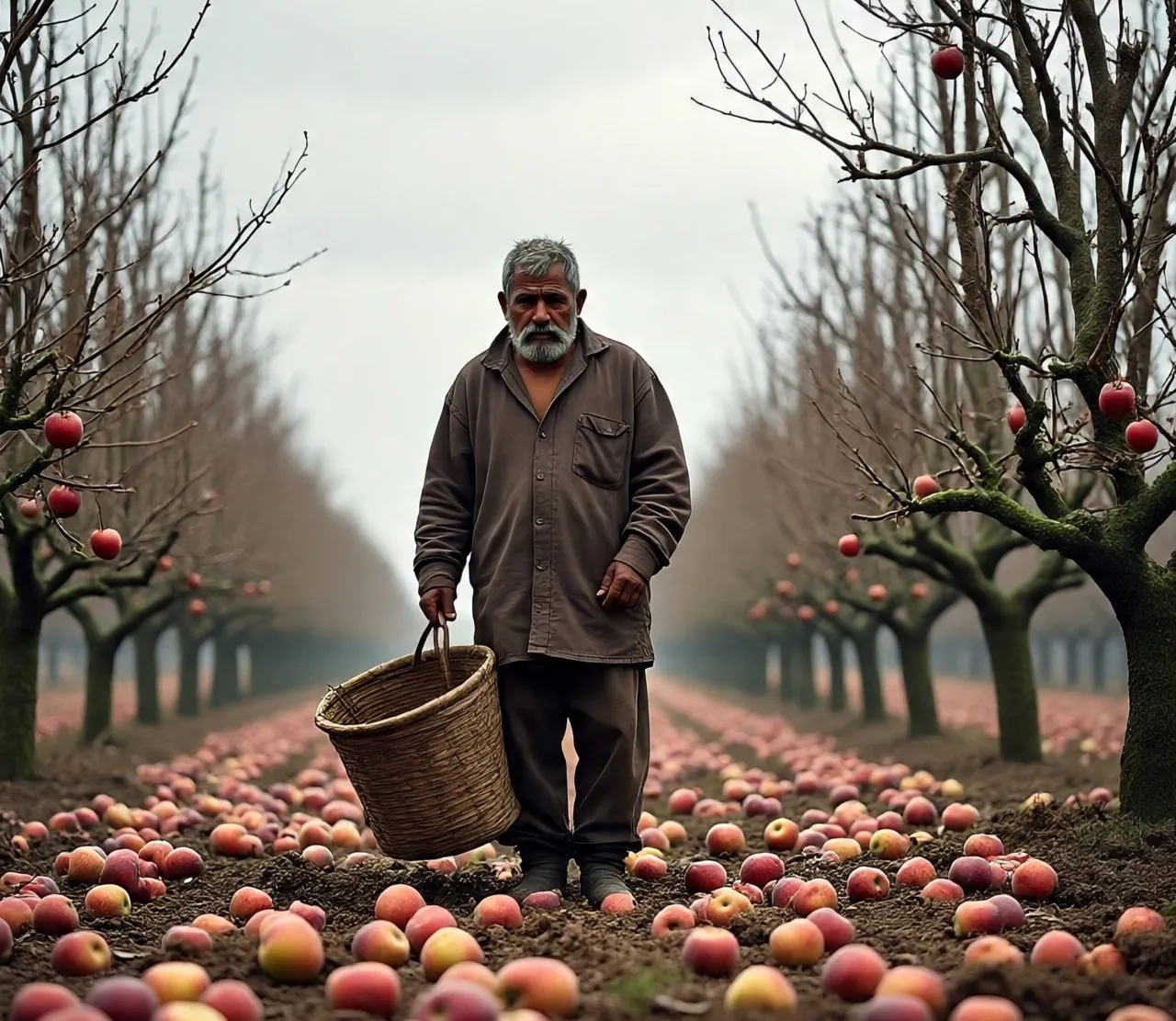






Srinagar, Dec 29: In 2025, Kashmir’s orchards bore fruit but harvested despair.
A brutal mix of climate shocks, broken roads, trade pressures, and nine years without crop insurance pushed Kashmir’s Rs 15,000-crore horticulture economy into freefall, leaving growers to absorb losses alone.
As the year draws to a close, Kashmir’s fruit industry is nursing wounds that many fear may take years to heal.
What began as a season of hope has ended in unprecedented financial ruin, marking 2025 as a watershed moment for the region’s agricultural backbone.
“We have estimated Rs 2000 crore losses this year,” says Bashir Ahmad Basheer, President of the All Kashmir Fruit Growers Union. “Farmers who invested their life savings, took loans, and worked the entire year were left with no option but to sell at throwaway prices. Many could not even recover the cost of harvesting and packaging.”
The figure represents more than just numbers – it encompasses broken dreams and families pushed to the brink in a sector that sustains 35 lakh people and affects eight lakh families either directly or indirectly.
Perhaps no issue better symbolises the sector’s vulnerability than the long-awaited crop insurance scheme trapped in bureaucratic limbo.
Though the Pradhan Mantri Fasal Bima Yojana and the Restructured Weather-Based Crop Insurance Scheme were formally adopted in J&K in 2016, they have never been rolled out for horticulture crops.
“Fruit growers in Kashmir have consistently urged the government to introduce crop insurance and a Minimum Support Price for apples, but both demands remain unfulfilled,” says Shabir Ahmad, a growers’ representative from Shopian.
“The delay in implementation of crop insurance for horticulture crops has been mainly due to non-participation and absence of healthy competition, coupled with high premium rates. That is why the scheme could not be implemented in J&K so far,” top officials said.
When bids were invited in November 2024, only two insurance companies responded for Kashmir’s apple and saffron crops.
Iffco-Tokio emerged as the lowest bidder, but their premium quotes ranged from 15.15 percent to nearly 30 percent, rates the government found unjustifiable.
In May, the State Level Coordination Committee on Crop Insurance reviewed the matter and eventually scrapped the process, leaving farmers to face another season without protection.
Beyond domestic policy failures, growers point to international trade agreements that undermine local producers.
“Free trade deals wreck our market. We saw one such deal between India and New Zealand,” said Bashir Ahmad Naik, President of JKPICCA.
The influx of Iranian apples through Afghanistan at zero duty this year flooded local markets and depressed prices even before the August catastrophe struck.
A prolonged dry spell and abnormal heat had already stunted fruit development when monsoon rains arrived with devastating force.
Massive landslides severed the Srinagar-Jammu National Highway for nearly a month at the peak of the harvesting season.
Thousands of trucks carrying fresh produce were stranded for days and weeks.
By the time consignments reached markets, significant portions had deteriorated.
The Mughal Road, positioned as an alternative, proved woefully inadequate.
“Only small vehicles were allowed, and even those were cleared after long delays,” Basheer said. “Large trucks could not pass, making bulk transportation impossible.”
Freight costs quadrupled, forcing desperate growers into Byzantine arrangements that damaged fruit quality and devoured profit margins.
The disconnect between official narratives and ground realities has never been starker.
“The horticulture sector has been our silent achiever. This growth isn’t just about numbers; it’s about the improved livelihoods of thousands of farmers across the region,” said a senior Agriculture Production Department official.
The statistics are impressive.
Between 2018-19 and 2023-24, J&K’s fresh and dry fruit production increased from 20.06 lakh metric tonnes to 26.43 lakh metric tonnes.
The area under fruit crops grew from 3,34,719 hectares to 3,41,697 hectares between 2020-21 and 2021-22.
High-density plantation coverage surged by 591 percent in a single year, from 880.89 hectares to 6090.91 hectares.
Export earnings climbed from Rs 5010.10 crore in 2020-21 to Rs 6369.08 crore in 2021-22, a 27.12 percent increase.
Kashmir’s fruit production has soared from 10,000 metric tonnes in 1950 to 25 lakh metric tonnes by 2020.
The sector generates 8.50 crore man-days of employment annually and contributes 9.5 percent to the State Gross Domestic Product.
Plans are underway to add another 5500 hectares under high-density orchards.
Yet growers question what these numbers mean when a single bad season can wipe out years of gains.
“Even during earlier political turmoil or disruptions, the losses were never this severe,” they said. “This year, everything failed at once – weather, roads, markets, and policy support.”
The growers cautioned that if urgent corrective measures are not taken now, the damage would not be limited to one season.
“It could permanently weaken the horticulture sector and the lives dependent on it,” they said.
As 2025 fades, Kashmir’s Rs 15,000 crore fruit economy faces fundamental questions.
Will the insurance scheme that has been pending since 2016 finally materialise with affordable premiums?
Will infrastructure match expansion plans?
Will farmers get protection from trade deals that flood markets with duty-free imports?
The Rs 2000 crore loss, roughly 13 percent of the industry’s worth, underscores the severity of this year’s crisis.
For a sector that has grown from 10,000 metric tonnes in 1950 to over 25 lakh metric tonnes today, generating over Rs 6000 crore in export revenues and employing millions, the stakes could not be higher.
The government’s vision of doubling farmer revenues through modern technologies rings hollow to those who could not even recoup harvesting costs this year.
The expansion continues with ambitious targets, but without addressing fundamental vulnerabilities – insurance, infrastructure, market protection, quality control – growers fear they are simply building a bigger house of cards.
What is clear is that Kashmir’s apple growers would not soon forget 2025, the year when nature’s fury combined with policy paralysis and infrastructure failure to deliver a devastating blow to an industry still called a “silent achiever” by officials.
In the ‘land of fruits’ that produces 26 lakh metric tonnes annually, the people who actually grow the apples are left to weather every storm alone, without insurance, without minimum price guarantees, and increasingly without hope that anyone is listening.