

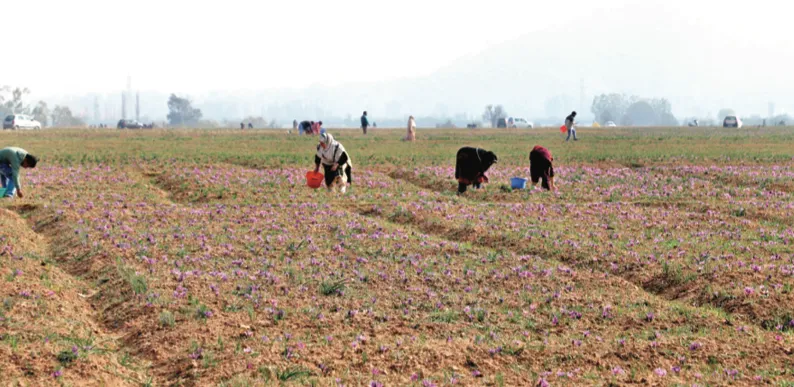






Pulwama, Dec 15: Ali Mohammad, a saffron cultivator in south Kashmir’s Pampore town, scans the grey, overcast sky each morning, hoping for rain or snowfall that could moist his farm.
Like hundreds of farmers across the saffron belt, Ali is battling an unusually long dry spell that is threatening one of Kashmir’s most prized agricultural products. The protracted dry spell has taken a toll on large tracts of saffron land spread across the karwas—elevated plateaus—of Pulwama and Budgam districts. The prolonged lack of moisture has left the soil dry, raising fears of reduced yields and long-term damage to saffron corms. “Saffron depends on timely rain and snow,” Ali said. “If the soil remains dry, the flowers do not bloom properly, and the yield drops sharply”, he added. Ali says that due to the dry season, corms will fail to develop properly, affecting the next season’s produce.
Irshad Ahmad, another farmer, said that in the absence of drip irrigation, farmers heavily rely on rains.
Pampore, also called the saffron town of Kashmir, supports thousands of families whose livelihoods depend directly or indirectly on the crop. This year, however, farmers say rainfall has been far below normal. In the district, crucial water bodies like Bulbulnag and Aripal springs have almost dried up, impacting the water supply to dozens of villages.
From November 1 to December 9, official data show that Pulwama received 11.4 mm of rainfall against a normal of 29 mm, recording a deficit of over 60 per cent. Budgam logged 7.5 mm compared with a normal of 33.3 mm, a shortfall of nearly 78 per cent, while Srinagar recorded 7.2 mm of rainfall against a normal of 43.2 mm, marking an 83 per cent deficit.
Overall, the Kashmir division witnessed an acute rainfall shortfall during the period, with average precipitation of only 7.98 mm against a normal of 44.7 mm — a deficit of about 82 per cent. The widespread deficiency highlights the severity of the dry spell, raising concerns over agriculture, water availability and winter recharge ahead of the peak sowing season.
Experts say that the prolonged lack of moisture could have lasting effects on saffron cultivation.
Dr Tariq Rasool, Associate Professor at Sher-e-Kashmir University of Agricultural Sciences and Technology (Kashmir) said, “Moisture stress at this stage hampers the development of daughter corms, which are crucial for the next season’s flowering”. “This results in fewer and weaker flowers, directly reducing stigma yield”, he added. He said that prolonged dry conditions could lead to a gradual decline in productivity and shorten the lifespan of saffron fields.