

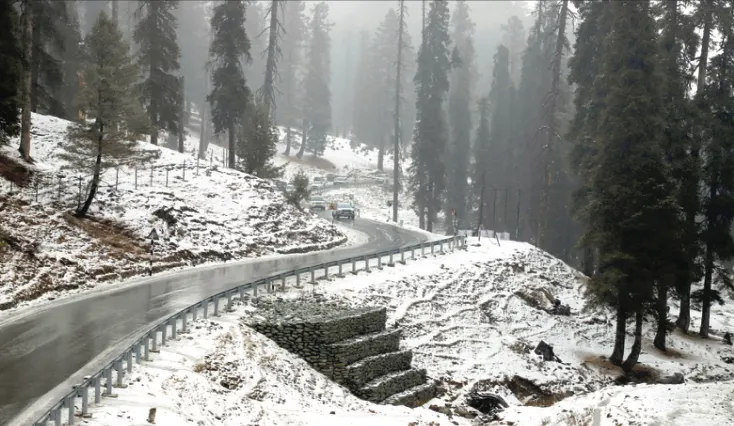






It is heartening to see the end of prolonged dry spell in Jammu and Kashmir with the beginning of Chillai Kalan, the 40-day harshest winter period.
The dry spell had severely affected normal life and caused a drought-like situation. With higher reaches receiving heavy snowfall and plain areas witnessing rains, the precipitation is set to recharge our depleting glaciers and water resources. Snowfall in the 40-day period December 21 and January 29 is considered important to regulating glacier health, stream flows which are imperative for maintaining ecological balance.
Till three decades ago, Kashmir’s plain areas including Srinagar used to receive heavy spell of snowfall ranging between 4 to 6 feet. But rising pollution levels coupled with climate change drastically reduced snowfall frequency.
Chillai Kalan used to be a boon for people who used to remain confined to homes due to heavy snowfall. All roads used to be buried under snow. People used to work hard in summer to store essential items mostly Hookh Sioon, sun dried vegetables—having a long shelf life.
Houses in Kashmir were mostly constructed with mud, bricks, and wood as these conserve heat. And the people used traditional cooking and heating methods. They used Daan, a traditional cooking stove made of mud using firewood as fuel. Most of the houses had hamam, a small room, where the floor warmed up by burning firewood.
It is said that in winter, traders from Central Asia used to place orders to Kashmiri artisans mostly for embroidering clothes and shawls besides making wood carving items.
What happened to that winter? For over a decade, we have been witnessing mostly dry and warmer winters. Going beyond global warming and climate change, we need to look into how official apathy and public greed have vandalised the pristine environment of Kashmir.
Not to talk of water bodies, wetlands, springs, we haven’t spared forests and glaciers too. Something is seriously wrong with our ecosystem. We must seriously think about how we are responsible for the erratic climatic patterns in this part of the Himalayas.
Recession of glaciers, which are our main sources of water, is a matter of serious concern. Rapid melting of glaciers is bound to enhance serious implications for regional water availability and hydrological regimes.
J&K Himalayas hosts some of the largest glaciers in the Hindu Kush region. Studies indicate that Kolahoi, the largest glacier of Kashmir valley’s Jhelum Basin, is retreating rapidly due to spurt rise in temperature triggered by global warming and extreme pollution. Thajiwas, Hoksar, Nehnar, Shishram, and glaciers around Harmukh are also retreating slowly.
Amid growing concerns over climate change and increasingly erratic weather patterns, weather-related disasters claimed 199 lives across J&K during 2025, with Jammu division emerging as the worst-affected region in terms of fatalities.
This year, J&K has witnessed 12 extreme weather events. As per the report by the Disaster Management Division of Indian Meteorological Department, 12 extreme weather events were recorded in 2025, higher than any recent year. 2022 had 8 extreme weather events while 6 and 4 were recorded in 2023 and 2024 respectively. In 2024, 535 internal displacements were attributed to dry mass movements, 1513 to hailstorms, and 33 to storms. On the parameters of Forests & Biodiversity and Climate Sub-Categories J&K features in the middle rung states and UTs. It has scored 53 points, crossing the halfway mark, far below Andhra Pradesh, which has scored 68.38 points, and also below all north-eastern states. Among all states and UTs, J&K is at the 24th rank.
In terms of sustainable land use. J&K has failed to uptake the new renewable energy resources and depends solely on old renewable energy sources where, 98 percent of energy comes from old energy sources, while 2 percent is from new renewable energy sources. Not a single Bio-CNG plant is operational in J&K, J&K remains in high Air Pollution graph for the period between January 1, 2021 and March 31, 2025, Srinagar Air Quality was ‘Poor’ for 449 days. Comparatively, the Air Quality during the same period was ‘Good’ only for 339 days. Srinagar recorded 203 days of ‘Satisfactory’ Air Quality in the 1551 days that were studied. The Air Quality also went ‘Severe’ bad for two days in Srinagar.
Like Delhi, Kashmir’s air is extremely polluted with high levels of PM2.5 and PM10 levels in winter. The particulate matter in air is usually blamed on cold weather, dry season besides dust and smoke emanating from roads, carbon fuel burning and construction activities. Studies have shown how vehicular pollution emission causes rise in particulate matter and carbon dioxide in Srinagar city. Emissions inventories show nitrous oxides and carbon monoxide spiking 30 to 40 percent in peak hours in J&K’s summer capital.
Studies have projected that the Kashmir valley will experience more frequent and prolonged droughts in future. The results show that the region will experience more frequent and prolonged dry spells from the mid to end of the 21st century making it a new norm during 2051-2099 due to the climate change. Climate warming will not only affect the retreat patterns but might affect dependent sectors of the economy that include agriculture, hydropower, and tourism in J&K.
Mitigating climate change calls for reducing the flow of heat-trapping greenhouse gases from cars, power plants and industries into the atmosphere. How important forests are for the environment as they absorb these greenhouse gases, but we leave no stone unturned to vandalise the green gold!
J&K ranks third among the Himalayan areas which are vulnerable to climate change. We need to wake up before it is too late and work for climate change mitigation!
Author is Executive Editor,
Greater Kashmir.