

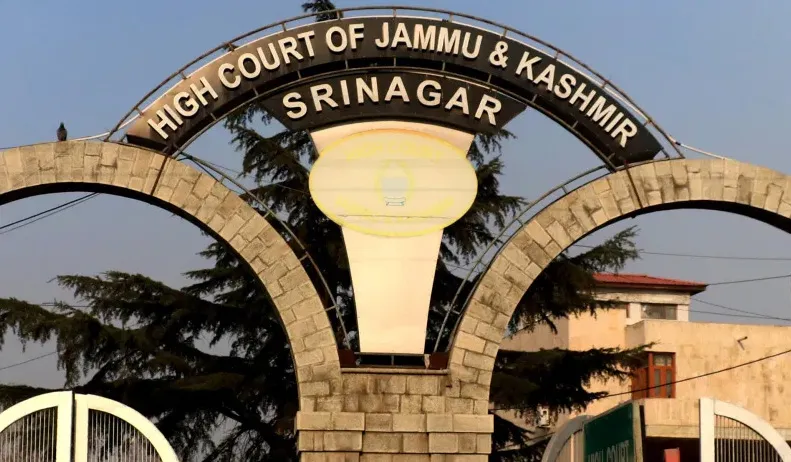






Srinagar, Dec 27: Underscoring that prolonged incarceration and inordinate delay in conclusion of trial are crucial factors while deciding bail pleas even in offences like murder, the High Court of J&K and Ladakh has granted bail to an accused in a 13-year-old murder case. “This Court finds that the petitioner has carved out a case for grant of bail on account of his long incarceration for more than 13 years and on account of the fact that by the conduct of the prosecution and the police department, there is hardly any chance of conclusion of trial in near future,” a bench of Justice Sanjay Dhar said while granting bail to the accused, Fahad Maqsood Khan.
The Court observed that the delay in the trial was solely attributable to the prosecution.
The petitioner had sought bail only on the ground of his long incarceration and on account of violation of his right to speedy trial in connection with FIR No. 135/2012 registered at Police Station Saddar Srinagar for various offences including murder under RPC.
The case is pending before an Additional Sessions Judge, Srinagar.
“It appears that the learned trial court has made tireless efforts to procure attendance of prosecution witnesses to complete the trial for which the trial court deserves appreciation,” the Bench said.
The prosecution contention is that on July 4, 2012, a complaint was lodged by a woman alleging that her neighbour along with his sons one of them Fahad Maqsood Khan attacked her husband with stones, lathis, bricks and a knife. The injured, G M Shah, later succumbed to his injuries at SKIMS on July 5, 2012. The chargesheet was filed on September 1, 2012.
The Court noted that Fahad has been in custody for over 13 years and out of 33 prosecution witnesses only 29 have been examined so far.
Despite repeated directions by the trial court and even intervention by the SSP Srinagar to secure the presence of witnesses, the prosecution failed to conclude evidence, the court said.
“The witnesses, whose statements are yet to be recorded, are the experts and the police officials. Therefore, it is not a case where some civil witnesses, who may have been won over by the accused and are avoiding to depose in support of the prosecution but it is a case where even the official witnesses are avoiding to help the prosecution in speedy trial of the case”.
The Bench observed that the trial court does have power to terminate the trial by closing the prosecution evidence. “But I am conscious of the fact that in heinous offences like murder, the Courts generally do not take this extreme step, particularly when the witnesses to be examined are expert witnesses and the investigating officer,” Justice Dhar observed.
The Bench observed that the Courts refrain from closing the evidence in such cases lest it may amount to failure of justice. “But this cannot be taken as a device by the prosecution to protract the trial. In such circumstances, the only course open to a criminal court is to enlarge the undertrial accused to bail”.
Allowing his plea, the Bench granted bail to Fahad and directed that the accused be released subject to conditions, including furnishing a personal bond with two local sureties of Rs 1 lakh each.