

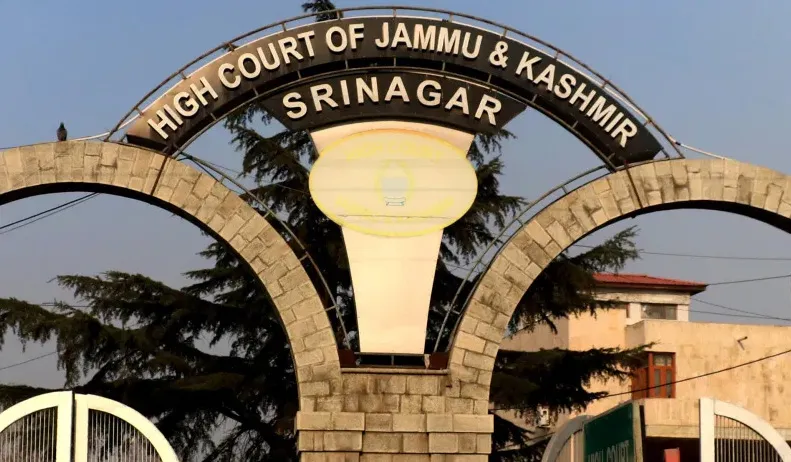






Srinagar, Jan 1: The High Court of J&K and Ladakh directed the authorities to conduct an interview and consider a candidate from Samba district for appointment to the post of Orderly under the scheduled Caste category (SC) in District Baramulla, even as it struck down the residence-based restriction in the recruitment process issued by the Chief Justice’s Secretariat in January 2019 as “unconstitutional”.
Balwinder Kumar, a candidate from Samba district who had applied under the SC category, was denied participation in the interview for the post of Orderly in District Baramulla after being shortlisted. Kumar had applied for the post in response to the advertisement notification dated January 10, 2019.
Kumar’s interview was scheduled to be held in the office of the Principal District and Session Judge, Baramulla, on 16 July 2019. However, he was not permitted to participate in the interview process on the grounds that he belonged to District Samba and was, therefore, ineligible for the post notified for District Baramulla.
Subsequently, Kumar had challenged the refusal primarily on the ground that Clause 1 (i) (a) of the advertisement notification of January 10, 2019 was unconstitutional and that no discrimination could be practiced by the State on the ground of residence.
Opposing the plea, the High court through its Registrar General, Principal Secretary to Chief Justice and PD&SJ Baramula (Chairman Interview committee for Class-IV of District Baramulla) contended that various posts borne on different cadres of the Subordinate Courts are governed by J&K Ministerial Staff of the Subordinate Courts (Recruitment and Conditions of Service) Rules, 2016 which empowers the Chief Justice to make appointments to District cadre posts as specified in Schedule-A of the said Rules.
They contended that a conjoint reading of Rule 2(f), 2(n) and Rule 5 and 12 of the Rules of 2016 read with Entry 19 of Schedule-A makes it clear that the Chief Justice was empowered to make appointments to the district cadre posts and regulate such selections and appointments by framing regulations providing for method of selection to a particular post.
For its decision, the Court framed two issues, whether the petitioner having submitted his application despite being aware of Clause 1 (i) (a) of the advertisement notification dated January 10, 2019 was estopped from challenging the constitutionality of the clause after having been rejected by the Selection Committee at the stage of interview.
The second issue framed was whether Clause 1 (i) (a) of the advertisement notification offends Clause 1 and 2 of Article 16 of the Constitution and therefore ultra vires the Constitution.
After hearing the parties, a Division Bench of Justice Sanjeev Kumar and Justice Sanjay Parihar while allowing Kumar’s plea declared Clause 1(i)(a) of advertisement notification No. 01 of 2019, which restricted eligibility to candidates belonging to the concerned district cadre, as ultra vires the Constitution.
The Court observed that discrimination in public employment on the ground of residence was impermissible unless backed by a law enacted by Parliament under Article 16(3).
The Court noted that “it is now well settled that a candidate by participating in the selection process only accepts the laid down procedure and not the illegality in it”. The participation in a selection process does not bar a candidate from challenging it where the process suffers from incurable illegality or constitutional infirmity, it said.
The Court directed the authorities to conduct Kumar’s interview and consider him for selection against the SC category post of Orderly in District Baramulla.